MinIO Alternatives for S3-Compatible Object Storage
Four self-hosted alternatives and two managed options fill the gap MinIO's archival left behind.
The dominant self-hosted S3-compatible store got archived in April 2026, and that ended the default choice most self-hosted teams had leaned on for years. The GitHub repository is now read-only: no active development, no security patches, no pre-built binaries for the open-source version. The commercial path forward, AIStor Enterprise Edition, carries an annual price tag, and that price rules it out for most teams even considering a self-hosted setup.
The AGPL-3.0 license is still attached to the archived code, but that freedom doesn't help much when there's nothing to patch and nothing pre-built to download. Self-compiling is the only route left for anyone avoiding the commercial tier, and that's a real operational tax, not a weekend project. None of this is a hypothetical risk to plan around. It already happened, so the teams weighing storage options this quarter are picking from what's actually live and maintained today, and they're not hedging against something that might fork down the road.
S3 compatibility as the structural requirement every alternative must meet
S3 compatibility works less like a checkbox feature and more like a portability contract. The S3 API turned into the default interface for object storage, so SDKs, CLI tools, AI frameworks, and data science software all expect it, no matter which cloud or hardware is running underneath. That's why switching providers can be as simple as changing an endpoint URL and a credential, with tools like aws cli, rclone, and s3cmd continuing to work without edits. Pricing shifts, outages, or a company changing strategy can strand petabyte-scale datasets behind a single vendor's walls, and a compatible API is the practiced defense against that trap. Who operates it, what the egress profile costs, what license governs it, and what workload it's actually built to run separate the alternatives worth evaluating from the ones that aren't. Who runs it decides how much operational load and compliance exposure a team is signing up for. Egress profile decides the real bill, because read-heavy data shouldn't be taxed per gigabyte out, and that one variable can swing total cost more than the sticker price on storage ever will. License decides what can be shipped commercially without legal risk. AGPL-3.0 versus Apache 2.0 matters because the archived project's AGPL terms were already generating legal questions for commercial users before the archiving even happened. Workload decides the shortlist itself, since single-tenant throughput, mixed object-and-file setups, compliance retention, and AI training all pull toward different tools.
Self-hosted open-source options: what each one is built for
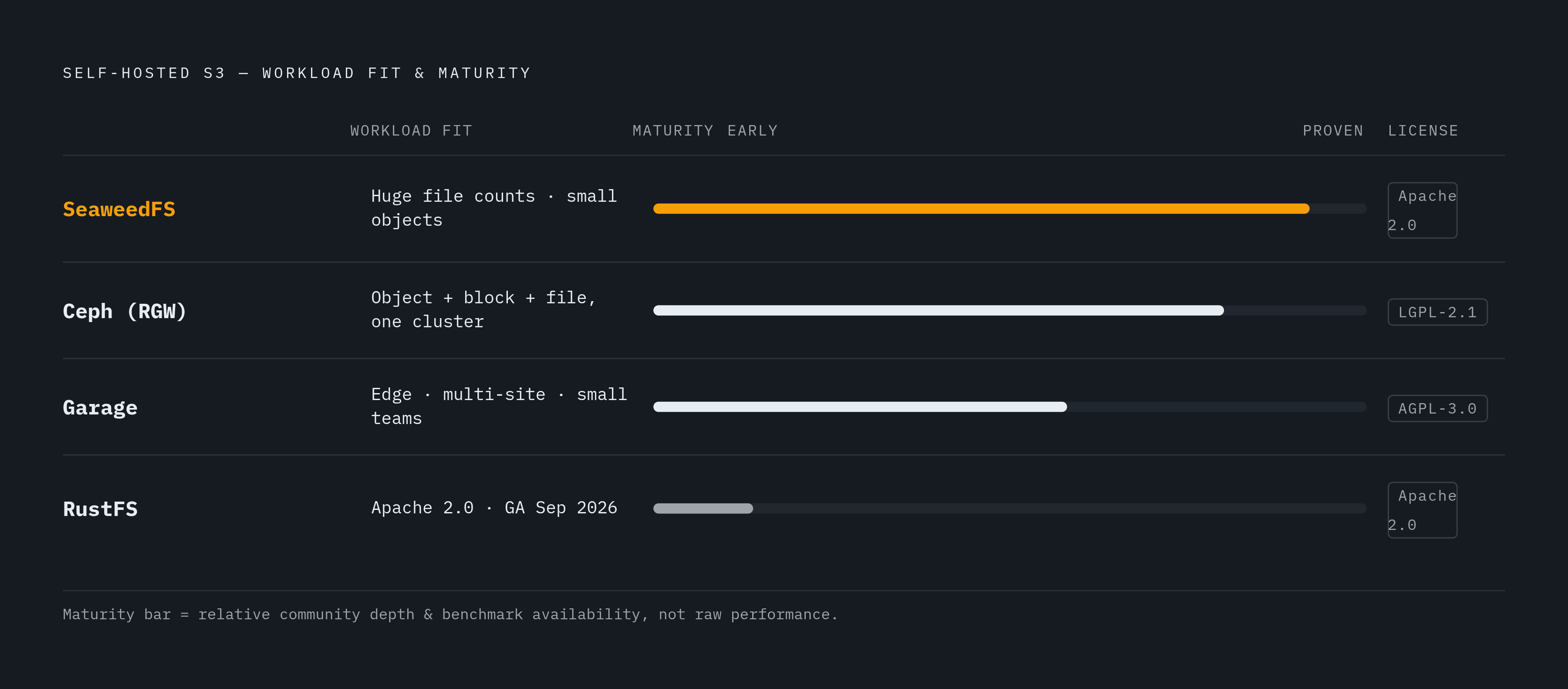
No self-hosted project on the market today is a universal replacement for what got archived. Each one was built around a different workload shape, and picking the wrong one means fighting the software instead of using it.
Ceph, through its RADOS Gateway, was built for teams running very large data volumes that need high fault tolerance and often need object, block, and file storage out of one system. The RADOS Gateway handles the S3 API, and RBD and CephFS cover block and file, all from the same distributed cluster. Ceph wants a dedicated storage team and careful capacity planning, and for smaller shops it's often more machine than the job needs. Ceph makes sense when object storage is one piece of a bigger storage puzzle that also includes block and file. It's the wrong tool when object storage alone is the whole requirement.
SeaweedFS was built for the opposite problem: workloads with huge file counts and lots of small objects, like content farms, thumbnail generation, or Iceberg table formats. Its design borrows from Facebook's Haystack paper, packing many small files into volumes so that reading any single file takes exactly one disk seek, no matter how many millions of files are sitting in the system. SeaweedFS gets a real architectural edge from this, because conventional storage can choke on file count alone. SeaweedFS ships under Apache 2.0, it has a production track record, and it plays well with Kubernetes. Where Ceph tends to struggle with small-object performance, SeaweedFS is tuned specifically for that case.
Garage was built for small teams and edge deployments where simplicity, especially across multi-site or geographically distributed setups, matters more than squeezing out maximum throughput. Written in Rust, its configuration is far lighter than Ceph's, aimed squarely at situations where Ceph would be overkill and nobody has the staff to run it. It's licensed AGPL-3.0, it replicates data across zones for resilience, and you can run it comfortably on modest hardware. Of the actively maintained options, it's the lightest-weight, and it earns its keep most clearly when the dataset is modest in size and the real constraint is geography.
RustFS is the newest name on this list, and it's built for teams that want Apache 2.0 licensing without AGPL's commercial complications, if they're willing to test software that's still finding its footing. RustFS ships as a single binary or Docker image, and it supports erasure coding and S3 Object Lock for WORM compliance, with a Kubernetes-native design and full S3 API compatibility. It hit 1.0.0 GA on September 16, 2026, its first stable production release, but the community around it is small and independent benchmarks are scarce. Treat it as a project to watch rather than a production pick today. The Apache 2.0 license and Rust's memory-safety guarantees make it a project to revisit as it racks up more real-world deployments.
Managed cloud alternatives: how egress pricing, compliance, and ecosystem depth differ
If you want to skip the operational burden entirely, several managed cloud providers speak the S3 API without asking you to rack a server. Egress pricing is the variable that moves the needle most, but it only tells half the story once compliance needs and ecosystem depth get factored in.
Cloudflare R2 prices storage at $15 per terabyte per month and charges no egress fees at all. So if you run read-heavy work like CDN origins, RAG pipelines, or API serving, it fits well, because egress charges would otherwise eat your budget alive. It integrates cleanly with Cloudflare Workers and Pages, and while its ecosystem is narrower than AWS's, that's rarely a problem for teams already running their own compute. The pitch is the lowest mainstream storage price paired with free CDN egress through the Bandwidth Alliance. Backblaze stands apart as the only major cloud storage provider publishing verifiable drive failure data, a differentiator that matters to teams who want proof behind durability claims rather than just a claimed high-nines guarantee. That makes Backblaze a strong fit for cost-conscious teams storing large volumes, backups, media archives, and ML datasets, especially when paired with Cloudflare for delivery. The trade-off on both is a thinner ecosystem than AWS offers, with no native analytics triggers or pipeline integrations built in.
Wasabi charges flat per-terabyte storage pricing, and it has no egress fees within normal usage limits and no API fees on top. The appeal is one predictable number on the invoice, no surprise egress charges, no per-request nickel-and-diming. But the catch that actually matters is the minimum retention period attached to every object. If a dataset gets deleted or overwritten frequently, Wasabi still bills for the full minimum retention window regardless of how long the data actually sat there, which makes it a poor match for ephemeral or high-churn data and a genuinely strong match for backups, archives, and compliance storage.
Hetzner Object Storage is the strongest option for EU-based teams with GDPR requirements, where a US sub-processor is disqualifying.
AWS S3 remains the reference implementation and still runs the deepest ecosystem of the group, with Lambda triggers, Athena queries, SageMaker pipelines, and native hooks into a long list of AWS services. Egress fees are the main cost driver for anything read-heavy, though S3's range of storage tiers, Standard, Standard-IA, One Zone-IA, Glacier Instant Retrieval, Glacier Flexible Retrieval, Glacier Deep Archive, Intelligent-Tiering, and Express One Zone, gives teams room to tune cost against access patterns. S3 makes sense as the default when a team is already deep in the AWS ecosystem and actually needs Lambda, Athena, or SageMaker. It's a poor default for teams without that dependency already in place. Every cloud-native S3 alternative in this list shares the same trade-off against AWS: a thinner ecosystem, no native Athena, Glue, or Lambda triggers, object storage without the surrounding data platform wrapped around it. If your compute already lives somewhere else, that trade-off is usually one worth making for backup, archival, and app storage.
DigitalOcean Spaces rounds out the group with flat monthly pricing that bundles a base storage and transfer allotment together, plus it has a built-in CDN. No surprise bills, predictable costs, straightforward to set up. It fits best for teams already running on DigitalOcean who want simple, predictable storage without taking on cluster management themselves.
S3 compatibility lets you point existing tools at a new endpoint, but it does nothing about the performance cost of pulling data out of object storage on every single read. That's the gap serverless filesystems address: Archil is a native S3-compatible, exabyte-scalable object storage platform with sub-millisecond cache hits, so AI agents and data-heavy pipelines can work against the same data without a rewrite to a different storage layer.
Enterprise on-premises platforms for regulated, large-scale, or hybrid deployments
Regulated industries and hybrid environments where public cloud is partly or entirely off the table need a different category of tool altogether: enterprise software-defined and hardware-integrated platforms that extend S3 compatibility into on-premises and sovereign deployments.
NetApp StorageGRID is software-defined object storage, and you can use it to manage large volumes of unstructured data across on-premises, cloud, and hybrid environments at once. It supports the native S3 API and shows up commonly in data lakes, analytics platforms, backup systems, and long-term retention setups. It fits organizations well when they need a hybrid cloud architecture anchored by on-premises storage, backed by mature vendor support.
Cloudian HyperStore is built to scale to exabyte volumes for AI, large-scale analytics, data protection, and hybrid cloud deployments. It's positioned for AI workloads moving out of the lab and into production, ingesting and managing images, video, and text for model training and RAG pipelines. It also supports direct GPU-to-object storage access, which reduces the I/O bottleneck that occurs between storage systems and accelerators.
Scality is an S3-compatible platform aimed at large-scale enterprise environments and cloud providers, and it's built around high performance, durability, and operational resilience. It appears in AI data pipelines, backup and archival systems, and large-scale analytics deployments.
What ties this entire tier together is scale: the operational and financial overhead only makes sense once an organization is operating at a size where dedicated infrastructure teams are already a given. These are platforms built to run a company's entire storage layer, not point solutions dropped in to solve one problem.
Object storage's limits for AI training workloads
AI training and agent workloads read the same files repeatedly, often in random-access patterns, so when you read against raw object storage, you pay network latency each time, and it adds up fast across a training run. A self-hosted S3-compatible store can be cheap to run and still become the slowest part of a compute pipeline, because the bottleneck is the round trip between storage and compute, not storage capacity.
That's the specific gap a caching filesystem layer closes. If you run your own S3-compatible bucket, you can pair it with a zero-copy filesystem layer, which caches reads locally while keeping the bucket as the system of record. The bucket keeps doing what it's good at, durable, cheap, portable storage, while the cache layer absorbs the repeated reads that would otherwise slow a training job down. So you keep the operational simplicity of running your own storage, but you don't pay the latency cost of fetching from object storage on every pass through the data.
For workloads built around AI training or agent execution rather than straightforward object serving, there's a question worth adding to who runs it, what the egress profile is, what the license is, and what the workload is: whether the data needs to reach compute faster than object storage alone can deliver it.
Sources
- Best S3-Compatible Object Storage Providers (2026 Comparison) - lowcloud
- Amazon S3 Alternatives in 2026: A Self-Hosted, S3-Compatible Shortlist - DEV Community
- Best S3-Compatible Object Storage Providers in 2026 - Tested & Ranked
- Best AWS S3 Alternatives (2026): Zero Egress Storage
- RustFS: Open-Source S3-Compatible Object Storage Built in Rust - Proactive Insights and Support For Open-Source Applications