S3 Intelligent-Tiering vs Standard-IA Cost Profiles

Let me be direct: most teams overpay for S3 storage not because AWS pricing is complicated, but because they picked a storage class once and never revisited it. Access patterns drift. Configurations don't. The result is a quietly growing line item that shows up as "cloud storage" in the budget and gets shrugged at because nobody knows exactly which knob to turn. The knob is storage class selection. It is the single largest controllable variable in an S3 bill, and the two classes most teams confuse for each other. Standard-IA and Intelligent-Tiering. They are not interchangeable. Their cost structures reward completely different behaviors. Understanding the mechanics of each one tells you exactly which workload belongs where. That is what this piece does.
A 2025 Crayon study found that a large majority of IT leaders still report difficulty optimizing cloud storage costs. That is not a beginner statistic. These are people who have been running cloud infrastructure for years. The problem is not awareness. It is that the cost structure is genuinely nuanced, and the wrong mental model keeps producing the wrong answer.
Let's fix the mental model.
How Each Class Charges You: The Five Pricing Dimensions That Determine Which Wins
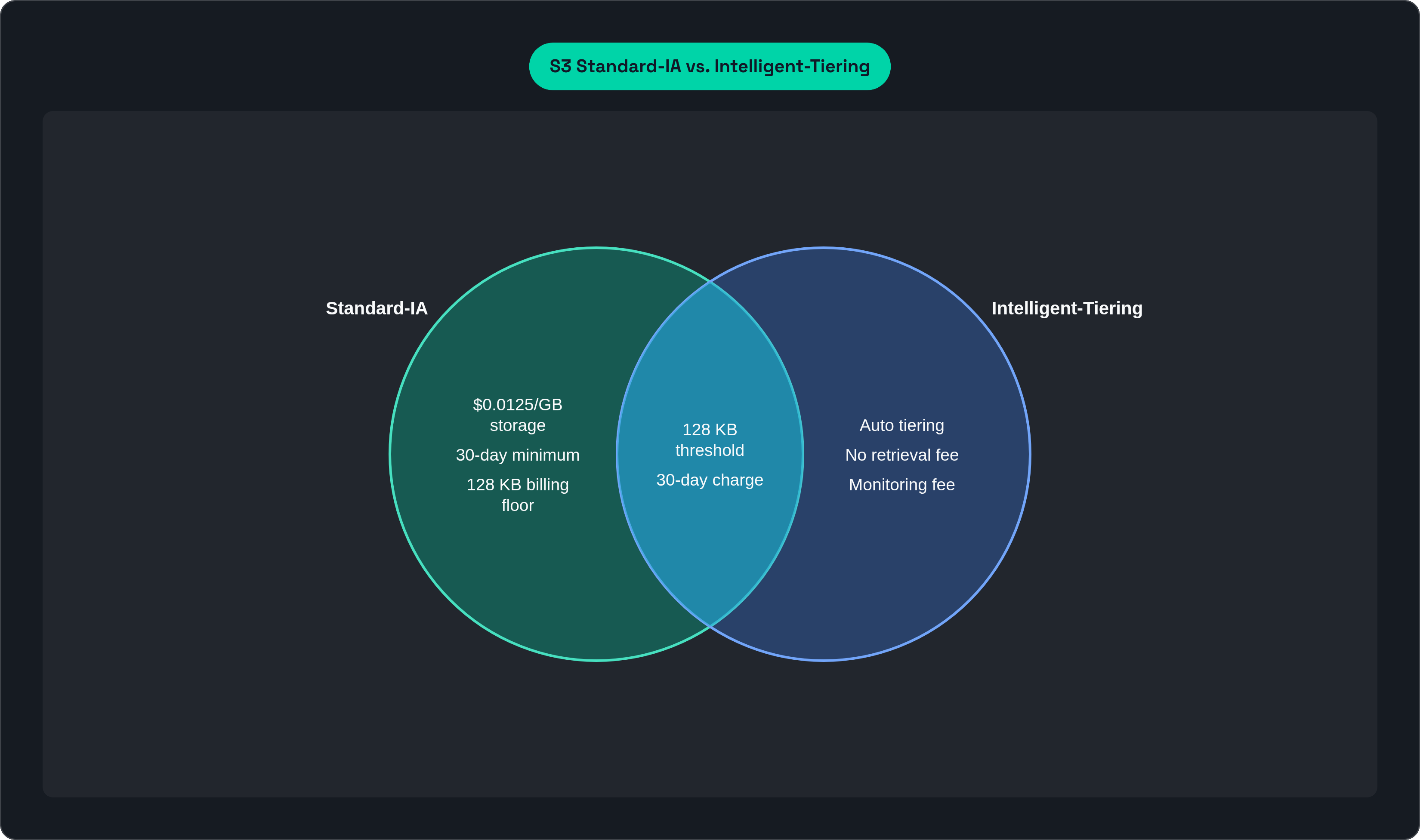
Before you can pick the right class, you need to understand what each one is actually billing you for. There are five dimensions. They interact. Getting one wrong can cancel out the savings from getting the others right.
Here is the full picture, side by side (US East, 2025–2026 pricing):
| Pricing Dimension | Standard-IA | Intelligent-Tiering | |---|---|---| | Storage rate | $0.0125/GB | $0.023/GB (Frequent Access), $0.0125/GB (IA tier), $0.004/GB (Archive Instant) | | Retrieval fee | $0.01 per GB retrieved | None, across any tier | | PUT request cost | $0.010 per 1,000 requests | Standard rates | | Monitoring fee | None | $0.0025 per 1,000 objects/month | | Minimum duration | 30 days | None | | Minimum object size | 128 KB (billed floor) | Not eligible for tiering under 128 KB |
A few things jump off this table immediately.
Standard-IA's storage rate looks like a deal. At $0.0125/GB, it is roughly 46% cheaper than S3 Standard. That is a real number and a meaningful discount. But it comes with a retrieval fee of $0.01 per GB every time data is read. Every time. That fee does not care whether the read was planned or a surprise. It just charges you.
Intelligent-Tiering matches Standard's storage rate when data is in the Frequent Access tier ($0.023/GB), then drops to match Standard-IA when data goes cold ($0.0125/GB after 30 consecutive days unaccessed), and drops further for deep archive tiers. Critically, there is no retrieval fee at any tier.
The monitoring fee ($0.0025 per 1,000 objects per month) is Intelligent-Tiering's fixed overhead. It exists whether or not any of your objects actually tier down. Think of it as the cost of the automation — like paying a librarian to reshelve your books so you never have to hunt through the wrong section. You are paying AWS to watch your objects and move them appropriately so you do not have to.
The retrieval fee asymmetry is the central structural difference between these two classes. Everything else flows from it. Keep that in mind as we go.
The Object Size Thresholds That Determine Whether Intelligent-Tiering's Monitoring Fee Ever Pays Off
Here is where a lot of teams get burned without realizing it. They look at the storage rates, see Intelligent-Tiering's tiering mechanics, and assume it will save them money on their entire bucket. It will not, if their objects are small.
Objects under 128 KB are not eligible for tiering in Intelligent-Tiering. They sit in Frequent Access permanently. They do not incur the monitoring fee, which is good, but they also receive zero tiering benefit. For small objects, Intelligent-Tiering is effectively neutral. No savings. No extra cost. Just no point.
The more important threshold applies once objects are above 128 KB and are being monitored. The monitoring fee has to be offset by actual storage savings from tiering. Below roughly 238 KB, the math does not work. The monitoring cost exceeds what you recover from the storage discount when an object moves to the IA tier. A practical rule of thumb: objects under 500 KB to 1 MB are net-negative in Intelligent-Tiering.
Standard-IA has its own small-object problem. The 128 KB billing floor means a 10 KB file is billed as 128 KB. Ten of those files bill as ten 128 KB files. If your workload is full of small objects, Standard-IA's attractive per-GB rate is effectively much higher than advertised once you do the actual math on billed volume versus stored volume.
The honest takeaway here: check your median object size before you evaluate anything else. If your workload is dominated by small files, both of these classes are the wrong answer. S3 Standard or a consolidation strategy where small files are bundled into larger ones is worth considering first.
One useful piece of context from AWS re:Invent 2025: the maximum S3 object size increased from 5 TB to 50 TB. AI and scientific workloads are trending toward fewer, larger objects. That structural shift favors Intelligent-Tiering's economics because monitoring overhead spreads across fewer, bigger objects.
How Retrieval Frequency Determines Whether Standard-IA's Storage Discount Survives Contact with Real Usage
Standard-IA's pitch is simple. Pay less per GB stored, accept a fee when you read it. That is a fine trade if you rarely read the data. It is a bad trade if you underestimate how often "rarely" actually happens.
Here is a concrete scenario. Store 100 GB in Standard-IA and retrieve it twice in a month. The retrieval fee alone on that second pull starts eating into the storage savings. At roughly one full retrieval per month, Standard-IA's cost advantage over S3 Standard is essentially gone. Beyond that point, Standard-IA costs more than just leaving the data in Standard.
That might sound extreme, one retrieval per month is pretty often for "infrequent" data. But consider how retrieval events actually happen in practice:
- A compliance team pulls data for an unexpected audit.
- A backup set gets restored after an incident.
- An ML dataset gets re-examined because a model underperformed.
- A reporting query runs against historical data that was supposed to be dormant.
None of these feel like "frequent" access when you are planning the storage architecture. They are all legitimate surprises. And Standard-IA charges you for each one.
Intelligent-Tiering sidesteps this entirely. No retrieval fee means an unexpected access event costs the same as an expected one: nothing. That is genuinely useful cost insurance against the fact that access patterns are harder to predict than teams usually admit at budget time. It is like the difference between a flat-rate phone plan and paying per call — the moment you go over what you planned for, one of those options starts hurting.
One more thing worth noting: retrieval fees are only one component of total read cost. Egress charges apply on top. So when Standard-IA's retrieval cost spikes, egress charges amplify the damage.
The Workload Profiles Where Standard-IA Wins Cleanly
Standard-IA is not the wrong choice. It is the wrong choice in the wrong context. In the right context, it is cheaper than Intelligent-Tiering and simpler to operate.
Standard-IA wins cleanly when access patterns are genuinely known and stable. Not assumed stable. Demonstrably stable.
Strong fits:
- Disaster recovery and backup archives. These get accessed during a recovery event. Full stop. Retrieval is rare, planned, and the cost is acceptable when it happens. No surprises.
- Compliance and audit data with defined retention windows. If regulatory requirements dictate that data sits for seven years and gets pulled only during a formal review process, you already know the access profile.
- Write-once, read-rarely pipelines. Monthly reporting pulls against historical data, for example, where the cadence is fixed and the team controls the schedule.
- Long-lived objects that genuinely will not be touched. If the object is staying put for 90-plus days with high confidence, there is no reason to pay Intelligent-Tiering's monitoring fee to automate a decision you have already made manually.
That monitoring fee is the decisive factor in these scenarios. If you already know the data is cold, the $0.0025 per 1,000 objects per month is pure overhead. You are paying for automation that is not doing anything for you.
The caveat here is real and worth stating plainly. Standard-IA's clean win depends entirely on the accuracy of your access prediction. The class has no mechanism to protect you if that prediction turns out to be wrong. There is no automatic tier adjustment. There is no safety net. Just a retrieval fee every time you are surprised by your own data.
The Workload Profiles Where Intelligent-Tiering Wins Cleanly
Intelligent-Tiering wins whenever retrieval timing is uncertain. The monitoring fee is the price of optionality. And optionality has real dollar value when the alternative is getting hit with retrieval fees you did not budget for.
Strong fits:
- Data lakes and research archives. Access here is driven by questions, not schedules. When a researcher or analyst decides to query something, they query it. There is no infrastructure timetable.
- User-generated content at scale. Access follows user behavior. User behavior does not follow your storage architecture.
- Long-running projects with hot-and-cold cycles. A dataset is accessed heavily during one sprint, goes completely dormant for two months, then heats up again. Intelligent-Tiering tracks this and moves data accordingly without anyone writing or updating a Lifecycle policy.
- Any workload where the team cannot confidently answer "how often will this be read in six months?" That uncertainty is precisely what the monitoring fee is buying you protection against.
The deep archive tiers add real weight to the case for large dormant datasets. AWS cites up to 95% storage cost savings versus Standard at the deepest archive tier for objects that have been untouched for 180-plus days. That is not a rounding error. And because there is no retrieval fee, accessing that archived data does not generate a surprise charge.
There is no Lifecycle policy to write, version, or update as access patterns evolve. That operational simplicity is an underappreciated advantage, especially for teams where infrastructure ownership is spread thin.
One footnote for very large archives: AWS stores 8 KB of metadata per archived object at Standard rates and 32 KB of index data per archived object at Glacier rates. At billions of objects, that overhead becomes a real line item. Worth modeling before assuming Intelligent-Tiering is always the cheaper option at massive scale.
AI Training Datasets as a Case Study in Access Variability
ML training datasets are the clearest real-world example of why access pattern assumptions break down.
The lifecycle looks like this. A team kicks off a training run. The dataset is pulled heavily, repeatedly, for days or weeks. The run finishes. The team switches to analyzing results. The data goes completely cold. Then the next iteration starts and the dataset heats up again. This is not an edge case. This is how training workflows actually run.
That hot-cold-hot cycle breaks the core assumption embedded in Standard-IA, which is that "infrequent" is a stable property of the data rather than a phase it passes through. An object that was cold last month is the most accessed thing in your bucket this month. Standard-IA charges you for that surprise. Intelligent-Tiering does not, and it automatically moves the object back to Frequent Access when access picks up, with no additional tiering charge.
AWS added S3 Tables support for Intelligent-Tiering in December 2025. For teams storing structured training metadata or experiment logs alongside raw datasets, that matters. The tiering mechanics apply to the metadata layer as well.
The 10x object size increase (from 5 TB to 50 TB, announced at re:Invent 2025) is also directly relevant here. AI teams can now store large training datasets as single objects. Fewer objects mean lower monitoring fee overhead and simpler pipeline architecture. The economics of Intelligent-Tiering improve as object count decreases and object size increases.
One honest caveat: during the active training phase itself, neither Intelligent-Tiering nor Standard-IA is the right tool. Training jobs need hot storage. S3 Express One Zone or a caching layer in front of S3 serves the active training phase better. Intelligent-Tiering is the right class for the idle periods between runs, which is most of the time in a typical training cycle. GPU cycles idling while waiting on data reads are a real compute cost. The storage class decision intersects directly with training job efficiency, not just storage cost.
The 30-Day Minimum Duration Trap and Other Hidden Charges That Distort the Comparison
The pricing dimensions in the first section are the ones most teams know about. These are the ones that catch teams off guard.
The 30-day minimum duration. Both classes charge for a minimum of 30 days. Delete, overwrite, or transition an object before that and you pay for the full 30 days anyway. This is a quiet but significant issue for data pipeline staging areas where files are written and cleared on a rolling basis. Any workload with object lifespans under 30 days should not be in either class. Full stop.
The 128 KB billing floor in Standard-IA. Already covered in the object size section, but it deserves a second mention here because teams routinely calculate storage costs against actual data volume rather than billed volume. These two numbers can be very different for small-object workloads, and the gap comes directly out of the savings Standard-IA was supposed to deliver.
Intelligent-Tiering's metadata overhead at archive depth. The 8 KB and 32 KB per object charges mentioned in the previous section. At moderate scale they are negligible. At billion-object scale they are a real cost center that rarely appears in initial cost models.
PUT request pricing in Standard-IA. PUT requests are charged at twice the S3 Standard rate. High-ingest workloads pay a premium on every write operation. This can be significant for pipelines with continuous or high-volume writes.
The availability SLA difference. Standard-IA carries a 99.9% availability SLA versus 99.99% for S3 Standard and Intelligent-Tiering. Durability (the eleven nines) is the same across all classes. Availability is not. For workloads where access to stored data needs to be highly reliable under SLA, this difference is worth weighing.
The broader point is that teams who model S3 costs purely on storage dollars per GB are systematically underestimating total spend. Egress, API calls, metadata overhead, and minimum duration charges can all multiply the base number substantially. Build the full cost model, not just the headline rate comparison.
A Practical Decision Framework: Reading Your Workload to Choose the Right Class
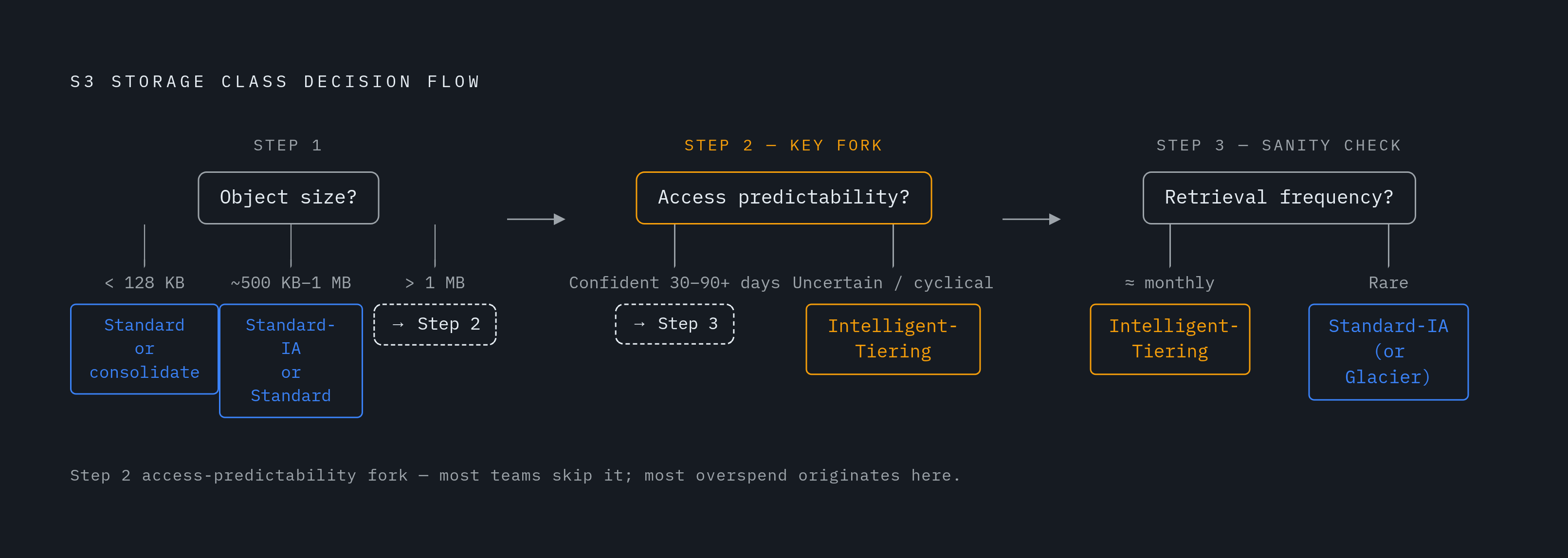
Here is how to actually make the call. Three steps. Work through them in order.
Step 1: Check Object Size Distribution First
This one comes before access frequency analysis because it can rule out both classes immediately.
- Dominant objects under 128 KB. Neither class is well-suited. Evaluate S3 Standard or consolidate small objects into larger ones before revisiting the question.
- Objects under roughly 500 KB to 1 MB. Intelligent-Tiering's monitoring overhead likely exceeds savings. Standard-IA or Standard is the better fit.
- Objects above 1 MB. Intelligent-Tiering economics improve meaningfully. Move to Step 2.
Step 2: Assess Access Predictability Honestly
The keyword is honestly. Not optimistically. Not based on how the data was intended to be used. Based on how it is actually used.
- High confidence the data sits untouched for 30 to 90-plus days. Standard-IA (or Glacier directly) wins. No monitoring overhead, lower storage rate, retrieval cost is a planned and tolerable expense.
- Uncertain, variable, or cyclical access. Intelligent-Tiering wins. The monitoring fee is the cost of not getting surprised by retrieval charges.
Step 3: Estimate Retrieval Frequency
If Step 2 left you in the uncertain camp, Step 3 confirms the direction. If Step 2 pointed you toward Standard-IA, Step 3 is a sanity check.
- Retrieval approaching once per month or more. Standard-IA's $0.01/GB retrieval fee erodes its storage discount rapidly. Intelligent-Tiering or S3 Standard likely comes out cheaper.
- Retrieval genuinely rare, planned, and well under once per month. Standard-IA holds its advantage. The retrieval fee is a manageable, predictable expense.
One final note. Run this analysis against real access log data when you can, not assumptions. S3 Storage Lens and S3 access logs both surface the retrieval frequency and object size distribution you need for Steps 1 through 3. The data is already there. The framework just tells you what to do with it.
The choice between Intelligent-Tiering and Standard-IA is not a matter of one being better. It is a matter of which one's cost structure matches your workload's actual behavior. Match them correctly and you will stop paying a premium for the wrong automation, or for the wrong assumption that your data never gets touched.