AI Agent vs AI Assistant Architectural Differences
Assistants answer questions; agents pursue goals across multiple steps and systems.
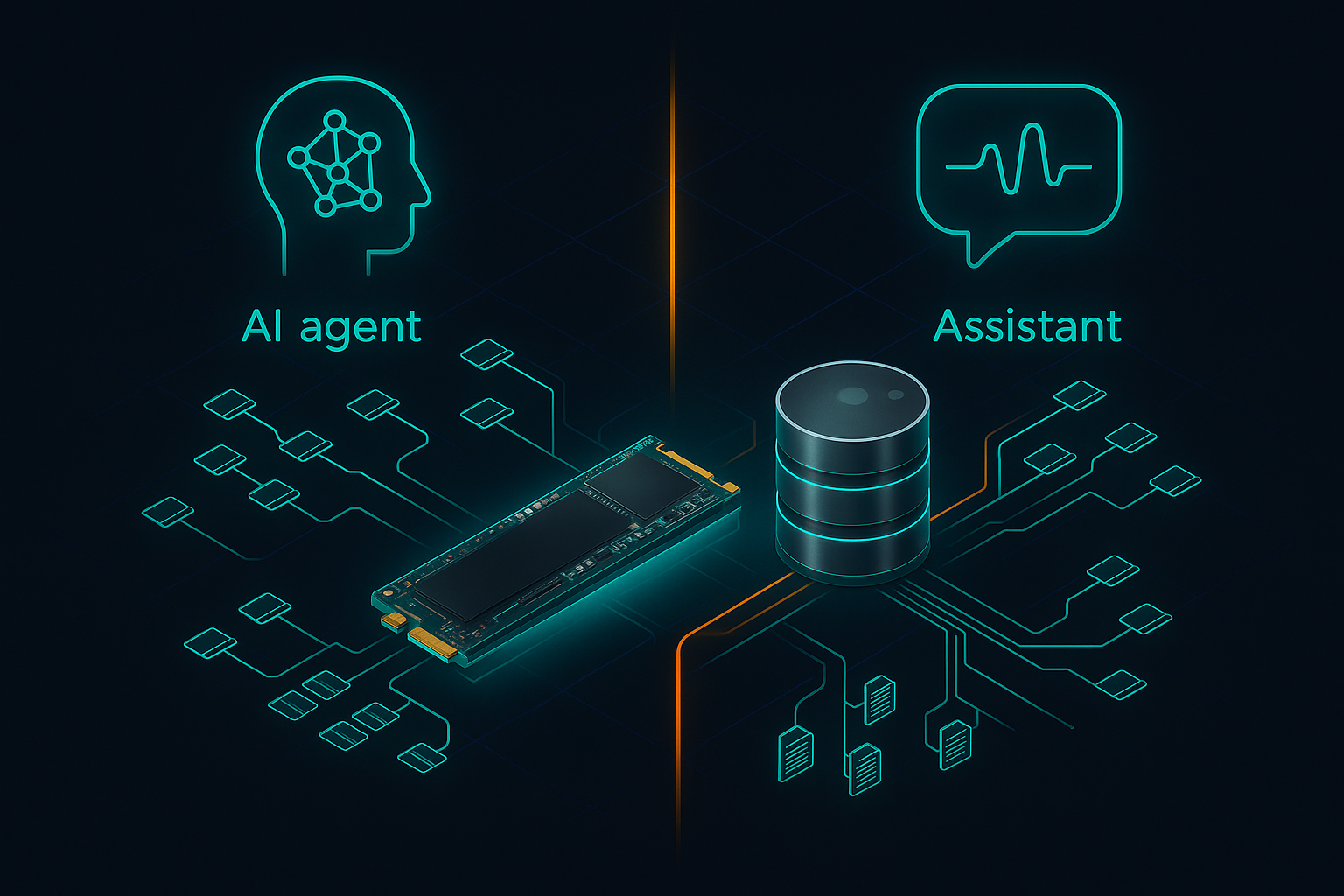
An AI assistant is, at its core, a function. Input goes in, output comes out, session ends.
That's the design on purpose. The LLM at the center of an assistant is stateless by default. It holds nothing between API calls. Every prompt is a fresh start. The wrapper around it is deliberately thin:
- Accept a prompt
- Pass it to the model with some system context
- Return the response
- State discarded. Done.
This works because assistants are built for discrete, bounded tasks. Draft this email. Summarize this document. Answer this question. The human carries the state. You remember what you said last turn. You re-supply the relevant context. You decide what to do with the answer.
The assistant never writes to anything. It surfaces information. You act on it.
That constraint is also what keeps the infrastructure footprint small. You need a model endpoint and a stateless API surface. No persistent storage. No tool orchestration. No execution isolation. For high-volume, human-reviewed tasks where the cost of autonomous action outweighs the efficiency gain, assistant architecture wins cleanly. Statelessness is the point, and the infrastructure savings follow directly from it.
The Agent Execution Loop: Plan, Act, Observe, Iterate
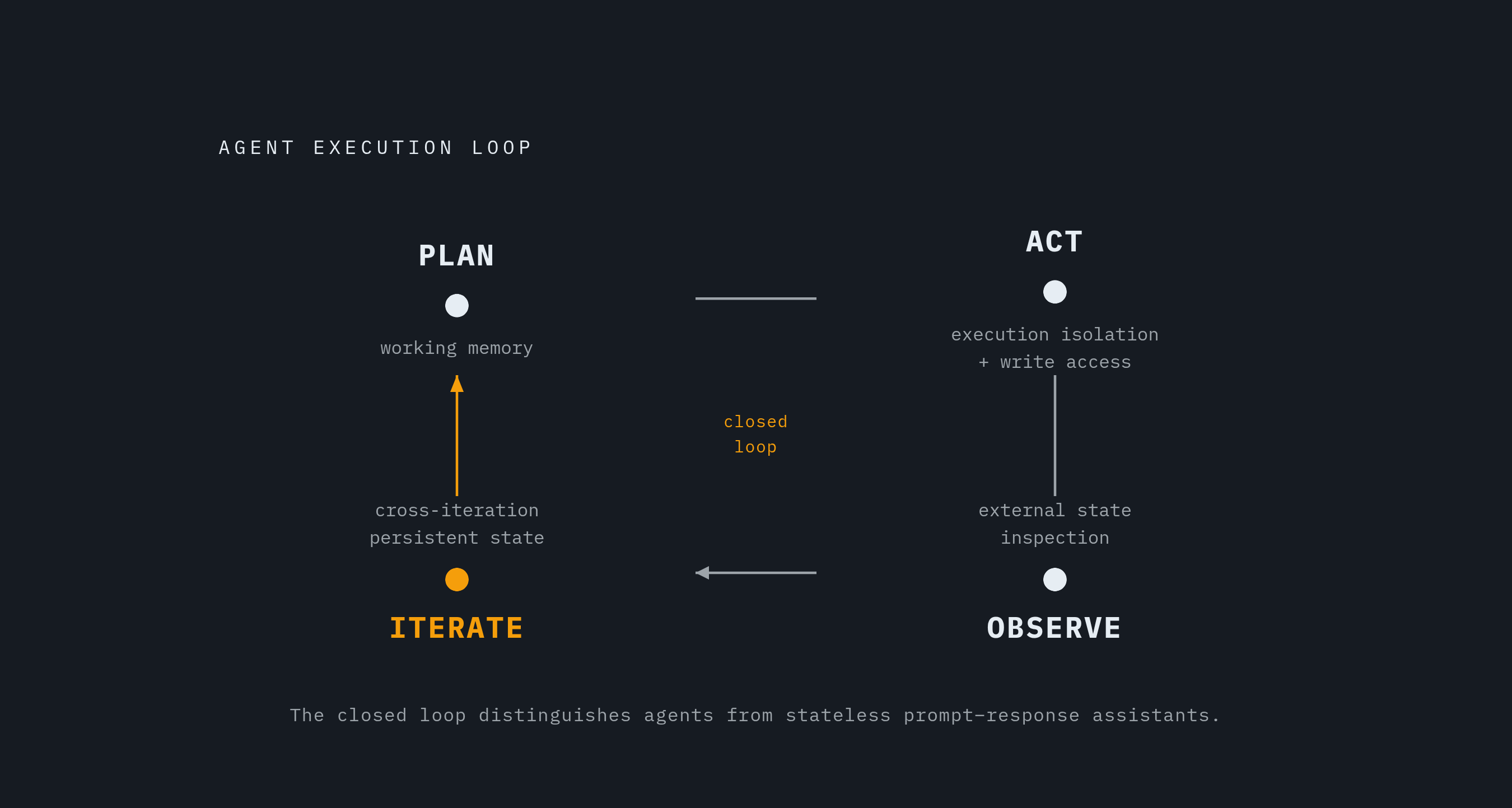
An agent does not receive a prompt. It receives a goal. That single shift changes what the whole system has to be.
Here's a way to hold the distinction: an assistant is a calculator. You punch in the numbers, it gives you an answer, and it forgets you the moment you put it down. An agent is closer to a contractor you've handed a project to — someone who reads through what needs doing, starts working, and leaves themselves notes so they know where they picked up the next morning. Those two things are not the same kind of tool.
Instead of a one-shot function call, you now have a loop. Four phases, each with distinct infrastructure demands:
- Plan: The model breaks the goal into steps. It needs working memory to hold that plan.
- Act: The agent calls a tool, executes code, writes to a system. This requires execution isolation and write access to external services.
- Observe: The agent reads the result of its action and checks it against the goal. It needs to inspect state that now lives outside its context window.
- Iterate: The agent adjusts the plan based on what it observed, loops back, continues. This requires state that persists across iterations, not just within a single context window.
Error recovery is a first-class concern here, not an afterthought. If something breaks mid-sequence, the agent has to reason about that failure and adjust. An assistant has no equivalent mechanism because the human handles recovery. You just rephrase and try again.
Some agents run a fixed number of iterations. Others loop until a termination condition is met. The open-ended case is where governance risk concentrates. Gartner's prediction that a large share of agent projects will be canceled by 2027 for lack of governance flows directly from deploying this loop without well-defined boundaries set before you ship.
The assistant tells you what to do. The agent does it. And writes back to every system it touches along the way.
(GitHub Copilot and Cursor blur this line with multi-file workspace edits that look agent-like from a chat interface. The architectural distinction still matters when you're deciding what to build, even if product labels don't respect it.)
State Management: The Structural Problem Assistants Don't Have and Agents Can't Avoid
LLMs remember nothing between API calls. Every iteration of the agent loop starts from a blank model. State has to be explicitly built as a separate architectural layer. The assistant architecture sidesteps this entirely by putting the human in charge of memory. The agent architecture cannot do that.
What an agent needs to remember breaks into three types, and each type requires different storage:
- Current working state. What step am I on? What have I already done? This is in-context working memory. Ephemeral. Cleared at session end.
- Session-scoped facts. What happened earlier in this task? This gets compressed or summarized and held for the task's duration.
- Cross-session knowledge. User preferences, learned workflows, prior task outcomes. This must persist across sessions, typically in vector or graph storage.
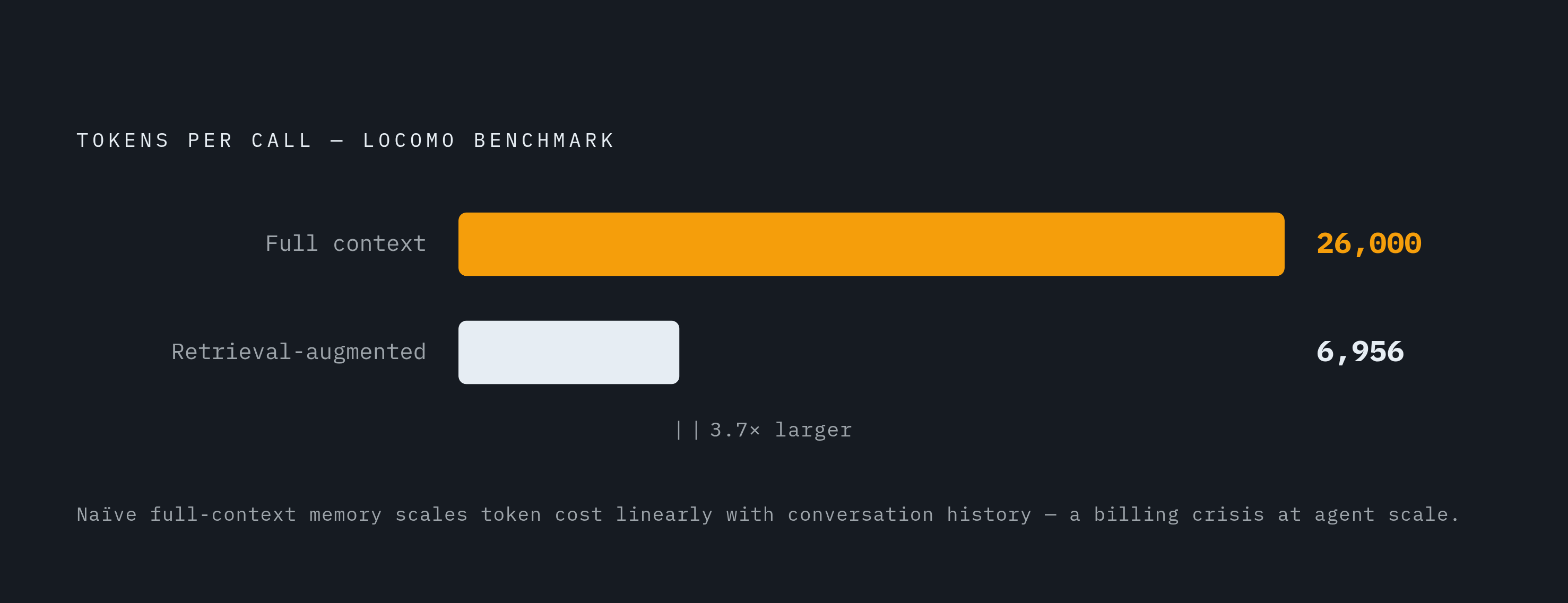
The token cost of naïve approaches here is real and shows up on your bill fast. Mem0's benchmark on the LoCoMo dataset shows full-context retrieval consuming roughly 26,000 tokens per call versus approximately 6,956 tokens with retrieval-augmented approaches. When agents run thousands of iterations, that difference isn't academic.
Teams that reach for separate databases — one for vectors, one for relational state, one for conversation history — accumulate consistency problems and infrastructure costs that scale faster than their data does. The trend in 2025 and 2026 production deployments points toward a single PostgreSQL instance combining hypertables, pgvectorscale, and standard relational tables as the pragmatic alternative to a fragmented stack.
And the retention horizon is not what you'd expect. Real persistent agent context means three to five years of data retention as an active memory concern, not just a backup concern. That's a different conversation than most teams are having when they start building.
Tool Use and Write Access: Where the Risk Profile Diverges Sharply from Assistants
Assistants are read-only by design. They surface information for a human to act on. They don't hold credentials, make API calls, or modify downstream systems.
Agents do all of those things, autonomously:
- API calls to external services
- Code execution against real environments
- File writes that persist beyond the session
- Escalations and handoffs to other agents or systems
A misconfigured agent acting on production data without isolation is a categorically different failure than an assistant producing a bad answer. One is an embarrassing output you correct and move on from. The other is a real-world action that is not reversible. Strong execution isolation is a structural requirement that follows from giving an agent write access, not an optional enhancement.
Model Context Protocol (MCP) and LLM gateways are becoming standard infrastructure to manage this tool surface. They handle routing: which model calls which tool, under what authorization, with what constraints.
An agent pursuing a goal through unintended paths compounds errors across a chain of actions. Each tool call is a new failure surface. The assistant architecture avoids this entirely by keeping the human as the actor. Whether that tradeoff is worth making depends entirely on the workflow, not on which architecture sounds more impressive.
Why the Infrastructure Requirements for Agents Are Categorically, Not Incrementally, Larger
Agentic AI consumes 20 to 30 times more tokens than standard generative AI. That's a direct consequence of multi-step loops, tool call results being fed back into context, and state retrieval on each iteration. That token number is just the opening signal.
Agents require four infrastructure layers that assistants simply do not need:
- Persistent memory architecture across all three tiers: working, session, and long-term.
- Multi-model orchestration for routing between specialized models and tools.
- Execution isolation for the layer where agents actually run code and perform actions.
- Low-latency storage that can serve both working state and persistent context without introducing sequential bottlenecks in the loop.
The data infrastructure gap is currently the decisive variable in production. In 2025, 95% of enterprise GenAI pilots delivered no measurable P&L impact. The models are capable. The infrastructure beneath them isn't designed for autonomous loops.
Nearly 6 in 10 enterprises are actively pursuing agentic AI in 2025. Gartner projects that 33% of enterprise software applications will incorporate agentic AI by 2028, up from effectively none in 2024. Microsoft's 2025 Work Trend Index puts 81% of business leaders anticipating moderate to extensive agent integration within 12 to 18 months. The gap between deployment intention and infrastructure readiness is exactly where projects fail, and that gap is wide.
"Production-ready" in this context means automated data-quality gates, drift detection, and confidence scoring baked in. Without them, a loop doesn't fail cleanly. It compounds a bad state across dozens of iterations before anyone notices something is wrong.
Storage as the Hidden Architectural Bottleneck in Agent Systems
Assistants made storage boring. A stateless prompt-response function reads a document, generates text, returns it. Storage throughput barely registers as a concern.
Agents make storage the thing that breaks you. A loop that iterates rapidly, calls tools, reads and writes intermediate state, and runs in parallel with other agents creates a sustained, high-frequency storage access pattern that is less like a faucet and more like a fire hose left running in a server room — it doesn't trickle toward failure, it floods toward it. That changes the problem completely.
Object storage is already dominant in enterprise environments. 90% of new data is unstructured — audio, video, PDFs, images — and enterprises are projected to generate nearly 400 zettabytes annually by 2028. The S3-compatible API has become the de facto interface for all of it.
The performance gap that training workloads exposed first, agents are now exposing in inference and execution:
- NVIDIA recommends 1.5 GB/s per GPU as a baseline for GPU-intensive AI workloads.
- Meta's implementation of GPUDirect Storage broke through a 50 GB/s CPU bottleneck to reach 192 GB/s, producing a 3.8x improvement in model training speed. The bottleneck was the data path, not the compute.
- Modern object storage platforms show what's achievable when storage is designed for AI throughput: MinIO at 183 GB/s, WekaFS at 191 GB/s, VAST Data at 200 GB/s, DDN EXAScaler at 250 GB/s. The gap between these and default deployments is where agent loops stall.
There's also a file interface problem that doesn't get talked about enough. Agents that need to read, write, and execute against storage through POSIX semantics — atomic rename, file locking, mmap — cannot get that from a raw S3 bucket. The API mismatch creates either workarounds or architectural compromises, and both of those cost you.
Archil addresses this directly. It mounts existing S3, GCS, R2, or Azure Blob buckets as a real POSIX filesystem with NVMe caching. The agent sees a filesystem. The bucket stays the source of truth. No data migration required. The execution layer accepts bash commands directly against the mounted filesystem, so the agent doesn't need a separate sandbox environment.
What Persistent, Shared Agent Context Actually Requires from the Storage Layer
If an agent's working directory is destroyed at session end, the next session reconstructs context from scratch. The memory architecture does part of that work. But the file-based artifacts the agent produced — intermediate outputs, logs, downloaded data — are gone. That's a storage design problem, distinct from the memory layer.
What agents actually need from persistent storage:
- Durability across sessions. The workspace survives session end and is available to the next run of the same agent.
- Shareability across parallel runs. Multiple agent instances working on the same task need to read and write to the same source data without conflicts. That requires real file locking semantics.
- Iterative discovery. The agent should be able to explore the filesystem to find what it needs, not require all context to be front-loaded into the prompt.
- Elastic capacity. You cannot know ahead of time whether an agent needs 1 MB or 1 GB of working space. Fixed-size block volumes are the wrong primitive here.
There's also a tool proliferation problem worth naming plainly. Each bespoke tool added to an agent's tool surface burns context window and accelerates context rot. A filesystem the model already knows how to navigate via bash collapses that surface into a single interface. Models are heavily trained on bash and file manipulation. That's an existing skill, not something new they have to acquire.
Archil's design maps onto these requirements directly. Persistent disks mounted on many servers simultaneously. Elastic capacity billed on active use. Full POSIX semantics: atomic rename, flock/fcntl, mmap, fsync, hard links, symlinks, sparse files. Existing agent code runs unmodified. The bucket stays the source of truth, and access can be revoked without data movement.
The underlying principle: state should be discovered iteratively by the model as it works, not front-loaded. A filesystem supports that naturally. A prompt-stuffed context window does not.
Choosing Between Assistant and Agent Architecture for a Real Workflow
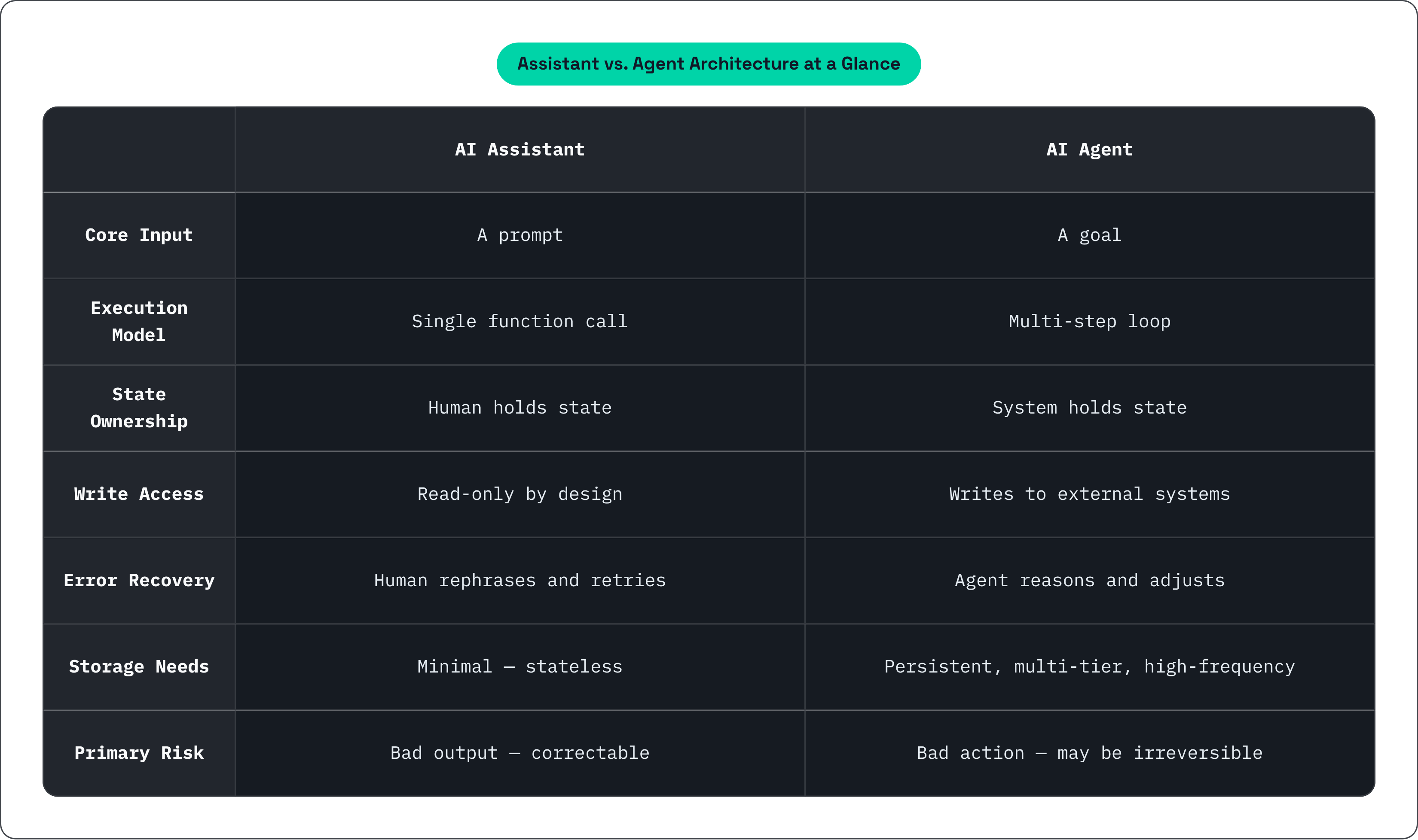
This is an architectural commitment with real infrastructure, governance, and cost consequences. The honest truth is that most teams are reaching for agent architecture when assistant architecture would serve them better and cost less.
There's a real failure mode hiding in the agent loop that doesn't get said plainly enough: an agent without a well-defined termination condition doesn't gracefully conclude. It just keeps going. That's the architectural equivalent of hiring someone to organize your filing cabinet and forgetting to tell them when to stop — six weeks later they've alphabetized the parking lot.
The assistant architecture is the right answer when:
- The task is discrete and well-bounded
- A human reviewing the output before acting is acceptable or required
- The workflow does not require writing back to downstream systems
- Volume is high and the cost of autonomous error is too
- Your team does not yet have the infrastructure or governance in place to safely run loops
The agent architecture earns its overhead when:
- The goal is too complex to decompose manually for every run
- The workflow requires sequential tool calls across multiple systems
- Human-in-the-loop at every step is the actual bottleneck you're trying to remove
- The task recurs frequently enough that the infrastructure investment pays off
- You have defined termination conditions, failure modes, and guardrails before you deploy. Not after.
The agent loop is genuinely powerful. It also requires persistent memory, execution isolation, write-access governance, and storage infrastructure that can keep up with a high-frequency, multi-parallel access pattern. Skip any of those, and the loop doesn't fail gracefully. It compounds errors until someone notices. That's the decision you're actually making when you choose between these two architectures.