EFS Alternatives for Cloud-Agnostic Architectures
Cloud-native file services lock you into a single provider, making multi-cloud training costly.

Amazon EFS does what it was built to do. Multiple EC2 instances, Lambda functions, and ECS containers can mount the same file system at once, capacity scales up automatically, and POSIX semantics hold inside a single AWS region. For teams running entirely on AWS, that combination removes a real operational headache: no NFS servers to patch, no capacity planning spreadsheets, no 2 a.m. pages because a volume filled up.
Every one of those strengths is borrowed from the same place. Multi-AZ write consistency, automatic scaling, and tight AWS integration all work because EFS is designed and operated entirely inside AWS infrastructure. Pulling the compute outside that boundary breaks the whole arrangement. EFS cannot be mounted from compute running on Azure, GCP, or on-premises hardware without bolting on a gateway appliance, and that appliance brings back the exact complexity EFS was supposed to delete. It's a bit like buying a universal remote that only works on one television.
There's a compliance angle too, and it's not a footnote. Encryption keys for EFS live in AWS Key Management Service, and that's run by a US corporation subject to the CLOUD Act. For EU organizations and regulated industries, that's a real exposure to weigh. Sumble data from June 2026 backs up the specialist read on all this: EFS usage skews heavily toward cloud engineers and cloud architects, not the broader engineering population. EFS behaves like specialist AWS infrastructure, built for a particular job inside a particular fence.
The 2026 AWS File Storage Landscape
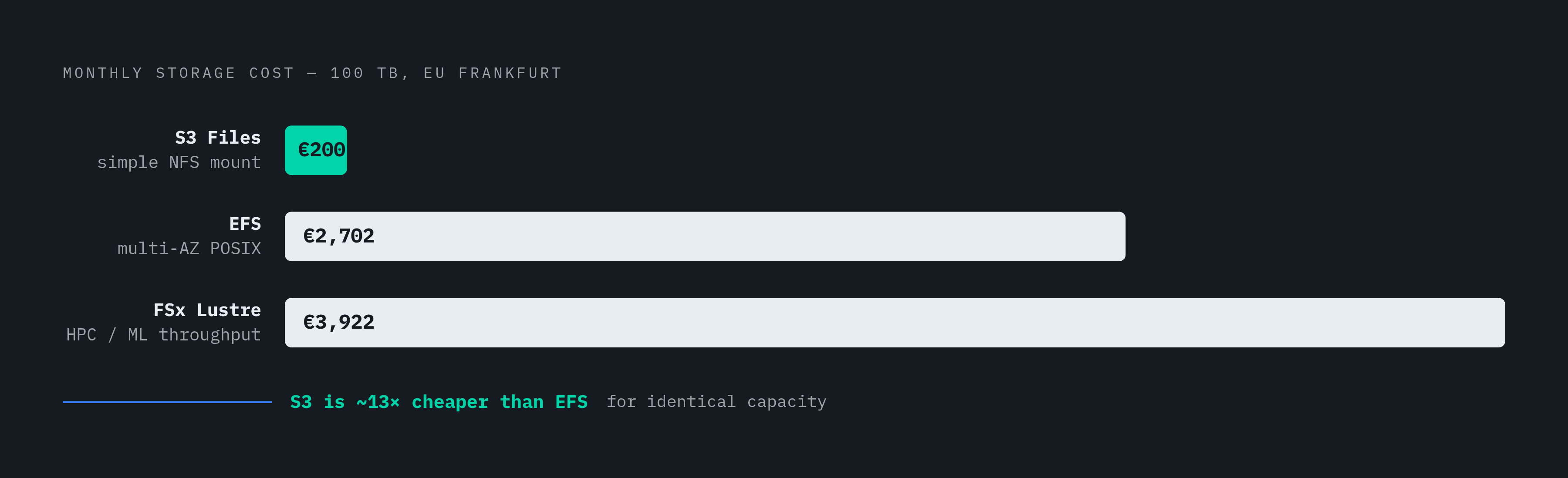
Amazon S3 Files reached general availability in April 2026, and that's when the option set inside AWS changed shape. Where cloud architects once had effectively one managed NFS choice, they now have three: EFS, FSx for Lustre, and S3 Files, and cost has become the sharpest line between them. A 100 TB comparison in EU-Frankfurt from May 2026 puts S3 Files (S3 Standard, excluding request costs) around €200 a month, EFS General Purpose (Elastic Throughput) around €2,702 a month, and FSx for Lustre Scratch FS 2 around €3,922 a month. One option costs roughly thirteen times another for the same 100 terabytes.
S3 Files earns that price by being simple: it mounts S3 buckets directly as NFS v4.1/v4.2 endpoints, with no appliance, no intermediary service, and none of the confusion that used to come with the older S3 File Gateway. Pricing follows S3 logic rather than EFS's throughput fees, which is most of why the gap is so wide.
None of that makes S3 Files a universal replacement. It has no enforced POSIX byte-range locking and no strong consistency guarantee for parallel writes from multiple clients, so databases and any application that depends on POSIX locks are ruled out. That leaves EFS holding one genuinely defensible job inside AWS: multi-AZ write consistency from instances in different availability zones with full POSIX semantics intact. That's a real requirement for some workloads, just a narrower one than EFS's original pitch implied. FSx for Lustre, meanwhile, is built for HPC and ML training throughput, not general-purpose shared storage, and its scratch-cluster design and pricing make that scope clear. Put together, the three services now split cleanly by job rather than competing head-on, and EFS's slice of that pie is smaller than it used to be.
Why multi-cloud architectures expose the deeper flaw in any cloud-native file service
EFS's AWS-bound mounting model is not a quirk of one vendor. Azure Files mounts from Azure infrastructure. Google Cloud Filestore mounts from GCP infrastructure. Every managed file service built by a hyperscaler is a tenant of that hyperscaler's own network, so cross-cloud mounting is structurally impossible without data replication or a gateway appliance standing in the middle.
Both Azure Files and Google Cloud Filestore are solid, well-built services, and G2's 2026 alternatives listing ranks them as the top EFS alternatives. But both are also cloud-native file systems tied to their own clouds. A team that migrates from EFS to one of them is still locked into a single cloud's infrastructure. It has relocated it to a different zip code. G2 reviewers comparing Azure Files and EFS directly rate Azure Files as slower to reach ROI and more expensive, which confirms the pattern: the per-cloud premium travels with you, it doesn't vanish when you switch providers.
A cloud-agnostic architecture needs storage that mounts identically no matter where the compute happens to be running that day. By construction, no cloud-native file service can offer that, because each one is built to serve its own cloud's compute first and treat everything else as an edge case requiring extra plumbing. That points toward a different kind of answer: not a better cloud-native file service, but a storage layer that treats the object store itself (S3, GCS, Azure Blob, R2) as the single source of truth, with a compatible mount interface placed in front of it on whichever cloud the workload happens to be running on. Archil, a serverless filesystem that mounts S3, GCS, and other object stores as native filesystems, is one example of that approach in practice: the same bucket mounts identically whether the compute sits on AWS, GCP, Azure, or on-premises hardware, because the object store, not any one cloud's file service, stays the single source of truth.
Why AI and ML workloads make the storage portability problem acutely expensive
AI training turns this architectural question into a line item on a GPU bill. If storage can't keep pace with GPU demand, your expensive compute sits idle waiting for the file system to catch up, and you pay for that in wasted GPU hours, not mild inconvenience.
Training workloads generate two distinct I/O patterns, and each one stresses storage differently. Dataloader reads are many small, latency-sensitive requests that stall GPU workers the moment a file system serializes them through a single mount point. Checkpoint writes are the opposite problem: bandwidth-heavy bursts that can eat a large share of total training time if the storage underneath isn't built for concurrent burst writes.
The Apertus LLM training project ran into this directly. Production runs showed substantial run-to-run variation in tokens per second even though the model and parallelization settings stayed identical, and the investigation traced most of that variability to I/O interference on a shared global filesystem. A standard NFS mount, EFS included, rarely sustains more than 1 to 2 GB/s on a single mount point, while the rough rule of thumb for data-heavy training workloads calls for about 4 GB/s of read throughput per GPU. That's not a tuning problem to fix with a config flag. The gap is structural.
Locking training infrastructure to one cloud's file service compounds the cost. Teams lose the ability to shift training runs to wherever spot GPU capacity is cheapest that week, and they can't share datasets across clouds without copying them wholesale, or reuse the same storage layer for inference workloads running on a different provider. The storage choice ends up dictating where the compute is allowed to go, which is backwards.
Archil: mounting any object store as a POSIX filesystem without moving the data
Archil approaches the problem from the object store outward. The bucket is the source of truth, Archil never keeps a persistent copy of its own, and that single design decision is what makes the same bucket mountable on EC2 today and GCP tomorrow, through the same interface, against the same data. Cloud-agnostic behavior here is the direct consequence of where the data actually lives.
Full POSIX semantics come along for the ride: atomic rename, flock and fcntl locking, hard links, symlinks, random writes, and appends all work as expected. That matters because it means existing code and tooling runs unmodified, with no SDK and no client library to bolt on first. A team doesn't rewrite its training pipeline to adopt a new mount; it just points the pipeline at the mount and keeps going.
You get billed on what's actively cached rather than on what's provisioned up front, and that fits training workloads whose active working set can swing wildly from one run to the next. Archil also ships serverless execution alongside the filesystem, so an agent or a training job can run commands directly against its own filesystem without managing a separate sandbox lifecycle on the side, and agent context persists across sessions and parallel runs rather than resetting each time.
Data residency stays put throughout. Cache nodes sit next to compute, so nothing moves cross-region unless you configure it to, you can revoke access at any time, and the bucket itself never leaves where it already sits. If you're weighing the compliance exposure described earlier around a managed network file system and its encryption key setup, this gives you a meaningfully different starting position.
Parallel file systems for throughput-first workloads: Lustre, BeeGFS, and managed variants
Parallel file systems exist to fix the exact problem that breaks NFS at scale: serialization. Instead of funneling every request through a single mount point, data gets striped across multiple storage servers, so many GPU workers can read at once without queuing behind each other.
Google Cloud Managed Lustre, which picked up expanded capabilities at Google Cloud Next '26, scales to very high aggregate throughput and integrates directly with S3: it can import an S3 bucket as a data source, process it locally at Lustre speed, and write results back to S3 when the job finishes. Sony Honda Mobility put it to work on the AFEELA Intelligent Drive project, and it said Managed Lustre let the team scale AI model training by 3x compared to other Google Cloud solutions. If you look at Google Cloud's Managed Lustre pricing page, the top throughput tier starts at a per-GiB monthly rate. The tradeoff is built into the name: it's managed on GCP, a GCP-bound service rather than a cross-cloud portable layer.
BeeGFS, maintained by ThinkParQ, takes a different approach to one specific bottleneck: metadata. Instead of routing every metadata request through one central server, BeeGFS distributes metadata by directory, assigning each directory to one available metadata server and cutting down on single-point contention. Licensing is split: the client runs under GPL v2, while the server operates under the BeeGFS EULA, ThinkParQ's own proprietary license defining Community and Enterprise editions. That makes it source-available rather than fully open source, but the Community Edition is free for most use cases. BeeGFS can run on any infrastructure, including on-premises and across clouds, which makes it more portable than a managed, single-cloud Lustre deployment.
Benchmark data from Spheron, run on H200 and B200 nodes against a pre-training dataset, found BeeOND delivering strong read throughput with low dataloader stall, while Lustre delivered higher throughput with lower stall still. Both are legitimate answers when throughput is the only variable that matters and the team running them has the operational capacity to provision, size, and manage a cluster. Neither is elastic the way an object-store-backed mount is, and their cloud-agnostic story depends on someone self-managing the deployment rather than a unified interface doing that work automatically.
Global-namespace and hybrid-cloud file services for distributed teams and governed data
A different constraint calls for a different tool. When organizations coordinate data across offices and clouds and the bottleneck is governance and consistent access rather than GPU utilization, they tend to land on global-namespace file services instead.
CTERA's Intelligent Data Platform leans into edge-to-cloud file services with a global namespace and caching, and it's built around secure distributed file access and governance across sites. Setup costs run higher than EFS, so it's a better match for larger enterprises with dedicated storage teams than for a small team hunting for self-service infrastructure.
NetApp Cloud Volumes ONTAP brings ONTAP's data management features, storage efficiencies, and replication tooling into a software-defined form that runs across AWS, Azure, and GCP. Its multi-protocol support (NFS, SMB, iSCSI, NVMe-TCP, and S3) makes it a natural fit for mixed Windows and Linux environments needing shared storage across operating systems, and it's a particularly strong match for organizations already running NetApp on-premises who want to extend that same operational model into the cloud.
Both solve the "same files, multiple sites" problem well. What they add is a managed coordination layer sitting above the object store rather than a replacement for one. That layer is a vendor-specific namespace and replication plane that isn't always transparent to the workloads running on top of it. For the distributed-enterprise, strong-governance profile, that tradeoff is a reasonable one to make.
Open table formats as a cloud-agnostic data layer for analytics workloads that do not need a file interface
Some workloads need no filesystem. Analytics and data pipeline workloads often just need structured, queryable access to data sitting in object storage, and open table formats can do that job with no POSIX layer anywhere in the picture.
Formats like these sit directly on top of S3, GCS, Azure Blob, or any other object store, managing schema, versioning, and transactional consistency through metadata rather than through a mounted file interface. Query engines read that metadata to know exactly which files make up a table at a given point in time. The same table can be queried from compute running on any cloud, with no copying and no gateway appliance standing in between.
That makes the open-table-format layer and a tool like Archil complementary, not competing answers to the same underlying question. Both start from the same premise: the object store is the source of truth, and the right interface gets placed on top of it depending on what the workload actually needs. A training job that expects to open files, seek around in them, and write checkpoints back needs POSIX semantics, which is the filesystem case. A SQL query scanning billions of rows across a dozen partitions needs a table abstraction. Treating the object store as the one constant, and choosing the interface on top of it by workload rather than by which cloud happens to be running the compute, is the throughline connecting every alternative this piece has covered.
Sources
- What is EFS? Competitors, Complementary Techs & Usage
- Top 10 Amazon Elastic File System (Amazon EFS) Alternatives & Competitors in 2026
- S3 vs. EFS vs. FSx: Which AWS File Service Fits Your 2026 Cloud Workload
- Parallel File Systems for AI on GPU Cloud: WekaIO, Lustre, and BeeGFS Production Deployment Guide for Multi-Node Training (2026)
- Managed Lustre