POSIX Filesystem Semantics for AI Agents
Models reason better with POSIX file systems than object storage.
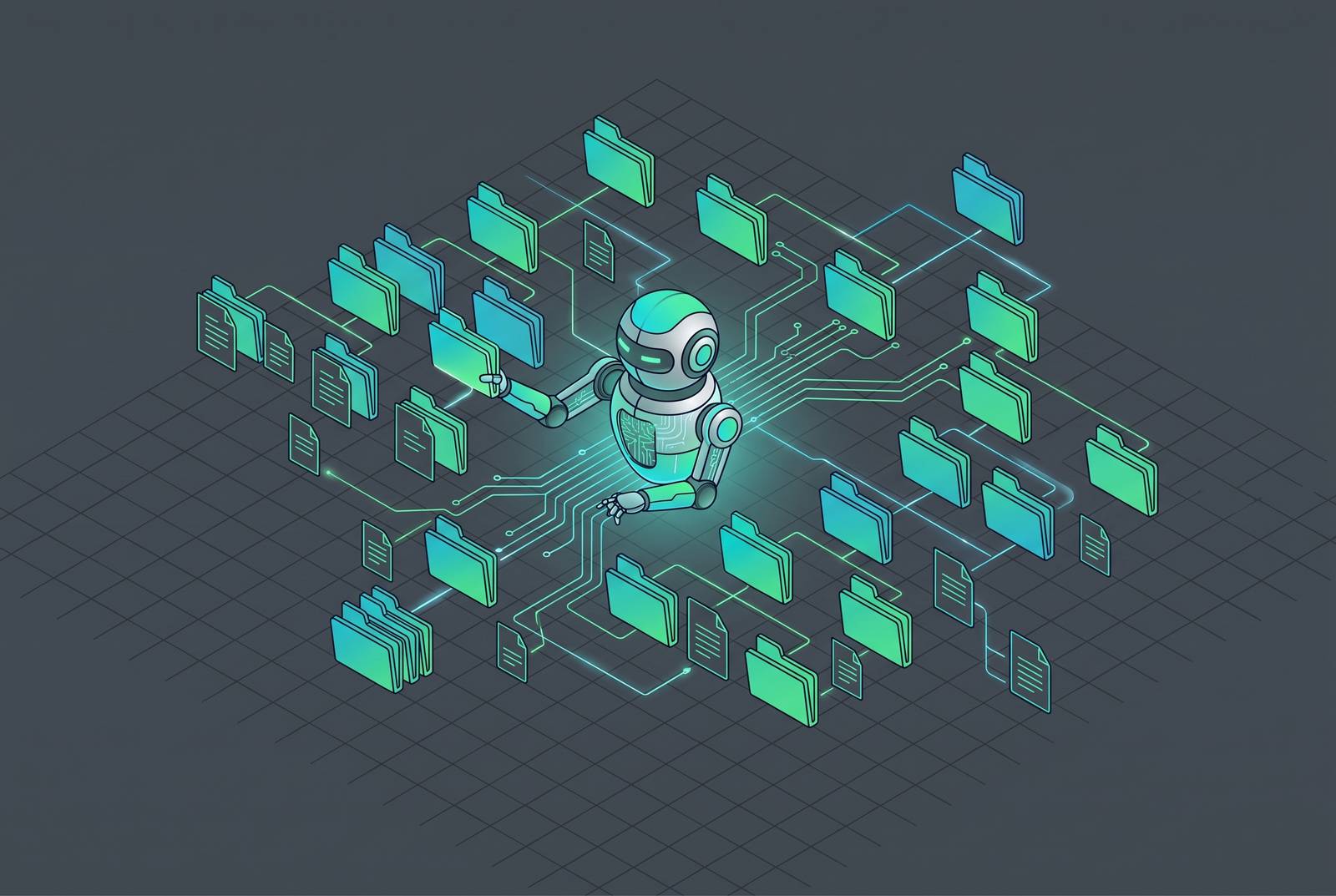
AI agents behave better when the state they work with is explicit, sitting right on local storage, and touchable through an interface the model already speaks fluently. That interface is the file system, and the reason comes down to how agents actually think, not what's fashionable in infrastructure circles. Most developers building agents today lean on local or single-node file systems through standard POSIX interfaces, because file operations are self-contained and the agent can execute them with whatever context it already has in hand. Open a file, read it, write it, close it. No side quests required.
Database operations are context-dependent and unforgiving about correctness. The agent has to carry a lot more invisible baggage just to reason about what it's doing and whether it did it right. Running a multi-table transaction requires an agent to hold a mental model of schema, locks, isolation levels, and rollback behavior, all before it writes a single row. Object stores create a different headache: they hand the agent a flat namespace and expect it to reconstruct a directory structure from scratch, which drives up both latency and the token cost of figuring out what exists and where it lives.
There's also a training-data reason file systems win, and it's a simple one. Frontier models have seen an enormous volume of bash and command-line tool use during training, so navigating a file system is what they do best. Commands like ls, cat, mv, or grep are the model's native language. Asking it to construct a correct call to an object store with pagination tokens switches it to a second language it speaks with an accent.
What POSIX semantics guarantee for agents
POSIX is a specific set of IEEE standards describing how an operating system is supposed to behave, and POSIX compliance means an application can talk to storage through standard APIs with no proprietary quirks to learn. For an agent, that standardization isn't decorative. The atomic rename, file locking, symlinks, mmap, and fsync guarantees it provides are each doing real work for an agent.
Atomic rename lets an agent swap a file for a new version without ever exposing a half-written draft to another process peeking at the same path, and this matters enormously when agents are writing checkpoints or intermediate results that something else might read mid-save. File locking, through mechanisms like flock or fcntl, lets multiple agents coordinate access to shared state, so they don't need a separate coordination service just to avoid stepping on each other. Symlinks and hard links let an agent organize and reference the same piece of data from multiple places in a task graph without copying it, which keeps a workspace coherent even as a project branches into parallel subtasks. mmap lets an agent treat a file's contents like memory, so it can jump straight to the part of a large file it needs instead of reading the whole thing end to end. And fsync hands the agent explicit control over durability: it can force a write onto stable storage and know, with certainty, that it's safe to move on to the next step.
Strip any one of these out and the agent isn't just slower, it's reasoning with a blindfold on.
Where object storage breaks down for agents
The gaps between object storage and POSIX appear constantly in the operations agents perform. They land squarely on the operations agents perform constantly, but object storage still earns its keep as the right home for durable, petabyte-scale data that doesn't need sub-millisecond response times. Both things are true at once, and the trick is knowing which layer each claim applies to.
Take AWS Mountpoint for Amazon S3, a tool that maps S3 objects onto file-like operations. It's useful, but it's upfront about what it isn't: a full POSIX file system. It can't modify existing files, can't delete directories, and has no support for symbolic links or file locking, which happens to be precisely the list of operations agents reach for most often. Taking away file locking leaves a group of agents sharing a workspace with no built-in way to avoid colliding over the same file. Someone has to invent that coordination logic from scratch, at the application layer, every single time. Taking away atomic rename and symlinks leaves an agent finishing a piece of work with no safe way to signal "done" to the next agent in line, because there's a window where the result looks finished but isn't.
None of this is an argument against object storage generally. Object storage is still the right default for workloads at scale that can tolerate latency above sub-millisecond, and AI workloads routinely need to ingest enormous volumes of unstructured data where the economics of object storage make it the only sane way to store petabytes of training material. The response "object storage has gotten a lot faster" misses what's actually being asked for: speed was never the complaint. Atomicity and locking are primitives, and no amount of throughput substitutes for a primitive that isn't there.
Which points toward the arrangement that actually works: object storage holding the durable copy of the data, and a POSIX layer sitting where the agent does its work. Everything that follows in this piece builds on that split.
The dual-copy tax that missing POSIX semantics imposes on AI pipelines
Most AI pipelines today keep the same data living in two places: once in a file system, once in object storage. Not because anyone wanted two copies. Because the two layers don't speak the same language, so a sync job has to shuttle data between them, and that sync job is a symptom of the architecture not fitting together, not a legitimate step in the pipeline.
A sync job that used to take minutes stretched out to many hours once the dataset scaled up significantly. That's not a rounding error in someone's weekly schedule. A training run sits idle while terabytes crawl from one storage layer to another, and the GPUs do nothing but wait, on the clock.
Part of why this keeps happening is that the workload itself has changed shape. Large sequential reads and writes used to dominate AI data access, and traditional POSIX-based parallel file systems were built for that pattern. Today, small and random read/write traffic is more common, and those older systems have struggled to keep up. The usual patch is to provision fast, node-local storage right next to the compute, so reads don't have to travel far.
The bigger the dataset, the bigger the wait before training can even begin, because the staging delay scales with dataset size. Removing the need for that movement, and removing the wait before inference or training starts, is where the real speedup lives.
How multi-agent coordination breaks without file locking and shared namespaces
If you put several agents in the same workspace without POSIX file locking and a shared namespace, you don't just get a modest dip in performance. It's a pipeline that's brittle and collision-prone, failing in ways that are hard to catch and harder still to reproduce after the fact. Two agents writing to the same file at the same time, with no lock to arbitrate, is a coin flip over which version survives, and coin flips make for miserable debugging sessions.
Google Cloud's Filestore agent volumes, launched in September 2026, let agentic coding platforms spin up thousands of isolated workspaces where agents install libraries, write patches across multiple files, run build tools, and execute unit tests, all using standard POSIX file semantics through integration with Agent Substrate on GKE and GKE Agent Sandbox. In that setup, a lead orchestrator delegating work to dedicated research, code generation, and validation sub-agents can have all of them share one unified file tree, rather than passing data back and forth through a side channel. AWS answered with S3 Files in 2026, giving agents a shared file system over S3 data with POSIX semantics, so agents running on EC2, Lambda, EKS, ECS on Fargate, and Amazon Bedrock AgentCore Runtime can all mount the same file system and use ordinary operations like open(), os.listdir(), and write(). In a multi-agent system, that shared file system becomes the handoff layer where one agent's output becomes the next agent's input, cleanly and without a translation step.
Agents today often have limited visibility into their own effects on the filesystem and limited control over them, which argues for putting more information and control into the filesystem layer itself rather than routing around it. The more immediate cost, though, is economic. Every bespoke coordination tool bolted onto an agent to patch over missing locks burns context window space just to re-explain rules the filesystem could have enforced on its own. Folding coordination into the shared filesystem the model already understands is the cheaper design, in tokens and in failure modes.
How Meta's PRISM benchmark revealed that storage choice is a research-productivity variable, not just a performance variable
Benchmarks that only measure peak throughput give AI teams the wrong answer, because real research and agent workloads arrive in bursts, across wildly different access patterns, and that burstiness disappears the moment you test under smooth, steady-state load. A storage system can look fantastic on a throughput chart and still fall apart under bursty, uneven load, which is exactly the situation most research clusters live in.
Meta's FAIR team addressed this directly with PRISM, an evaluation framework built to reproduce representative AI research workloads across data ingestion, checkpoint I/O, and developer workflows, built specifically because existing benchmarks only grade peak performance and miss the bursty, mixed I/O patterns that real AI research actually produces. Real research work is dynamic and fragmented. It's interactive, spans multiple data modalities, and is often experimental, reshaped on short notice, repeated constantly in the near term, and thrown away once it's served its purpose, which demands a storage layer that can bend without breaking. POSIX-compliant systems like Lustre and POSIX-like systems like NFS supply the compatibility layer that the huge ecosystem of existing and custom research software expects, and if that layer is missing, researchers end up working around their storage instead of through it.
What PRISM found reshaped real decisions. Using PRISM, a flash-backed NFS solution outperformed a flash-backed Lustre solution by up to 3× for the distributed checkpoint load use-case, a result that directly informed cluster design choices. A bug in a notable storage vendor's system caused an 8× increase in checkpoint latency and a dramatic reduction in overall cluster efficiency, and you only see this kind of failure under realistic workload patterns, not peak-throughput benchmarks.
The lesson generalizes past Meta's cluster: the right standard for picking AI research storage is performance delivered through a POSIX-compatible, researcher-friendly interface, not raw throughput on its own. It's one of the biggest levers a team has.
What hyperscale deployments reveal about where POSIX and object storage each belong in a production AI stack
Hyperscalers are stacking these two technologies rather than discarding one for the other. Hyperscalers are stacking them, keeping object storage as the durable source of truth and placing a POSIX layer as close to the compute as the hardware allows.
Google Cloud Managed Lustre, generally available since July 2025 and expanded in April 2026, now delivers bandwidth at scale with capacity pushed out to 80 petabytes, and it can use TPUDirect and RDMA to let data skip the host entirely and move straight to the accelerators. Alongside it sits Rapid Buckets on Google Cloud Storage, which brings sub-millisecond latency and high operations per second to object storage, and Google positions it as a complement to Managed Lustre, not a replacement for it. That's the layering argument made in product form: one system for raw bandwidth next to compute, another for durable, high-throughput object storage, each doing the job it's actually suited for.
IBM's Vela and Blue Vela infrastructure describes GPU-Direct RDMA enabling direct transfer of data between GPU memory across different nodes, while NVIDIA's separate GPU-Direct Storage technology handles direct transfer between storage systems and GPU memory, cutting out the usual data transfer bottleneck, but that path still needs POSIX-compatible storage sitting underneath it as the source layer. Parallel file systems like Lustre and GPFS have come roaring back because they can keep GPUs fed during training, while object stores are picking up ground on the inference side, where the requirements look nothing like training.
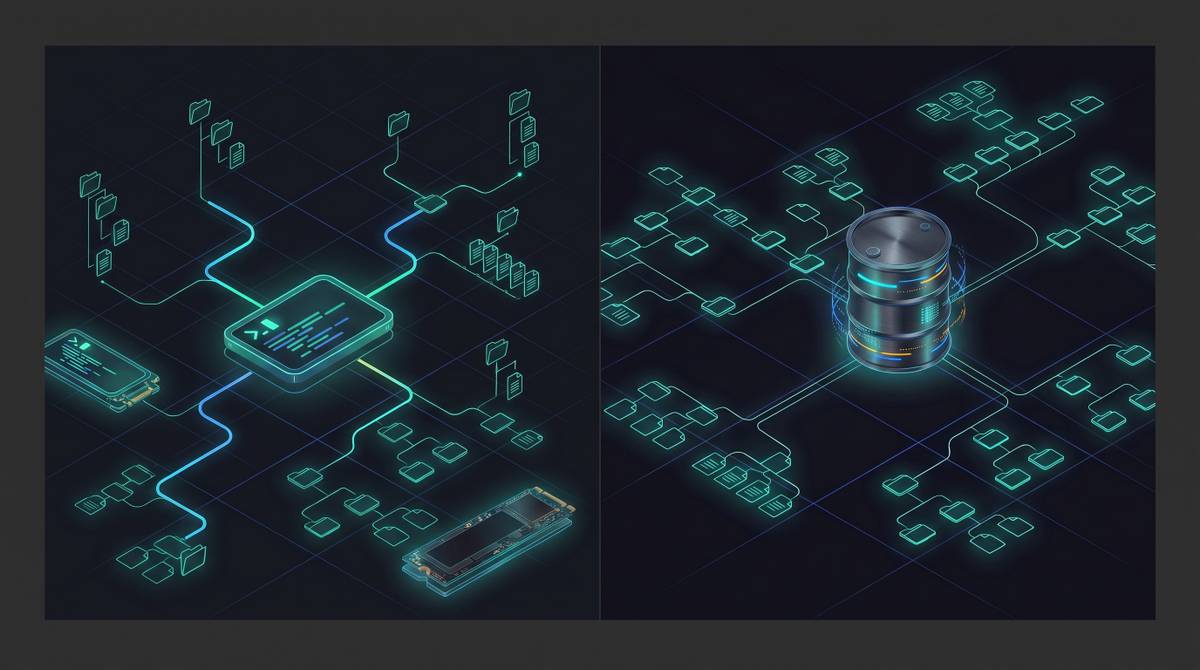
Object storage's per-request latency, typically tens of milliseconds against the sub-millisecond latency of local block storage, isn't something to argue away. In production, teams keep the durable copy sitting in object storage and cache the hot, frequently touched data on fast local media like NVMe or RAM, right next to compute. A cloud-agnostic POSIX layer sits over existing object buckets, with the bucket staying the source of truth and an NVMe cache absorbing the hot reads, so a team gets the economics of object storage alongside the semantics agents actually need, with no migration project and no ETL pipeline to maintain.
Why persistent, cross-session agent context requires POSIX semantics as a structural property
An agent that loses its workspace the moment a session ends, can't share state with the agents running alongside it, and has no stable place to execute code is a stateless function call wearing a longer prompt, and POSIX semantics are what separates it from a persistent agent.
Context windows run out. Files don't. Agents reach for a filesystem because context windows are finite and files persist across sessions, and in multi-agent systems, that shared filesystem becomes the handoff point where work passes cleanly from one agent to the next. An agent that can mount the same workspace across multiple sessions and multiple parallel runs, reading from it, writing to it, executing against it, has something close to a stable identity and can build on its own past work, while an agent without that gets reset at every boundary, starting from zero each time.
Execution is part of the deal too. An agent that can run bash commands directly against its own workspace, with no separate sandbox layer bolted on, has fewer moving parts, so there are fewer places for something to quietly break. No one knows the size of an agent's working set in advance, so the storage underneath has to be elastic, metered by actual use rather than provisioned ahead of time on a guess. POSIX semantics are the floor an agent's architecture stands on.