Shared Filesystem Access for Parallel Agent Runs
How parallel agents can safely share files without losing data to race conditions.
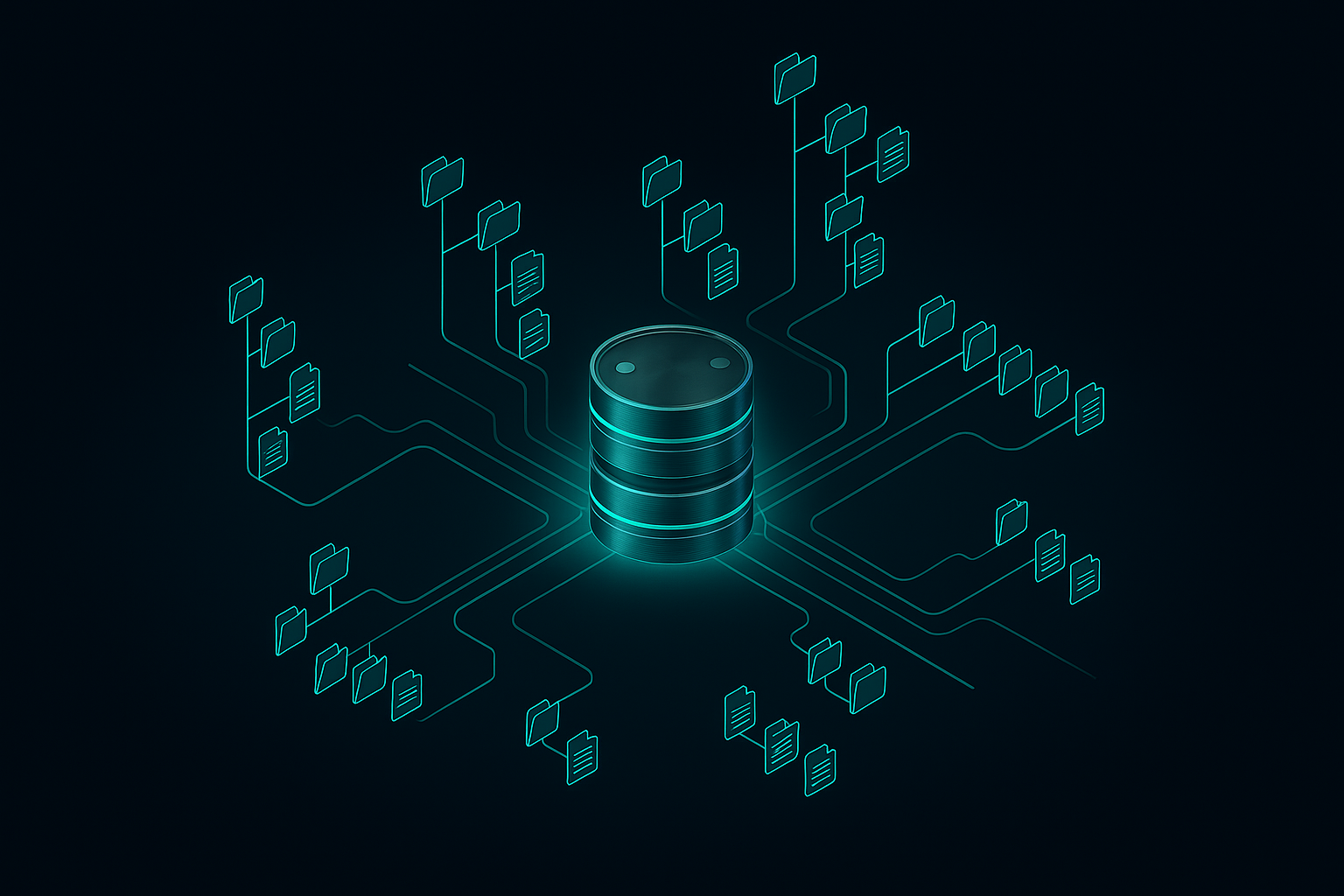
Two agents hit the same file at the same time. One writes, one writes over it, and nobody throws an error. That's the failure this piece is about: a correct answer, quietly erased by a peer that never knew it existed.
Neither agent screwed up. Neither was buggy, neither was confused. The gap was that nobody told them about each other, and that's a coordination problem. Coordination problems have coordination solutions, and one of the oldest on the planet, the POSIX filesystem, has been solving this exact thing since before "AI agent" meant anything at all.
Content pipelines that ran in a straight line have taken around 30 minutes; the same work, split across agents with no dependencies on each other, can finish in under 20. Split independent work across a task graph with enough separate branches and you can shave a third to half off total run time. That's the pitch anyway, and it's a real one.
Here's the catch nobody puts on the slide: the number only holds if the work actually splits. Chain every task to the one before it, and parallel agents buy you nothing but overhead on a job that was always going to run in sequence. And even when the graph is sparse enough to split cleanly, the gain is fragile. Race agents on shared state with no real coordination layer underneath, and you'll trade speed for correctness every single time. So what does that layer actually need, structurally, to not fall over?
What "shared filesystem access" actually requires from the underlying storage
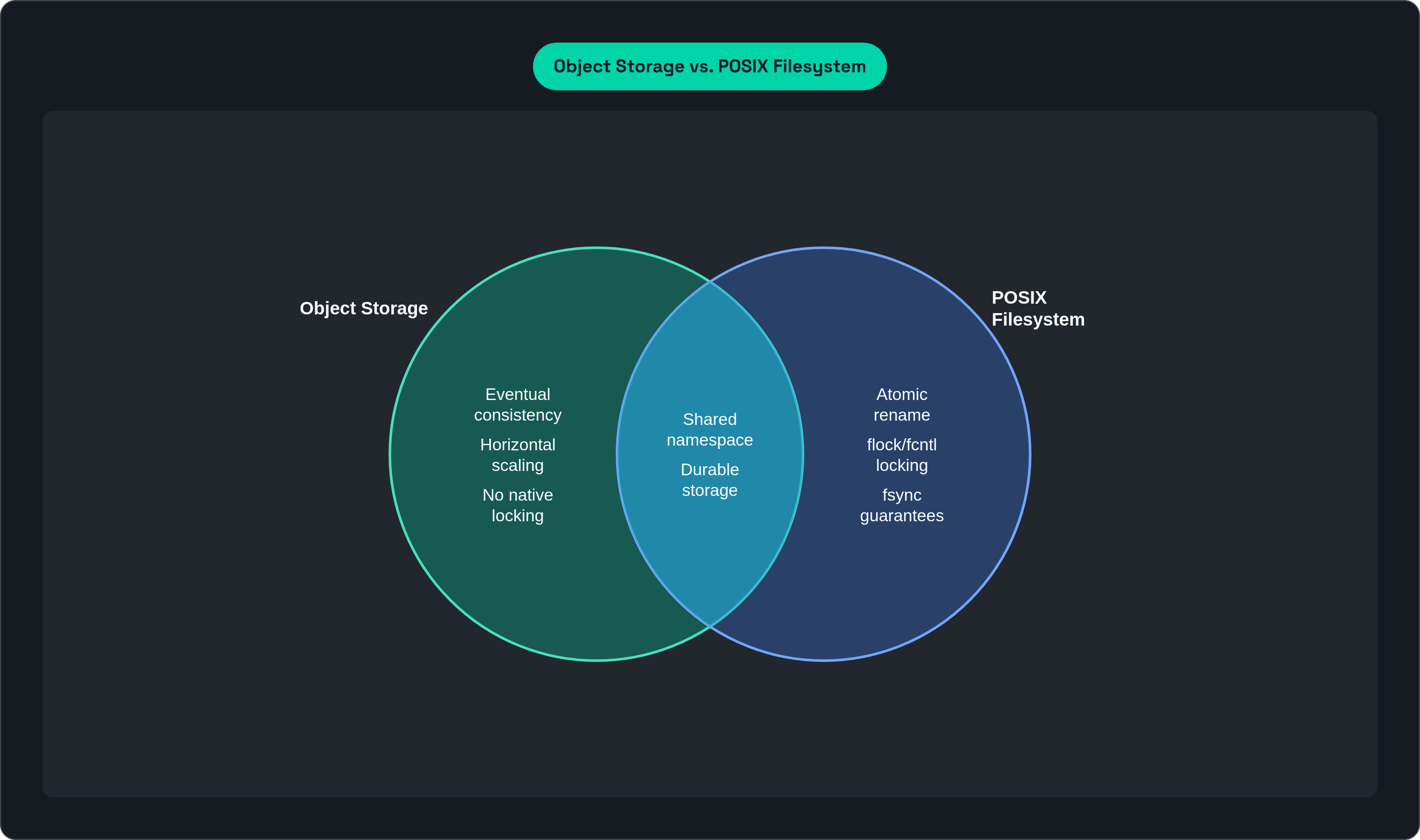
A network file share and a POSIX filesystem with full semantics look identical in a file browser. The difference shows up the second two writers show up at once.
A handful of primitives do the actual coordination work:
- Atomic rename, so a file lands in place as one move and nobody reads it half-written
- File locking (flock, fcntl), so a writer claims exclusive access and everyone else waits its turn instead of racing
- Hard links and symlinks, for pointing multiple names at the same data, or swapping a canonical path without copying anything
- fsync, so a write is actually on disk before you tell another agent it's done
- mmap, for the zero-copy access patterns that matter in data-heavy inference work
Tools, scripts, and libraries already assume these work, because they've worked on local disks for forty-plus years. Storage that fakes POSIX, that answers a lock call without enforcing it, breaks code that was written correctly. The bug lives underneath the code, somewhere nobody thinks to look until things start disappearing.
Plain object storage and "a POSIX filesystem mounted over object storage" get lumped together constantly, and they shouldn't be. Object storage on its own is eventually consistent: no locking, no rename atomicity, none of it. A POSIX layer built correctly on top of that same bucket can preserve all of that behavior while the bucket still does the storing underneath. The gap between storage that's technically shared and storage that actually behaves like a filesystem is where nearly every parallel-agent failure I've seen starts.
One more wrinkle, and it's a genuine headache: nobody can predict how much intermediate state an agent run throws off. A megabyte one run, a gigabyte the next, no warning either way. Storage billed for what you actually use, instead of provisioned against a worst case you're guessing at, is the only approach that survives contact with that kind of uncertainty.
Three coordination patterns that use filesystem primitives directly, and when each one fits
Get the primitives right, and three patterns cover almost everything parallel agents need to do.
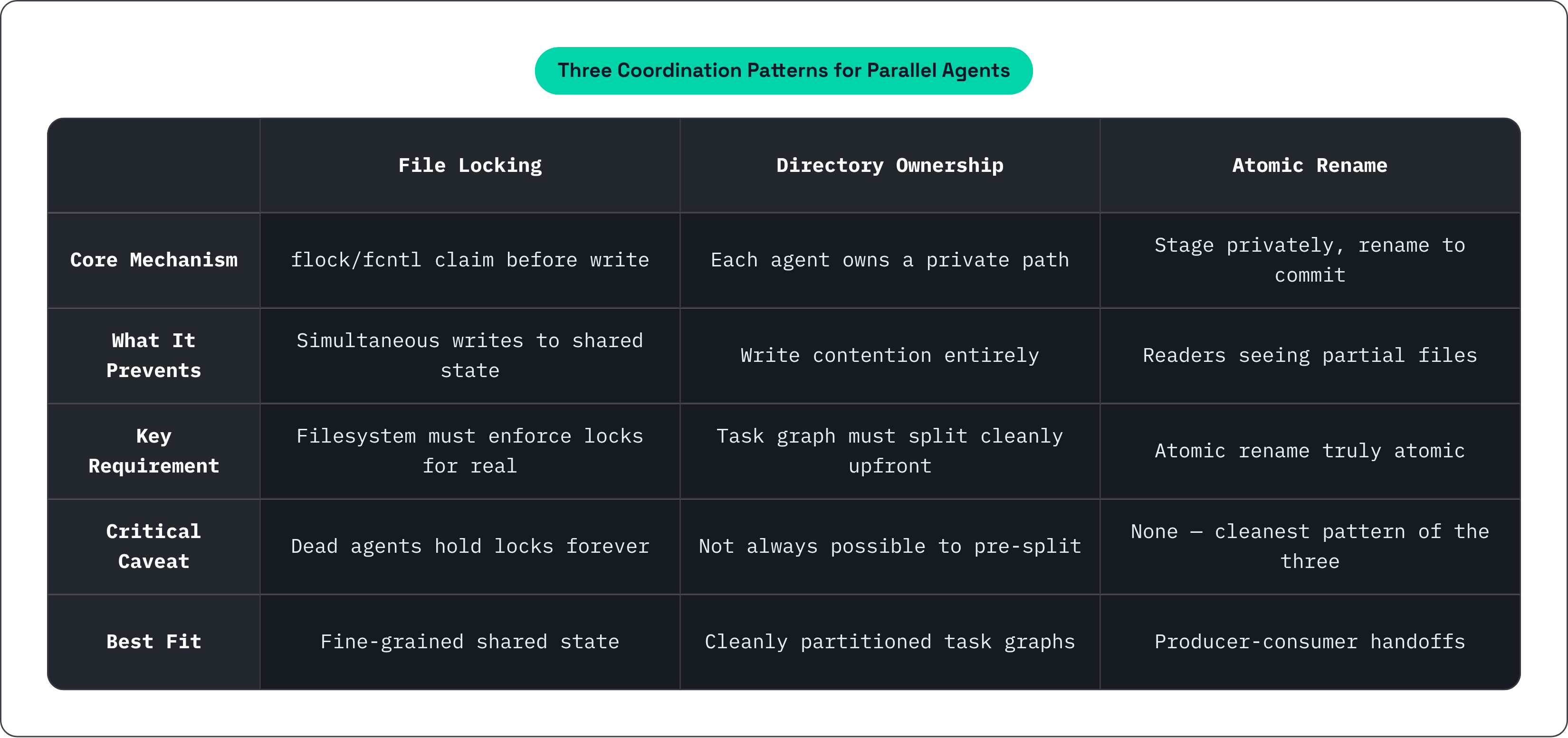
File locking with short TTLs. An agent grabs a lock before writing; everyone else waits. Short TTL matters because agents crash, and a lock held forever by a dead process is worse than no lock at all. General-purpose tool, but only if the filesystem underneath actually implements flock and fcntl. Plenty of network filesystems just fake it.
Directory ownership. Each agent gets its own path, writes only there. The shared filesystem becomes a common namespace instead of a shared write target, so there's nothing to fight over in the first place. The catch: you have to cleanly split the task graph before dispatch, and that's not always doable.
Atomic rename as a commit signal. An agent writes to a private staging path, finishes, then renames into the shared spot everyone else reads from. Readers never catch a partial file, because the rename is the exact moment the file becomes visible. Works like a database commit without a database, a queue, or a coordinator process watching over anyone's shoulder.
Harvey AI's document-editing workflow mixes two of these in practice, for what it's worth. Sub-agents each get an isolated copy of a document, edit independently, then a reconciliation step auto-merges whatever doesn't conflict. Directory isolation plus a merge step standing in for real-time locking, and it works because drafting tolerates a reconcile-later approach just fine.
Which pattern fits depends on the shape of the work. Locking for fine-grained shared state, directory ownership for tasks that split cleanly, atomic rename for producer-consumer handoffs. A filesystem that does all three properly means one pipeline can use different patterns at different stages instead of getting locked into one for the whole run.
What breaks when the storage layer does not deliver real POSIX semantics
The worst part of this failure mode is how quiet it is. No exception, no stack trace, no line in a log pointing at the culprit. An agent's write is just gone.
Eventually-consistent object storage used as a shared workspace is the classic setup for this. A reader can pull a stale copy of a file seconds after another agent wrote a fresh one, because nothing at that layer ever promised otherwise. Skip atomic rename and two agents race to finalize the same output; one wins, one vanishes, and neither the losing agent nor the orchestrator gets so much as a warning. Advisory-only locking might be worse, honestly: the code calls the lock function, gets a success response back, proceeds like it's protected, while the storage layer treated the whole call as theater.
There's a scale problem hiding behind all of this too. Modern LLM workflows can throw off hundreds or thousands of files per checkpoint, and a parallel filesystem that chokes on high-concurrency metadata (the bookkeeping of which files exist where) stalls the whole cluster. You don't catch that with three agents in a demo. It shows up the day you go from three agents to three hundred, usually at the worst possible time.
Gartner projects that by 2027, 40% of enterprises will pull back or shut down autonomous agent deployments over governance gaps nobody noticed until production broke. Untested infrastructure assumptions contribute to those failures. The problem never announces itself as a storage error. Three weeks later it shows up looking like a data quality problem, and tracing it back to a lock call that was never really a lock is its own small nightmare.
State isolation patterns that work above the filesystem, and what the filesystem must provide underneath them
Production multi-agent systems don't lean on one isolation trick. They stack a few, usually three, sometimes more.
Filesystem isolation comes first. Git worktrees are the clean example: each agent gets its own HEAD, its own index, its own working files, and the rest of the repo stays shared. No copying, real isolation. Process isolation comes second, containers or sandboxes that keep an agent away from shared paths it has no business touching. A merge gate sits above both, checking for conflicts before anything folds back into shared state.
Two things get mixed up constantly here: agents running in true parallel, and agents just taking turns. Most multi-agent demos are sequential underneath the marketing gloss. AutoGen's group chat pattern has agents publishing messages one after another, and in that setup wall-clock time is roughly the sum of every agent's latency plus whatever orchestration tax got bolted on top. Parallelism only pays off when the architecture actually dispatches work at the same time, not when a diagram implies it does.
For any of that layered isolation to hold, the filesystem underneath has to deliver a few specific things. Simultaneous mounts across many compute nodes, since a disk that attaches to one host at a time kills the whole model before it starts. Persistent state across sessions, so whatever got written in one run is still sitting there, readable, in the next one, nothing re-fetched or recomputed for no reason. A shared namespace with per-path isolation, meaning the same mount point everywhere, each agent staying in its own directory, merging on purpose when it's actually ready.
Skip any of that and teams end up hand-rolling their own sharding or copying logic, which is exactly the bespoke plumbing a shared filesystem was supposed to make unnecessary in the first place.
How the storage architecture underneath parallel agents determines whether coordination primitives actually work
Production AI infrastructure tends to run in tiers: hot NVMe for active tensors and KV cache, a parallel or NVMe-over-fabric tier for active datasets and checkpoints, object storage underneath as the durable system of record. Parallel agents usually work across the warm tier and the capacity tier at the same time, not one or the other.
The mistake I keep seeing: treating this as one problem when it's really three, then pointing a single storage platform at every stage from hot cache to cold archive. Object storage earned its spot as the system of record honestly. It scales horizontally, shrugs off parallel access, does the job it was built for. It still doesn't speak POSIX natively though, and every coordination pattern covered above (locking, atomic rename, all of it) needs that exact vocabulary to work.
That's the specific gap a filesystem layer over object storage exists to close: real POSIX semantics, exposed to agents and code, without moving the data or running an ETL job, while the bucket stays the actual source of truth.
A filesystem layer over object storage is a working version of that shape. The approach mounts an existing object store bucket as a real POSIX filesystem. The bucket stays the authoritative source of record, so no separate persistent copy sits parked with the vendor. Parallel agents across many servers need to mount that same filesystem at the same time, and that's a hard requirement baked into the design, not a checkbox tucked into a settings page somewhere. Capacity stays elastic and metered on actual cache use too, since agent workloads never call ahead to say how big they'll get. No migration, no ETL, no rewriting code against a new API. Teams stop building pipelines whose entire job is moving data around, and start pointing agents straight at data that was already sitting in the bucket the whole time.
Why bash and the filesystem are the lowest-friction interface between agents and data
Frontier models have been exposed to substantial amounts of bash and file manipulation throughout their training. The filesystem is the surface where a model's actual competence runs deepest.
An agent that can run bash against a mounted filesystem can list, read, write, pipe, and grep without a custom tool bolted on for every single action. The alternative costs more than it looks like on paper: every bespoke tool strapped onto an agent eats into its context window. One interface the model already understands cold beats ten thin wrappers around ten different APIs, every time, no contest.
There's a design principle buried in here too. Context works better discovered as the agent goes than dumped into the prompt all at once up front. A filesystem supports that naturally, since the agent can look around, read what it actually needs, jot down intermediate results, keep moving. For parallel agents specifically, that turns into something clean: each one works alone in its own directory, signals "done" with an atomic rename, and the orchestrator reads results from paths it already knew about. No queue, no coordinator process babysitting the run, no custom protocol somebody has to maintain forever after.
Some implementations push this further by co-locating execution with the filesystem itself, so agent-written code runs against mounted state without a separate sandbox. And because working state lives on disk instead of some per-session memory buffer, it can persist between sessions rather than requiring costly recomputation.
Designing for parallel agents: the properties that actually matter when evaluating shared filesystem storage
Evaluating shared storage for parallel agents comes down to a handful of real questions, not a marketing checklist. Does it implement atomic rename, flock/fcntl, fsync, mmap, hard links, and symlinks for real, not in the advisory, best-effort sense? Can it mount across many compute nodes at once without bolting on a separate coordination service? Does the underlying storage stay the actual source of truth, so losing access to a vendor doesn't mean losing the data with it? Is capacity billed on real use instead of provisioned against a worst case nobody can actually name in advance? Does it work across S3, GCS, R2, and Azure Blob without a migration project attached to the decision?
Here's what to run from: storage that emulates POSIX on the surface without enforcing it underneath. That failure is silent by nature, always. It shows up downstream as a data quality problem, and by then it's expensive and annoying to trace back to the source.
Storage should attach to compute, not the other way around; that's the idea sitting underneath everything above. Agents need a workspace that survives across sessions and that any node running a piece of the job can actually reach. Structured, schema-shaped data still belongs in a database, nothing here replaces that. The filesystem picks up everything else: the unstructured and semi-structured mess that never fit a schema and was never going to.
Forget the benchmark number. The real test is whether parallel agents coordinating through filesystem primitives throw fewer silent conflicts, need less custom orchestration glue, and recover more predictably when something breaks halfway through, compared to agents stitched together with a homemade protocol on top of object storage or a message queue. Judged that way, the filesystem usually wins by doing less. That's not a coincidence, and in infrastructure, it rarely is.