AWS S3 Egress Cost Reduction Techniques
Multiple hidden charges stack on every gigabyte of S3 data you move.
AWS S3 Egress Cost Reduction Techniques.
Why S3 egress costs are hard to see until they're large
S3 egress isn't a single line item you can watch climb. It's a cluster of separate meters running at the same time: internet delivery, cross-AZ transfer, NAT Gateway processing, cross-region replication, and request fees, each triggered by a different kind of traffic. Fixing one leaves the others unfixed. That's why so many teams think they've solved egress when they've really just closed one of five open taps.
The scale of the pain is not a rumor. S3 is repeatedly one of the top cost drivers for any organization moving real volumes of data, and a September 2025 Crayon study found 94% of IT leaders still say they're struggling to get cloud storage costs under control CloudZero - Amazon S3 pricing: the complete 2026 guide. Separately, a 2025 Finout report found nearly 95% of organizations have been blindsided by a cloud storage bill they didn't see coming, one big enough to mess with actual financial planning impossiblecloud.com CloudZero - Amazon S3 pricing: the complete 2026 guide.
Part of why it sneaks up on people is structural. Compute has a ceiling. You run out of instances, you hit a quota, someone notices. Egress has no such governor: it just accumulates, quietly, under a line item called something like "DataTransfer-Out-Bytes" that blends into a long bill. Nobody schedules a meeting to discuss static.
So the fix isn't a single settings change. It's an order of operations: knock out the cheap, fast routing wins first, then cut the actual volume of data moving, then rebuild the workloads that generate egress by design (AI training and inference are the worst offenders here). Each layer earns its place before the next one matters.
The actual egress price structure, including the charges engineers don't see on the pricing page
Start with the sticker price. Those numbers are clean and predictable, and that's exactly the problem: they're also incomplete.
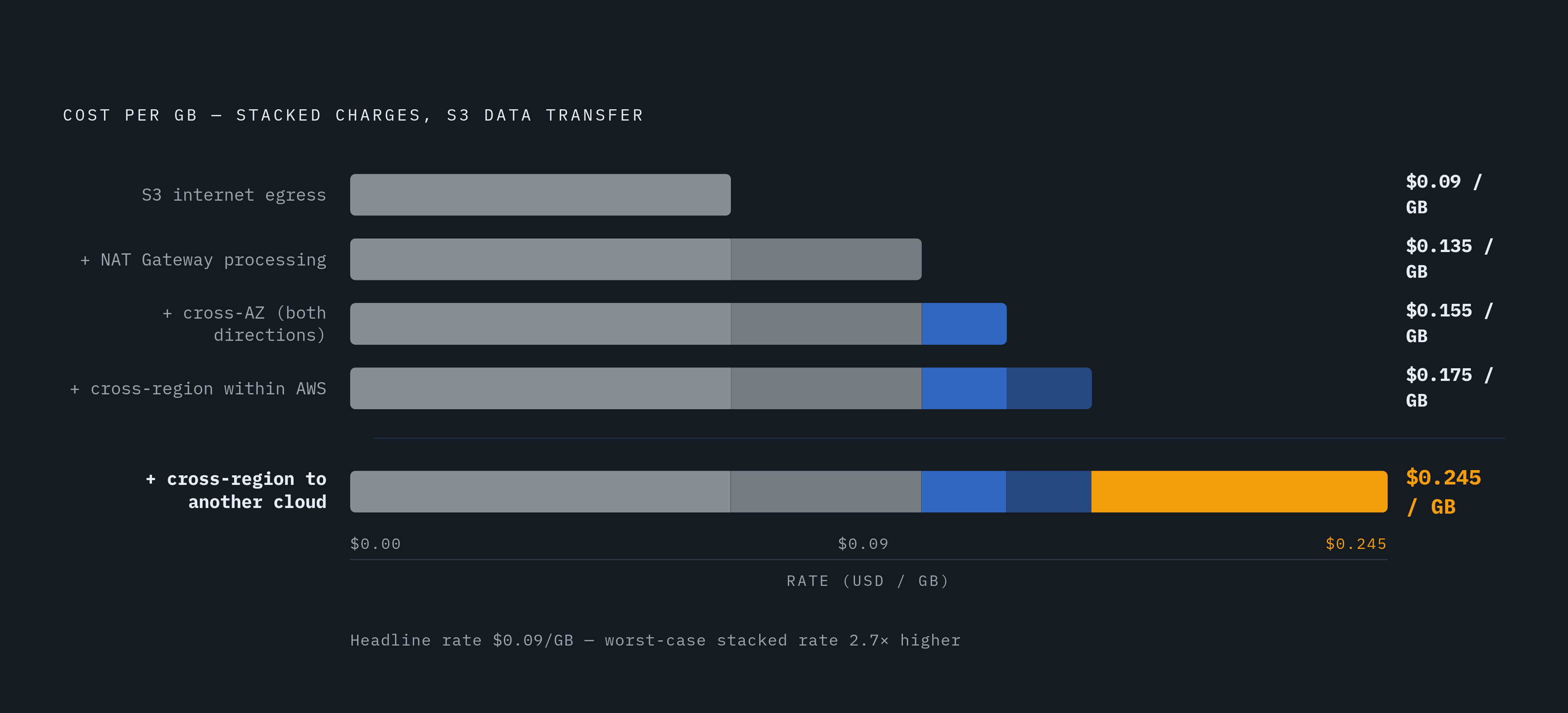
Now here is what doesn't appear on the pricing page anybody actually reads. Routing S3 traffic through a NAT Gateway instead of a direct path costs another $0.045/GB in processing fees, stacked on top of whatever S3 already charged, and this happens by default for EC2 and Lambda sitting in private subnets. Cross-region transfer runs $0.02/GB between AWS regions, and jumps to $0.09/GB the moment that data leaves AWS for another cloud entirely Usage.ai - S3 Egress Cost egresscost.com.
Stacking those together makes the headline rate stop meaning anything. A workload that sends data to the internet, through a NAT Gateway, and across AZs is paying three separate meters on the same gigabyte, and the total bears almost no resemblance to the $0.09/GB number everyone quotes Usage.ai - S3 Egress Cost egresscost.com. Azure Blob charges $0.087/GB and Google Cloud charges $0.12/GB for the first terabyte, so the egress-fee model is structural across every major hyperscaler, not a unique AWS tax akave.com tatacommunications.com.
Before touching any of the fixes below, find out where the money's actually going. Turn on Cost Allocation Tags and pull a Cost Explorer or Cost and Usage Report broken out by service and usage type. Optimizing blind is how teams end up fixing the $0.01/GB problem while the $0.09/GB problem keeps running https://costnimbus.com/article/how-to-cut-aws-egress-costs/. The headline internet-egress rate is $0.09/GB for the first 10 TB/month after 100 GB free, stepping down to $0.085/GB for the next 40 TB and $0.07/GB for the next 100 TB, with volume discounts only mattering at significant scale Usage.ai - S3 Egress Cost Usage.ai - S3 Egress Cost egresscost.com braincuber.com. At those rates, 1 TB/month costs $83.16, 10 TB/month costs $912.60, and 50 TB/month costs $4,394.70 Usage.ai - S3 Egress Cost. Regional variation means Asia Pacific (Singapore) starts at $0.12/GB, a third higher than US/Europe rates akave.com tatacommunications.com. Cross-AZ transfer costs $0.01/GB each direction, or $0.02/GB round trip, invisible in microservices architectures where services are distributed across zones for HA Holori - Guide: 10 Useful Tips About Reducing Cloud Data Transfer Costs in 2026 egresscost.com.
VPC Gateway Endpoints and same-region routing: the fastest, cheapest fix on the list
EC2 and Lambda instances sitting in private subnets route their S3 traffic through a NAT Gateway by default, nobody chose this on purpose, and it tacks on $0.045/GB in processing charges on top of whatever S3 already bills. A VPC Gateway Endpoint sidesteps the whole thing. It opens a private connection over AWS's own backbone straight to S3, no NAT Gateway involved.
The pricing on this one is almost suspicious. Gateway Endpoints are free, the only item in this entire cost structure with a zero attached to it, and they cover both S3 and DynamoDB. Setup takes under five minutes and touches no application code. It's the rare infrastructure change that's pure upside: no tradeoff, no migration, no rewrite.
The same logic extends to physical placement. Kubernetes shops get a version of this too: topology-aware routing (alpha since Kubernetes 1.17, renamed Topology Aware Routing in 1.27) keeps service traffic inside the same zone by default, and AZ-aware load balancer zone affinity settings do the same job without giving up availability.
None of this reduces how much data moves. It just stops taxing the movement that shouldn't have been taxed in the first place. Volume reduction is the next layer. At 10 TB/month through NAT Gateway, the bill is $459/month in NAT processing alone, and routing 75% of that traffic through a Gateway Endpoint drops it to $115/month, a 74% reduction costnimbus.com. Under the same-region routing rule, S3-to-service transfer within the same region is generally free while cross-AZ traffic within the same region is $0.01/GB each direction, so co-locating tightly coupled services in the same AZ eliminates this entirely for stateless workloads Holori - Guide: 10 Useful Tips About Reducing Cloud Data Transfer Costs in 2026. Interface Endpoints (AWS PrivateLink) for other services such as SNS, SQS, Kinesis, and API Gateway carry a small per-hour and per-GB charge, but still far less than internet egress rates for high-volume workloads.
CloudFront as an S3 egress gateway: shifting internet delivery off the $0.09/GB meter
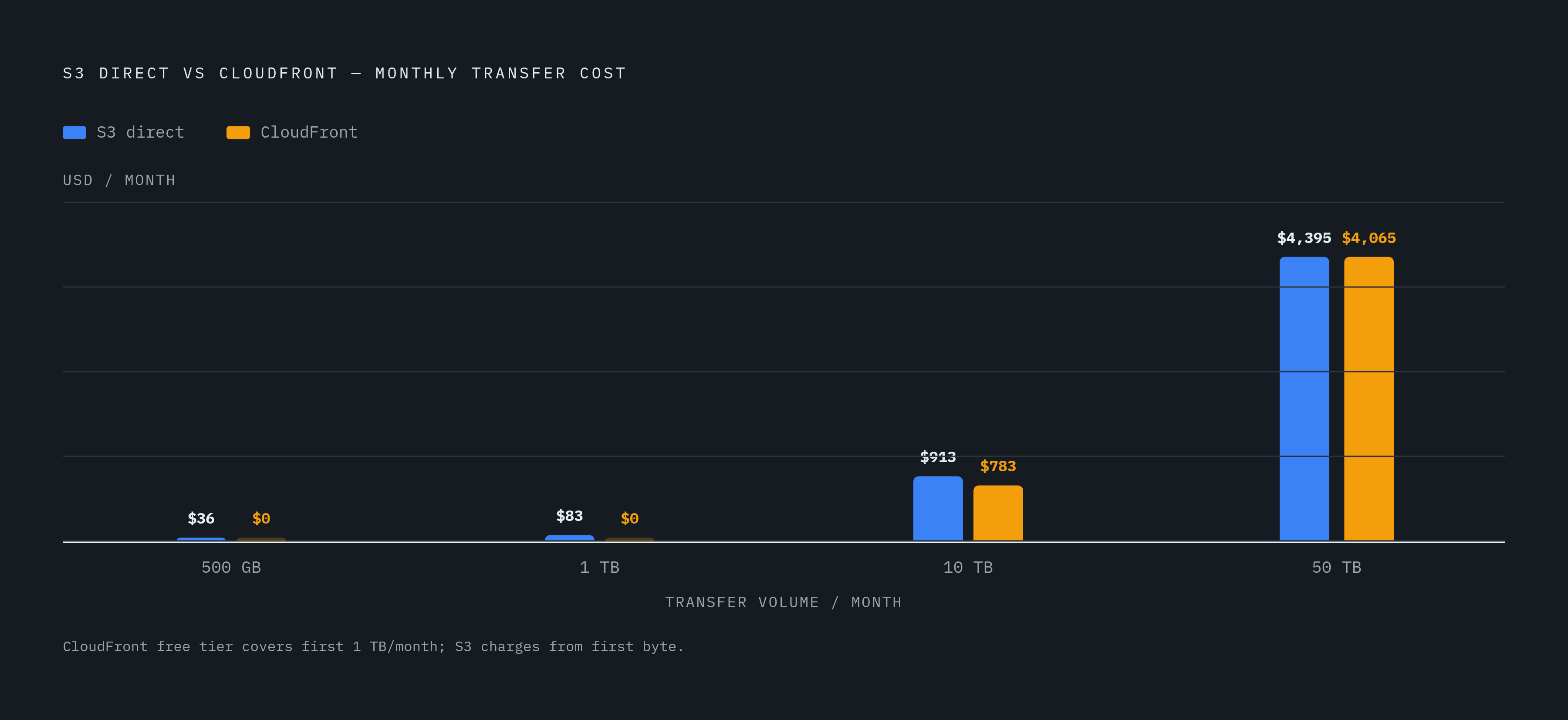
The asymmetry here is almost comedic. Transfer from S3 to CloudFront, its origin, costs nothing, while direct transfer from S3 to the internet costs $0.09/GB Usage.ai - S3 Egress Cost egresscost.com. Every gigabyte served to an end user through CloudFront instead of straight from a bucket is a gigabyte that never touches the S3 egress meter at all Usage.ai - S3 Egress Cost egresscost.com.
The pattern holds at different scales, per a September 10, 2026 update from usage.ai. At 500 GB a month, direct-from-S3 costs $36.00, while CloudFront costs $0.00. At 1 TB, it's $83.16 versus $0.00 Usage.ai - S3 Egress Cost. At 10 TB, direct S3 costs $912.60 against $783.36 through CloudFront, a $129.24 gap Usage.ai - S3 Egress Cost. At 50 TB, it's $4,394.70 versus $4,065.28, a $329.42 difference Usage.ai - S3 Egress Cost. The savings shrink as volume climbs (CloudFront has its own billing beyond the free origin fetch), but they never flip negative Usage.ai - S3 Egress Cost egresscost.com.
Cache hit rate is the lever that decides how big this gets. A CDN configured well, with an 80% cache hit rate, cuts origin requests by 80%, and static assets routinely hit 80 to 95% cache rates in practice impossiblecloud.com CloudZero - Amazon S3 pricing: the complete 2026 guide egresscost.com.
None of that happens automatically, though. Cache-Control headers do the real work: static assets need long TTLs, a year is standard practice if filenames are versioned; cacheable API responses like product catalogs or config data benefit from public max-age settings; anything user-specific needs to stay private-cached only. Compression adds another layer on top: Brotli beats gzip by roughly 15 to 25%, and turning on compression at either CloudFront or the application server meaningfully shrinks text-based responses before they're even counted. CloudFront's delivery-to-viewer pricing varies by edge geography, so model where the audience actually sits before assuming one flat global rate applies. In a startup case study, $250/month in S3 data transfer on 2.6 TB/month of direct downloads was cut by 98% in a single day after routing through CloudFront costnimbus.com. In a Terraform example, price class selection using PriceClass_100 limits edge locations to NA/EU for cost savings when audience is concentrated there braincuber.com.
Reducing what S3 sends: S3 Select, compression, and multipart discipline
Routing fixes address how data travels. This layer addresses how much of it needs to travel at all. S3 Select is the clearest example: instead of pulling down an entire object and filtering it inside the application, the filter logic runs at the storage layer, and billing is based on data scanned and returned, not the size of the whole object. It supports CSV, JSON, and Apache Parquet, with GZip and BZip2 compression handled for the CSV and JSON cases.
Picture the access pattern this fixes: pulling a 10 GB CSV file to process 50 MB of rows that actually matter generates 10 GB of egress for 50 MB of value. Running that same query through S3 Select shrinks the egress to whatever's actually returned, so the savings scale directly with how selective the query is. A highly selective query saves a lot; an unselective one saves almost nothing, which is worth knowing before assuming this is a free win everywhere.
A few housekeeping habits round out this layer, unglamorous but persistent in their savings. Multipart uploads are recommended above 100 MB and should stay single-part below that threshold; incomplete multipart uploads pile up silently and get billed at S3 Standard rates indefinitely unless a lifecycle rule aborts them after a set number of days braincuber.com. Versioning has a similar trap: every version gets stored and billed separately, so a bucket with versioning turned on can balloon well past its apparent size over time, and lifecycle rules to expire old versions and delete markers keep that in check. Replication deserves the same scrutiny: filter rules should replicate only what genuinely needs to live in multiple regions, and periodic review often finds regions that no longer need to be part of the footprint at all, since fewer regions means fewer inter-region flows generating charges. Storage class matters too. S3 Intelligent-Tiering shifts data automatically and can cut storage costs by 30 to 50%, and its small monitoring fee (roughly a quarter of a cent per thousand objects) pays for itself once data starts landing in cheaper tiers CloudZero - Amazon S3 pricing: the complete 2026 guide.
Where AI workloads break the standard egress model
AI doesn't get a discount. Training pulls, model weight transfers, and inference streaming all bill at the exact same per-GB rate as any other traffic; what's different is the shape and sheer repetition of the traffic. That repetition is where the bill quietly explodes.
Take model checkpoint re-pulling. Attach a persistent volume to the inference node instead, and that entire cost disappears, because the weights simply stay put spheron.network.
Training data behaves the same way. Running a 10 TB dataset through a pipeline once costs roughly $900 in egress, but multi-cloud or cross-region setups involving repeated runs, re-reads, restores, and exports on that same dataset can push monthly costs toward $4,000 akave.com aurorainfra.ai. The billing event is every single pass through the data, not the dataset's size akave.com aurorainfra.ai. For multimodal pipelines, high-frequency streaming APIs, or anything that re-pulls weights on a loop, bandwidth alone can eat past 20% of total monthly cloud spend, according to spheron.network.
The structural answer is unglamorous but effective: put compute where the data already lives. Training and inference should run in the same region, and ideally the same AZ, as the bucket feeding them, because cross-region pulls are almost always a choice, not a requirement. Teams that build custom ETL to stage data before training often pay egress twice, once moving the data into position and again when training reads it, and cutting the staging step out entirely removes one of those charges completely.
AWS-native services that reduce AI egress by keeping more work inside S3
AWS has been shipping tools that quietly attack this exact problem, not by discounting egress, but by keeping more of the work from ever needing to leave S3 in the first place. S3 Vectors, generally available since December 2025, lets vector embeddings live and get queried directly inside S3, scaling to 10,000 indexes per bucket, and AWS claims cost reductions of up to 90% versus running a standalone vector database CloudZero - Amazon S3 pricing: the complete 2026 guide CloudZero - Amazon S3 pricing: the complete 2026 guide. That saving is really an egress saving in disguise: querying inside S3 means the traffic that would've flowed to a separate vector database never happens.
Amazon S3 Files, generally available since April 7, 2026 and live in 34 AWS Regions, gives buckets native NFS access with full POSIX semantics, backed by a caching layer that keeps active data close while the full dataset stays in S3 computingforgeeks.com builder.aws.com. It runs on the same infrastructure as Amazon EFS, and its whole design goal is killing the copy-process-copy-back loop that ML data prep and agentic pipelines tend to fall into computingforgeeks.com builder.aws.com. Mountpoint for Amazon S3's CSI Driver v2, out since August 2025, adds caching across multiple pods, and large workloads finish up to twice as fast simply because pods stop each independently re-fetching identical data from S3 aws.amazon.com CloudZero - Amazon S3 pricing: the complete 2026 guide. Every one of those redundant fetches was redundant egress, so cutting the fetch cuts the cost.
S3 Storage Lens, updated with performance metrics at re:Invent 2025, can now analyze billions of prefixes for cost allocation and lifecycle tuning, and for AI and ML pipelines where slow storage drags down GPU utilization, the slowness is visible in that data as a root cause CloudZero - Amazon S3 pricing: the complete 2026 guide. Slow storage and inefficient access patterns tend to travel together, and inefficient access patterns are usually excess egress wearing a different hat CloudZero - Amazon S3 pricing: the complete 2026 guide. Another tool for completeness is S3 Transfer Acceleration, which routes large transfers over AWS's global network when neither co-location nor CloudFront is an option. It won't lower the per-GB rate, but it cuts transfer time and retransmission waste on big objects. The thread running through all of these: keep the processing inside AWS's own network, where S3-origin traffic is free or nearly so, and the egress savings occur as a byproduct of better architecture rather than a special discount anyone had to ask for.
Storage-agnostic caching layers as an alternative to AWS-native lock-in
Every fix above assumes the workload stays inside AWS CloudZero - Amazon S3 pricing: the complete 2026 guide. Plenty don't. Egress out of S3 to another cloud still costs the full $0.09/GB, and any team running workloads split across AWS, GCP, Azure, or Cloudflare R2 pays that internet-egress rate on every single cross-cloud transfer, no exceptions Usage.ai - S3 Egress Cost egresscost.com. S3 Files and the other AWS-native tools above don't touch this problem, because they were built to keep things inside AWS, not to bridge across clouds Usage.ai - S3 Egress Cost egresscost.com.
Mount object storage, whether S3, GCS, Azure Blob, R2, or any S3-compatible bucket, as a POSIX filesystem backed by a local NVMe cache. A cache hit serves in sub-millisecond time and generates zero S3 egress; a cache miss pulls from the bucket once and caches it for next time, with the bucket itself remaining the single source of truth. That distinction matters enormously for AI training specifically, since a job reading the same dataset repeatedly only pays egress on the first read per node, and every read after that comes from local cache at no cost, which directly targets the repeated-read pattern driving so much of the AI egress described earlier.
For this to actually work in production, the filesystem semantics have to be real, not approximate: atomic rename, flock and fcntl, mmap, fsync, hard links, symlinks, and sparse files, so that existing training scripts and data pipeline code run unmodified with no SDK rewrite required. That same architecture extends naturally to agentic pipelines, where serverless execution sitting alongside the filesystem lets agent-written code run against cached data without spinning up a separate sandbox, while persistent context carries across sessions. And because the mounting mechanism is identical across S3, GCS, R2, and Azure Blob, with no migration, no ETL, and no duplicate copies, teams can stop building the very data-movement pipelines that were generating a second round of egress charges before training or inference ever started. That's not a discount on the existing bill. It's removing a category of spend that shouldn't have existed in the first place.
Sources
- Holori - Guide: 10 Useful Tips About Reducing Cloud Data Transfer Costs in 2026
- Amazon S3 pricing: the complete 2026 guide
- S3 Egress Cost: Pricing, Architecture and Savings
- Amazon S3 Pricing Explained | Pricing, Storage & Savings 2026
- 12 Proven Strategies to Reduce Cloud Egress Costs (2026)
- How to Cut Your AWS Egress Bill by 80% (Without Changing Your App)
- tatacommunications.com
- akave.com