S3 Storage Class Transition Latency and Cost Impact
Transition charges and hidden fees can overwhelm the savings lifecycle policies promise.
Lifecycle policies get sold as a savings feature. Set a rule, let objects age into cheaper storage automatically, watch the bill shrink. What actually happens is that the rule fires a separate, billable event every time it moves an object, and that charge sits right next to the savings it's supposed to generate. A policy can be running exactly as configured and still produce a bill nobody expected.
S3 pricing isn't one number. AWS breaks it into storage, request and retrieval, data transfer and transfer acceleration, data management and insights, replication, and transform and query charges. Six dimensions, billed at the same time, not sequentially. Most teams track the storage line because it's the one that shows up as a tidy per-GB rate on a dashboard. The other five get discovered when a bill arrives looking heavier than the storage math predicted.
This trap is sharpest at scale. A lifecycle policy applied to a brand-new bucket lets transition charges trickle in as objects age naturally. A lifecycle policy applied retroactively to a dataset already sitting in the bucket, millions of objects deep, transitions every eligible object in the same billing window. One rule, one afternoon, one invoice spike. The rest of this piece walks through where those charges come from, where they compound, and where an architectural fix sidesteps the problem instead of just budgeting around it.
What each S3 storage class is optimized for
AWS organizes storage into eight classes, and each one trades latency, availability, and durability against per-GB price in a different ratio. Knowing the trade-off is the only way to judge whether moving data between classes is worth what that move costs.
S3 Standard is the baseline: general-purpose, highest availability, lowest latency, and the highest per-GB rate of the group. Everything else in the lineup is a variation on giving something up in exchange for a lower rate.
S3 Express One Zone sits at the performance end. It delivers single-digit millisecond access and lives in a single Availability Zone through a directory bucket type rather than a standard general-purpose bucket. Requests cost less than Standard and run faster, but there's no multi-AZ redundancy behind it.
S3 Intelligent-Tiering watches how data gets accessed and shifts objects automatically between Frequent Access, Infrequent Access, Archive Instant Access, and two optional archive tiers. The automatic tiers carry no retrieval charge, and the trade is a monthly monitoring and automation fee on any object over 128 KB.
S3 Standard-IA and S3 One Zone-IA are built for data that's accessed rarely but needs to answer fast when it is. One Zone-IA shaves the cost further by giving up the second Availability Zone, so it can't absorb an AZ failure the way Standard-IA can.
Data touched about once a quarter fits S3 Glacier Instant Retrieval, with archival pricing and millisecond access built in. S3 Glacier Flexible Retrieval suits data touched once or twice a year, with retrieval windows stretching from minutes to many hours. S3 Glacier Deep Archive is the floor on price across the entire lineup, meant for data touched less than once a year, including long-term regulatory retention, with retrieval that can take a day or more.
The spread between Standard and Deep Archive is wide enough that storage class choice dominates the entire storage line item on its own. That spread is why teams reach for aggressive lifecycle rules to chase it, and why the mechanics of the transition itself deserve as much attention as the destination class.
How transition request charges accumulate
Moving an object between classes, whether a person triggers it manually or a lifecycle rule does it on schedule, is a PUT or COPY request, and PUT and COPY requests cost money. AWS states on its pricing page: "There are per-request ingest charges when using PUT, COPY, or lifecycle rules to move data into any S3 storage class. Intelligent-Tiering is the one exception: its internal moves between access tiers add no extra per-request or tiering charge beyond the monthly monitoring fee already baked into the service.
The charge is per object, not per byte. That distinction matters enormously depending on what the data actually looks like. A dataset made of a few enormous files barely notices transition charges. A dataset made of millions of small files, tokenized text chunks, individual training images, pays the transition fee millions of times over, regardless of how little total data volume those files add up to.
Lifecycle rules run on a schedule, and that schedule doesn't care how the data got there. A rule applied to a dataset that's already sitting in a bucket, rather than one that accumulates naturally over time, transitions every eligible object in the very first cycle after it activates. That's a lump sum rather than a gradual cost curve.
For AI training sets structured as huge numbers of small files, this is where the math can flip. The per-object transition charge, multiplied across a dataset with millions of entries, can outpace whatever the cheaper storage class was supposed to save in that first billing month. The rule did its job. The bill just arrived faster and bigger than the savings did.
Minimum storage duration charges and early-deletion penalties
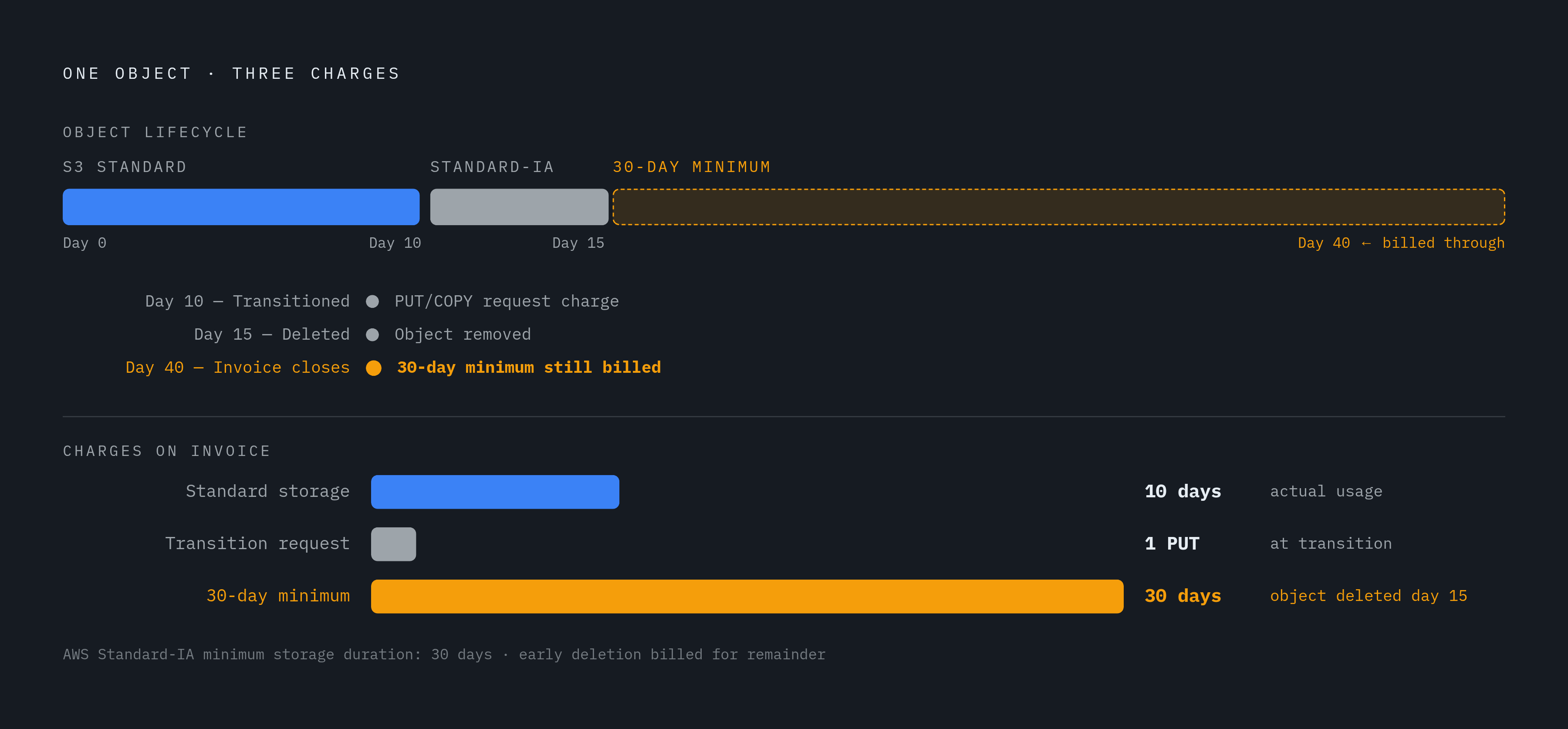
Cheaper storage classes come with a catch beyond the transition fee: a minimum amount of time AWS expects to bill you for, whether or not the data sticks around that long. S3 Standard-IA and One Zone-IA carry a 30-day minimum storage duration. Deleting or transitioning an object out before that window closes still bills the remaining days, pro-rated at the class rate. The Glacier classes carry minimum durations longer than 30 days, with the same early-exit penalty applied to whatever time was left on the clock.
Picture a team that sets a lifecycle rule moving objects from Standard into Standard-IA. A downstream pipeline, built for a different purpose, deletes those same objects a few days later because the data was only ever needed temporarily. That team now owes Standard rates for the days the object spent in Standard, IA rates for the full 30-day minimum even though the object is long gone, and the transition request charge from the move itself. Three charges, one short-lived file.
There's a second floor sitting underneath the first one. Standard-IA and One Zone-IA both carry a minimum billable object size of 128 KB. An object smaller than that gets billed as if it were 128 KB, no matter how small it actually is. Combining the size floor with the duration floor compounds the two penalties directly: small objects that don't survive 30 days get charged for storage they didn't use and size they don't have.
Workloads built around many short-lived small objects run straight into this combination. Inference logging and checkpoint saving are two of the most common patterns that generate exactly that shape of data, lots of small files, often deleted or overwritten well inside a month. A well-intentioned lifecycle rule can cost more here than leaving the data in Standard and not touching it.
Where S3 Intelligent-Tiering saves money
Intelligent-Tiering exists to solve the two problems above at once: no manual rule writing, and no retrieval charge on its automatic tiers. For a lot of workloads that's a genuinely good trade. But it has edges, and the edges line up almost exactly with the small-object patterns common in AI pipelines.
The monitoring and automation fee only applies to objects larger than 128 KB. Objects smaller than that threshold skip monitoring entirely and sit permanently at Frequent Access tier rates, no monitoring fee, but also no tier savings, ever. For a bucket where most objects fall under 128 KB, tokenized training chunks, small image patches, individual log records, Intelligent-Tiering ends up charging Standard pricing without giving back Standard's operational simplicity. None of those objects are going anywhere.
The service earns its keep where access patterns are genuinely hard to predict: data lakes, user-generated content, analytics targets that get queried on an irregular schedule. In that setting, automation reacting to real access beats a lifecycle rule guessing at a schedule in advance.
The service loses its edge at both extremes. Data that's always hot doesn't need monitoring, because it's never going to move. Data that's genuinely archival and never touched doesn't need monitoring either, because it's never going to move back. In both cases, a static class assignment costs less than paying a monitoring fee for a decision that was never going to change. And for buckets with very high object counts and low data volume per object, the monitoring fee per object can exceed whatever savings the actual tier movement would deliver.
Whether the access pattern of the data matches the cost structure built into that class, including a class's automation, its minimums, and its retrieval behavior, matters more than which class is cheapest. Which raises the dimension no S3 invoice line item captures at all: how long a request actually takes to come back.
Retrieval latency as a cost that does not appear on the S3 invoice
For AI training and inference, the wrong storage class drives up idle GPU time, a cost invisible on any billing dashboard. That idle time still costs money. It just gets billed through compute spend instead of storage spend, so it's easy to miss when the only thing being audited is the S3 line item.
Every S3 request carries a time-to-first-byte overhead before any actual data starts moving. For large files, that overhead is a rounding error against the transfer time. For small files, it's the opposite: TTFB dominates the whole request, almost regardless of how small the object actually is.
A dataloader pulling thousands of individual training samples, one tokenized chunk at a time, spends most of its wall-clock time waiting on that overhead rather than moving bytes. GPUs sit idle through every one of those waits, and idle GPU time is one of the most expensive line items in any training budget.
Shifting that same training data into Standard-IA or Glacier to cut the storage bill adds exactly the wrong kind of friction: retrieval latency and retrieval fees both climb, and either one alone can cost more in stalled GPU cycles than the storage class ever saved. Cloudian's guide to avoiding storage bottlenecks in AI environments makes this point directly: a storage bottleneck in an AI pipeline is not an I/O inconvenience but a compute multiplier. Every second a GPU waits on a slow read is a second of rented compute producing nothing.
Glacier Flexible Retrieval and Deep Archive make the stakes concrete. Flexible Retrieval adds delays ranging from minutes to many hours. Deep Archive adds 12 to 48 hours. For any dataset a training job might need on short notice, those classes don't just save on storage, they convert that saving into a job stall measured in hours or days.
Filesystem cache layer and the storage class trade-off
The traditional fix for this latency problem is staging: copy cold data into a faster tier before the training run starts, let the job read from there, then clean up. It works, but it adds a data-movement step that takes time, eats egress bandwidth, and bolts another layer of complexity onto the pipeline.
A caching layer sitting between compute and the bucket removes the staging step. Reads that hit the cache get served from NVMe at local speed. Reads that miss fall through to the source storage class, wherever that class happens to be, Glacier tier included. The job starts immediately against a filesystem path instead of waiting on a pre-staging copy, and the cache fills in as the job runs.
What this buys is a genuine decoupling: the bucket stays the source of truth, and data lives in whatever class is cheapest for its actual access frequency, while the cache absorbs the latency gap without requiring a migration step or an ETL pipeline bolted on the side. The storage cost decision and the access latency decision stop being the same decision.
The interface matters as much as the caching itself. Training pipelines, dataloaders, and agent workloads written against ordinary filesystem paths run against a cache like this unmodified: no SDK rewrite, no porting effort to adapt code to the S3 API. That removes one of the oldest objections to treating object storage as a primary layer for training data in the first place, the assumption that cheap storage means a slow, awkward interface bolted on top of it.
Retrieval fees on Glacier classes
Glacier-tier classes don't stop at a retrieval delay. They also charge a per-GB retrieval fee on top of the request charge itself, and that fee is where a lot of archival cost planning quietly comes apart. Standard-IA, One Zone-IA, and all three Glacier classes carry this per-GB retrieval charge. Standard and Intelligent-Tiering's automatic tiers do not.
The entire economic case for an archival class rests on a bet about how often the data will actually get touched. If retrieval stays as rare as the class assumes, the storage saving comfortably outweighs the occasional retrieval fee. If the data gets pulled more often than planned, the retrieval fees stack up fast enough to erase that saving inside a single billing month.
This is exactly the trap that catches data labeled "cold" that turns out not to be. A dataset archived for compliance gets pulled for an audit. A model's old training set gets pulled again for a retraining run. An evaluation set assumed dead gets reused to benchmark a new model. In every case, the data wasn't actually cold, it was just unused for a while, and the Glacier bet assumed those two things were the same.