Hybrid Cloud Storage Architecture Patterns
AI workloads demand different storage at each stage, making hybrid architecture a deliberate choice.

A manufacturing enterprise spent 12 years migrating to the cloud, repatriating workloads, and absorbing acquisitions, and ended up with an architecture nobody actually chose: a mix of public cloud, private infrastructure, and on-premises systems that reflected history rather than intent, a pattern close to the industry norm, since 82% of enterprise workloads ran in hybrid cloud environments in 2024 and most of those setups were never designed, they were accumulated. Three migration attempts, two repatriation efforts, and a round of acquisition integrations can produce a hybrid footprint just as easily as a deliberate architecture review can, except one of those paths leaves you with operational scar tissue and the other leaves you with a system you understand.
The change underway in 2026 is cloud-first losing its status as the default setting nobody questions. TechBlocks points out that what worked fine for experimentation does not hold up once workloads reach real scale. That distinction matters because it reframes hybrid cloud storage from a fallback position into an actual design discipline, the kind of thing you plan on a whiteboard instead of discover during a postmortem.
Three forces are doing the pushing. AI workloads behave differently at each stage of their life: training wants elastic GPU capacity that only public cloud can supply on demand, fine-tuning needs enterprise data that has to stay inside private environments, and inference needs to sit close to users for low latency. No single environment satisfies all three at once. Data gravity has also turned from a preference into a physical constraint: once a dataset gets large enough, hauling it to compute costs more in egress fees, latency, and compliance exposure than moving the compute to the data instead. Regulatory requirements also keep tightening, and for specific categories of healthcare, finance, and government data, public cloud just can't resolve this. Put those three together: hybrid stops happening to you, and you start drawing it up on purpose.
The three workload characteristics that justify a hybrid architecture
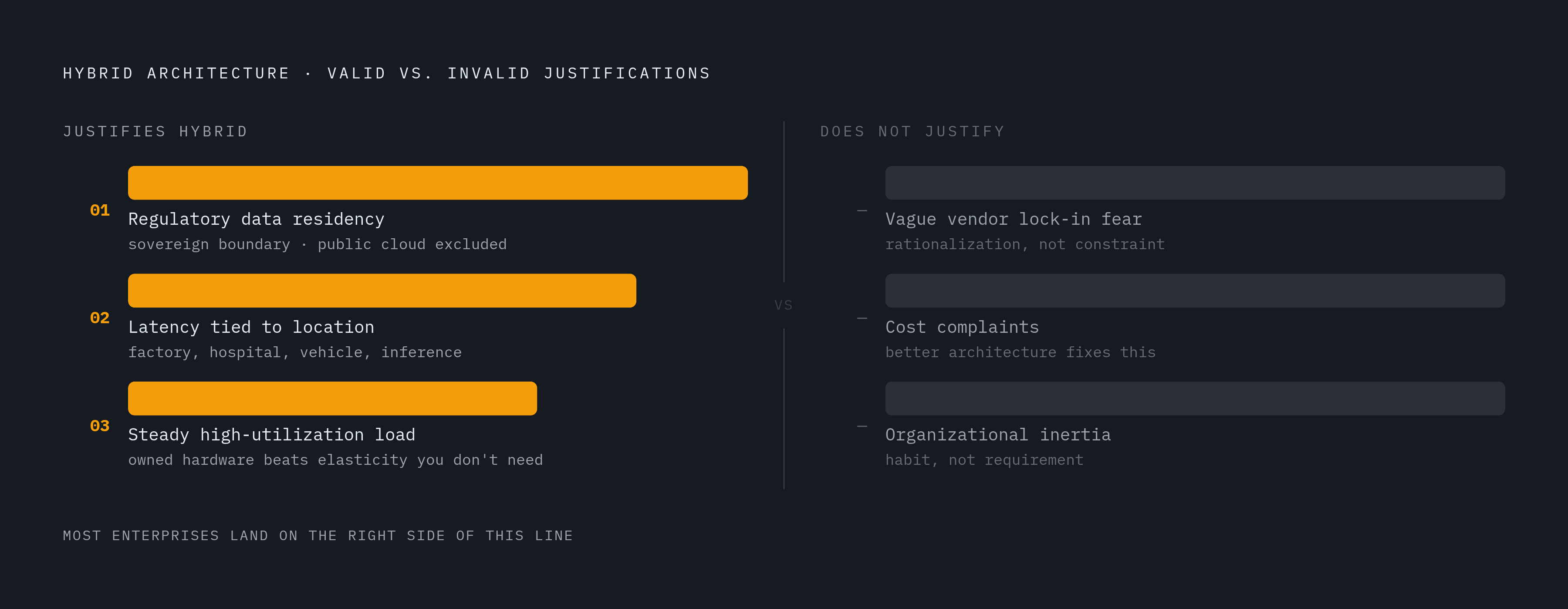
Not every workload earns a hybrid architecture, and treating hybrid as a default is how enterprises end up paying for two environments without getting the benefit of either. Exactly three workload characteristics justify the complexity. Everything else should converge onto a single environment, or you accept its inefficiency openly instead of dressing it up as strategy.
The first characteristic is regulatory data residency, and public cloud cannot satisfy it. Government data, certain healthcare records, and specific financial data categories have to stay inside a defined sovereign boundary for audit and compliance reasons that no cloud contract can paper over. This requirement has gone from a niche concern to a mainstream one fast: 50% of European organizations plan to adopt sovereign cloud solutions in 2025 specifically to meet compliance needs. When this condition applies, the line between what stays on-premises and what goes to the cloud is categorical, fixed in advance rather than negotiated workload by workload.
The second characteristic is latency sensitivity tied to a physical location. If you run a factory floor, an autonomous vehicle system, a hospital, or a retail store, you can't wait on a round trip to a data center somewhere else when decisions need to happen instantly. TechBlocks singles out inference workloads as the most sensitive to latency and user proximity, which explains why inference is usually the first AI stage to move toward the edge or into private environments.
The third characteristic is steady, high-utilization load with predictable demand, where you simply pay less for dedicated hardware than for cloud elasticity you don't need. If a workload runs at sustained high utilization around the clock with a load curve you can set your watch to, owned hardware usually wins on cost. Cloud still earns its keep for anything variable or bursty. On-premises or colocation handles the steady base.
None of the usual anxieties belong on this list. Vague fear of vendor lock-in, cost complaints that better cloud architecture would fix anyway, and plain organizational inertia: none of this justifies hybrid. They just produce a hybrid environment that runs badly, because the strategy got rationalized after the fact instead of designed up front.
Choosing hybrid for the right reasons still comes with a bill. Expect operational complexity spread across two environments, integration overhead from VPNs, dedicated interconnects, and federated identity, the cost of keeping two distinct skill sets on staff, and tooling that fragments across platforms. None of that is disqualifying on its own. It's just a bill that needs pricing in up front, because teams that back into hybrid by accident tend to discover these costs only after they've already been spent.
How AI training pipelines exposed storage as the actual bottleneck
AI training has turned storage into the main performance constraint inside hybrid architectures, for a straightforward reason: GPUs can chew through data much faster than most storage systems were ever built to deliver it. It's an old mismatch finally getting tested hard enough to show.
Most enterprise storage was built for transactional work, consistent IOPS and quick access to structured records sitting in a database. It was never built for the sustained, high-throughput sequential reads that a training pipeline demands hour after hour. Training and inference, in fact, want almost opposite things from storage. Training wants raw throughput, sequential reads across enormous data sets at maximum bandwidth. Inference wants speed of a different kind: fast, random access to model weights and context, often under real-time serving pressure. A single storage tier rarely satisfies both, part of why the tiered model covered next exists.
The industry has taken notice at a level that reaches boardrooms, not just infrastructure teams. At Google Cloud Next 2026, Google expanded the storage layer of its AI Hypercomputer architecture, adding higher-performance file services, faster shared storage, and new metadata intelligence capabilities. The move amounts to a public admission that storage is now an active contributor to AI performance rather than a passive shelf sitting behind the compute layer.
Timing makes this harder, not easier. The storage industry is dealing with a global shortage of NAND flash memory, and that shortage is pushing prices and lead times up across the board. Flash-to-disk cost ratios are shifting fast enough that an all-flash approach to every tier is turning into a liability most enterprises can't afford to carry for cold or warm data. Storage tier selection was always workload-specific. What's new is that getting it wrong now costs enough, in both dollars and missed performance targets, to be visible well above the infrastructure team.
The tiered storage model that hybrid architectures are converging on
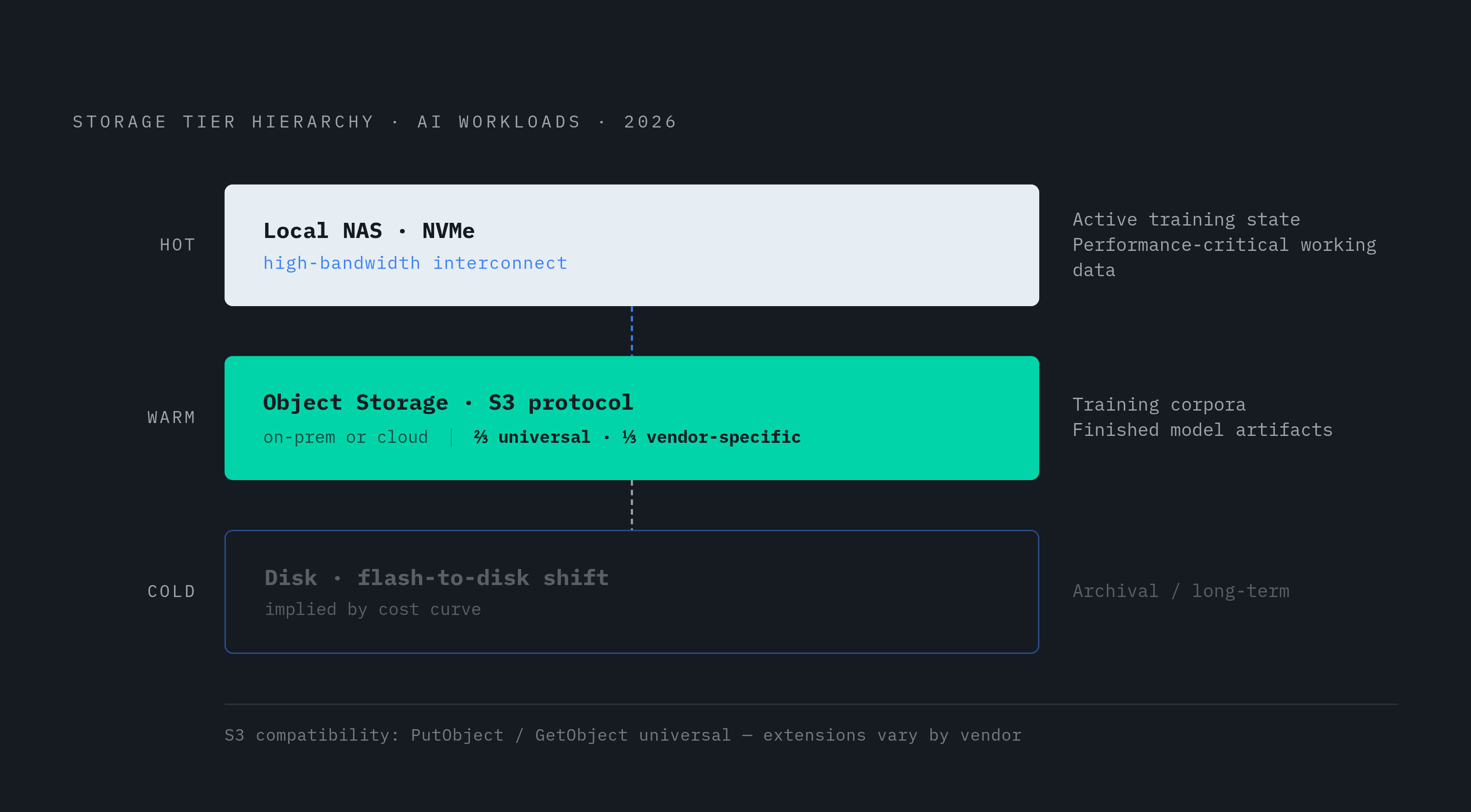
Hybrid storage architectures in 2026 are settling on a three-tier model that places data on specific media based on how often it's accessed and how fast it needs to respond, not on whatever happened to be easiest to administer. That structural answer is what makes the "storage is the bottleneck" problem solvable instead of just alarming.
The hot tier handles performance-critical working data on local NAS, running NVMe over high-bandwidth interconnects for anything that can't tolerate delay. The warm tier covers data you access regularly but that isn't latency-sensitive; this is typically object storage, whether it sits on-premises or in the cloud. AI workloads split cleanly along these same tier lines: training corpora live in object storage because that's where scale and throughput both work in your favor, the active training run's working state lives on block or NVMe storage for speed, and finished model artifacts move back to object storage for serving and version history.
S3 has effectively become the common language of storage, to the point that even NAS vendors now expose S3 endpoints on their own hardware. That's what makes the warm tier the practical connective layer between environments, the place where different systems can actually talk to each other without a translation project.
That compatibility has real limits, and understanding where it breaks matters before building a pattern on top of it. Core operations like PutObject and GetObject work the same way across vendors. But roughly a third of the full S3 surface consists of vendor-specific extensions: event notifications, specialized encryption schemes, IAM integration, requester-payer configuration, and these don't carry over. Applications that stick to core operations move freely between environments.
The broader trend favors software that automates data placement across flash and disk under one management layer, so it replaces the older approach of separate arrays and manual migration jobs. If a dataset grows past a certain size, manual migration gives you exactly the kind of operational guesswork that stops scaling.
The sovereign core pattern: when the data must not leave
The sovereign core pattern fits workloads that carry data residency, key custody, or audit requirements no public cloud contract can satisfy, and it should apply only to those specific workloads, with everything else deliberately routed to the cloud. Applying it wholesale, out of caution, defeats the purpose and recreates the cost hybrid was supposed to solve.
Structurally, you keep identity roots, key management, and systems of record inside your private infrastructure. Public cloud picks up elastic analytics, non-sensitive bursts of demand, and anything where residency was never a constraint. The trust boundary is the actual design feature here. It gets enforced at ingress and egress, mechanically, every time, not by default permission that happens to work out. So you need a data classification policy enforced at every point data enters or leaves, key management and rotation centralized inside the boundary, immutable audit logs kept inside it as well, and controlled export pathways that require an approval trail for anything crossing out.
The real risk in this pattern is weak transfer governance: if the boundary isn't enforced mechanically, exceptions pile up quietly, and the sovereign guarantee erodes over time without any single decision ever being made to break it. Nobody signs off on the failure. It just accumulates, one exception at a time.
Industrial edge deployments show this pattern working outside the compliance context entirely, just through plain data gravity. Instead of shipping 1.5 GB of raw sensor data to the cloud, a gravity-aware design sends a 5 KB JSON packet with just the health score and defect indicators, a thousand-to-one cut in data moved. A ResearchGate case study found that a data gravity-aware placement framework cut unnecessary cloud transfers by 32 to 35%, because the raw data was too large and too sensitive to move in the first place.
For AI workloads, this pattern lines up with the fine-tuning stage specifically. If enterprise training data can't leave the sovereign boundary, it has to stay inside it. The base model, being lighter and less sensitive, moves into the boundary for the training run itself, and only the fine-tuned artifact that comes out the other end gets registered to a central artifact registry. The sensitive data never travels. Only the result does.
The split-plane governance pattern: separating policy from execution
The split-plane pattern fits enterprises running a mixed portfolio of workloads with different sensitivity levels and different placement needs, and it solves the single most common failure in that situation: policy that applies consistently in theory but drifts apart in practice across environments.
The pattern divides the system into two planes. The control plane, covering identity, the policy engine, and the audit store, runs in private infrastructure and stays centralized and authoritative. The execution plane splits by workload type: regulated and stateful workloads run in private cloud, elastic and non-sensitive workloads run in public cloud. The advantage is that governance stays consistent even when execution doesn't. One policy layer covers both planes, so your audit trails stay unified even when the work happens in two different places.
The risk sits in the connection between the two planes rather than in either one alone. As execution environments evolve on their own schedules, the interfaces linking control and execution can go stale, and policy enforcement weakens at the edges, often without anything obvious breaking to signal it. Nothing crashes. Enforcement just gets quietly thinner.
TechBlocks frames this as a shift from managing environments to engineering platforms: golden paths replace one-off builds, policy-driven deployments enforce compliance before changes go live rather than after, and cost visibility runs continuously as part of normal operations instead of appearing as a surprise at the end of the month.
A specific set of tools makes this pattern workable in practice. Kubernetes acts as the workload abstraction layer, letting containerized workloads run in either environment with the same operational patterns. Google Distributed Cloud (formerly Anthos and GKE Enterprise), Azure Arc, AWS Outposts, and Red Hat OpenShift all extend cloud-native patterns onto on-premises infrastructure, and available deployment data shows single-pane management through Azure Arc or AWS Outposts cuts admin time by 40%. Federated identity, through something like Microsoft Entra ID or Okta, has to work across both environments, because managing identity separately per environment stops being workable once the footprint grows. Cross-environment observability tools such as Datadog, Dynatrace, Grafana Cloud, or New Relic give one unified view across both planes.
The cloud-native burst pattern: matching elastic compute to where data already lives
The burst pattern keeps steady-state workloads running on dedicated on-premises infrastructure, and when you need it, it lets variable or peak demand spill into the cloud. Its cost advantage only materializes under one condition: the data layer has to be ready for that burst compute to start immediately, without a migration step standing in the way first.
The common failure mode runs in the opposite direction. Burst compute gets provisioned in the cloud correctly, on schedule, and ready to go, but the data it needs is still sitting on-premises and has to be copied over before the job can actually start. That copy step erases most of the savings the pattern was supposed to deliver, because the business ends up paying for idle cloud compute while the data catches up, plus the egress cost of moving it there. The pattern depends on the data already sitting where the burst compute will land, or at minimum reachable through the warm tier's shared object storage layer, rather than locked inside a system that treats cloud bursting as an afterthought. Getting that part right is what decides whether this pattern pays for itself or just adds a third environment to manage.