S3-Compatible API Ecosystem
Most vendors claim S3-compatibility but implement wildly different feature sets.
Nobody certifies this claim. There's no standards body handing out badges, no auditor checking boxes. Two vendors can slap "S3-compatible" on a landing page and mean completely different things by it, and both of them would be telling the truth.
Real compatibility needs three pieces working together, and most vendors nail one or two, not all three. The wire format has to match S3's URL structure, its headers, the XML it sends back, and the error codes that client libraries actually branch on. Authentication has to work the same way too, using AWS Signature Version 4, just with keys issued by whoever's running the system instead of AWS. And the data model has to hold up: buckets, keys, prefixes, metadata, plus consistent behavior when something gets overwritten or deleted.
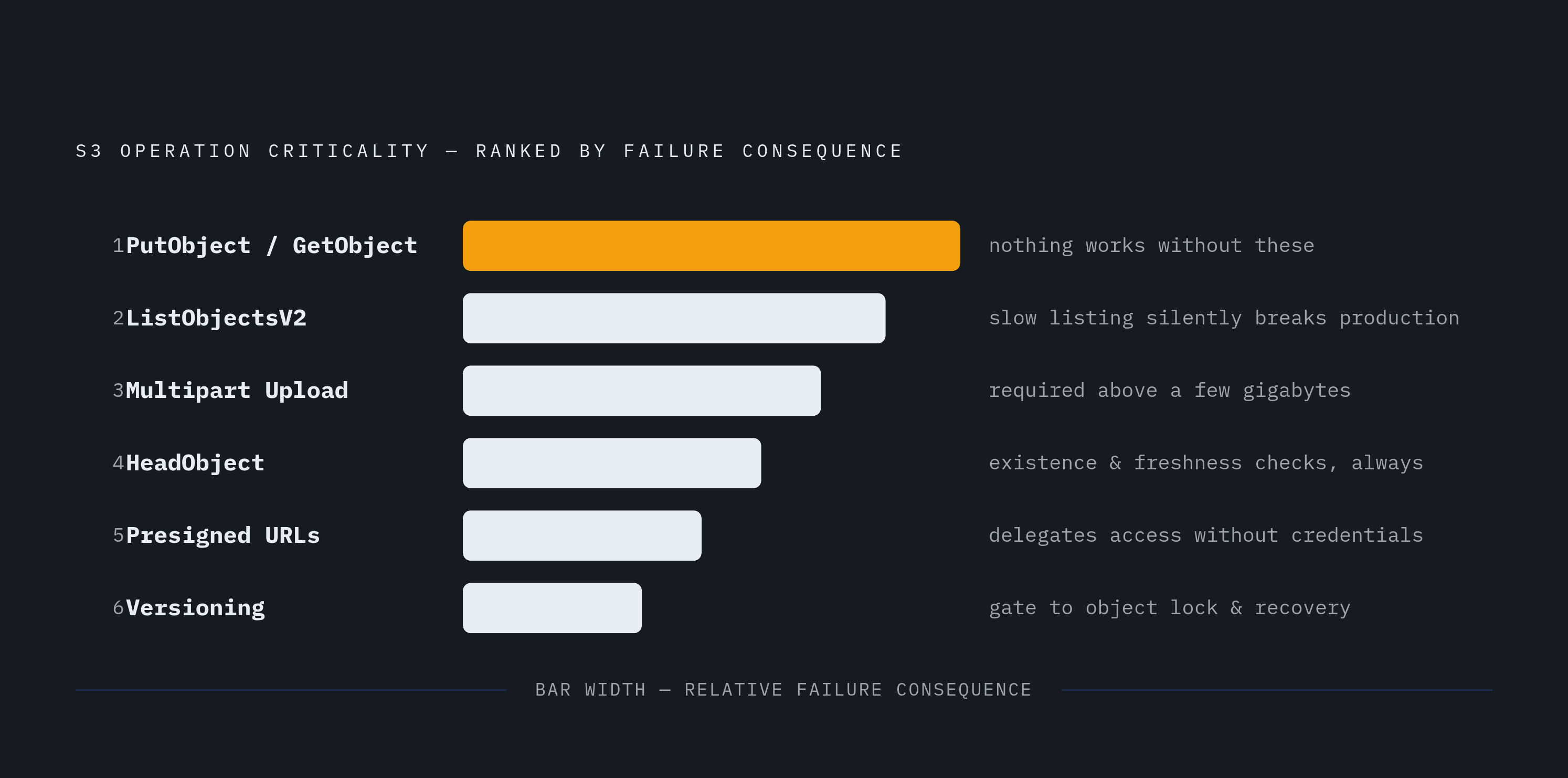
A small handful of operations carry almost all the real-world traffic, and if a vendor fumbles any one of these six, don't bother with the rest of the spec sheet. PutObject and GetObject are the basic unit of every workload. ListObjectsV2 is where slow listing on buckets with millions of keys quietly breaks things in production. Multipart upload matters for anything above a few gigabytes and is the main lever on ingest speed. HeadObject gets used constantly for existence and freshness checks. Presigned URLs are how apps hand data to users without sharing credentials. Versioning is a prerequisite for object lock and most recovery workflows.
Past that core list, things fragment fast: object lock, lifecycle policies, bucket policies, IAM-style access control, server-side encryption, cross-region replication, tagging, CORS. This is where most implementations quietly diverge, and it's also where most buyers stop reading.
So skip the marketing page. Ask for the actual supported-operations list, the API reference. If a vendor can't produce one, that tells you everything you need to know before the sales call even ends.
Where compatibility gaps reliably show up in production
Gaps rarely show up in a proof of concept. They show up three months in, usually around 2 a.m., which is its own kind of consistency.
AWS S3 has offered strong read-after-write consistency for every request since December 2020. Some older or geographically distributed systems are still eventually consistent, meaning a write might not show up in a read a split second later. Any application built after 2020 that assumes the newer guarantee will break against one of those systems, and it won't be obvious why until someone's tracing a race condition at midnight, half-asleep, blaming the wrong service.
Object lock deserves a second look, maybe a third. Plenty of systems implement the API surface for it without actually enforcing the lock at the storage layer, or they let an administrator with enough privileges override it anyway. The API accepting a lock request is not the same thing as the retention actually holding when someone tries to delete the object. That gap is invisible until the day it isn't, and by then the object it was supposed to protect is already gone.
Listing at scale is its own animal. Pagination, delimiter handling, and latency on buckets holding tens of millions of keys vary a lot between vendors. Access control depth trips people up too, since bucket policies, IAM users and roles, and temporary credentials through STS are often partial or missing entirely. That one only bites once more than one team starts sharing the same bucket.
Error codes matter more than they sound like they should. If a system returns a generic error where AWS would return something specific, client libraries retry when they shouldn't, or fail to retry when they should have. And the newest capabilities AWS ships tend to be the last things anyone else catches up on, which makes that a reliable trailing edge to check before signing anything.
Oracle's OCI is worth studying here, not because it's under-resourced (it isn't) but because it shows how even a serious implementation diverges in specific, deliberate ways. It skips a global bucket namespace in favor of compartments, replaces object-level ACLs with an IAM group and policy model, and keeps encryption always on rather than letting anyone configure it through the API. None of that makes OCI worse. It proves "S3-compatible" is a spectrum, not a switch.
The current provider landscape, and what each one is actually built for
AWS S3 is still the reference point, the ruler everyone else gets measured against, and pretending otherwise wastes everyone's time. Late in 2025, AWS raised the maximum object size from 5 TB to 50 TB, letting a single object hold high-resolution video or an entire AI training dataset without splitting it into multipart chunks. At re:Invent 2025, AWS disclosed scale numbers that are hard to argue with: 20 billion objects per batch job, 20 trillion vectors per bucket. Lifecycle automation, S3 Inventory, Batch Operations, multi-layer encryption, S3 Access Points, the list runs deep enough that most competitors treat it as the baseline, not a target anyone's realistically beating. The differentiator is depth, and how far the ecosystem plugs in, not price.
Cloudflare R2 was built around one specific complaint: egress fees. It runs an S3-compatible API across Cloudflare's network in more than 125 countries, and by default it picks the closest available region to wherever the bucket gets created. As of July 2026, pricing sits at $0.015 per GB stored with zero egress cost. There's a real catch, though: gaps remain in the S3 management API, so R2 is strong for high-read, egress-heavy workloads and weak for teams leaning hard on S3-native automation.
Wasabi also runs zero-egress pricing, undercutting R2 on a per-GB basis at $0.00699 per GB (its pay-as-you-go rate rose to $7.99 per TB on July 1, 2026). It enforces a 90-day minimum retention period on stored objects, which matters a lot if a workload deletes things frequently or holds short-lived data. Skip Wasabi if that's the shape of the job.
Hetzner's Object Storage keeps things simple: cheap, GDPR-compliant, with Object Lock and Versioning covered, which makes it a solid pick for backup and archival work. It skips a lot of the advanced S3 management surface on purpose, choosing narrow-but-solid over trying to do everything.
Vultr Object Storage takes a similar tack: a transparent, well-documented subset of the API covering core functionality without much extra, leaving more operational responsibility on whoever's running it.
DigitalOcean Spaces leans developer-first, API-first, with a CDN built in. Documentation shows real limits around ACLs and lifecycle rules, so it's built for web asset delivery rather than enterprise-grade data management. That's not a knock. It's just what it's optimized for, and pretending it's something bigger would be the actual mistake. (For context, the global cloud object storage market was sized at $8.14 billion in 2024, growing toward $9.49 billion in 2025, a 16% annual growth rate, which gives some sense of the volume this whole provider landscape now serves.)
Ceph RGW is the strongest self-hosted option for teams that need S3 compatibility on their own hardware, and it's not close. It covers a mature subset, multipart uploads, versioning, lifecycle policies, server-side encryption, bucket policies, multi-site replication, and the Tentacle release (v20.2.0, November 2025) added FastEC, delivering a 2 to 3x improvement in erasure coding performance, plus improvements to RGW deployment tooling. Its active-active multi-site replication with configurable consistency is a genuine edge for lakehouse deployments spread across multiple data centers, something few alternatives match at the same maturity.
For teams weighing other self-hosted options, SeaweedFS, Garage, and RustFS came up as realistic alternatives in IOMETE's June 2026 analysis, particularly after MinIO moved into maintenance mode in late 2025 and was archived in April 2026. That left a real hole in the self-hosted conversation, one these three are now racing to fill.
Cloudian HyperStore runs a distributed architecture built for thousands of concurrent operations, and it integrates with NVIDIA's RDMA for S3 along with ML frameworks like TensorFlow, PyTorch, and Spark ML, letting training jobs pull directly from object storage in parallel.
One more distinction worth knowing: multi-tenant systems and dedicated arrays can expose the identical S3 API surface while running very different machinery underneath. Dedicated, hardware-isolated arrays add array-native encryption, more aggressive data reduction, and integrated protection policies, which matters most for compliance-heavy workloads that can't share infrastructure with anyone else.
Why AI training is straining the S3 interface, and what's being built to fix it
By 2028, enterprises are projected to generate close to 400 zettabytes of data a year, and roughly 90% of that will be unstructured: audio, video, PDFs, images. That's the volume S3-compatible storage now has to serve for AI pipelines, and it's a very different shape of problem than backing up spreadsheets.
Modern AI work spans ingestion, cleansing, training, checkpointing, and inference, each with its own performance profile. Object storage handles the whole chain through one consistent API, which is the appeal. But it also exposes the core bottleneck: GPUs sitting idle while storage struggles to keep up. Bolt a non-S3-compatible system into any part of that pipeline, and the integration friction just makes the idle time worse.
Checkpointing is where this bites hardest, and most often. Saving model state during training means frequent, heavy writes to object storage, and at training-scale throughput, any latency in that write path shows up immediately as wasted GPU time. There's no hiding it downstream, no batch job to quietly absorb the delay later.
Cost is the reason nobody's walking away from object storage despite these growing pains. It delivers up to 80% lower total cost of ownership than file storage alternatives, since capacity and performance scale independently on commodity hardware. Its flat address space also stretches from petabytes into exabytes without the hierarchical ceiling a file system eventually hits, which matters as synthetic and multi-modal datasets push storage needs past the 100-petabyte mark.
The fix showing up now is RDMA, Remote Direct Memory Access, for S3-compatible storage, introduced by NVIDIA. It moves data between storage and GPUs without routing it through the CPU, which means higher throughput per terabyte, higher throughput per watt, lower cost per terabyte, and meaningfully lower latency than standard TCP transfer. The CPU stays free to do actual compute instead of babysitting data movement. Cloudian HyperStore, Dell Technologies ObjectScale, and HPE's Alletra Storage MP X10000 have already built in NVIDIA's RDMA libraries, with a broader release through the NVIDIA CUDA Toolkit expected in January 2026. NVIDIA built the architecture open, with a standardized model meant for industry-wide adoption, so third-party vendors can build on it instead of waiting on one company's roadmap.
Where the S3 API stops and a file system starts, and why that line matters for AI agents
RDMA fixes the pipe between storage and GPU. It doesn't fix the interface itself, and that's a separate problem RDMA was never built to solve.
S3's flat key-value model is great for parallel access at scale. It's a bad fit for anything needing atomic operations, file locking, random writes, or just poking around a directory tree to find what's needed, and that second category happens to describe exactly how AI agents work. That mismatch is the whole problem in one sentence.
AI agents frequently need to read, write, and move data around in ways that map naturally to a file system interface rather than a key-value store. That mismatch isn't easily overridden by configuration alone.
Every custom connector bolted onto S3 to make it look like a file system to an agent costs something real: it consumes context window and adds overhead that compounds the longer a session runs. Collapsing all of that into the interface the model already understands, the file system, beats stacking on more connectors.
The POSIX behaviors that matter here aren't exotic. Atomic rename, flock and fcntl, mmap, fsync, hard links, symlinks, sparse files: ordinary operations that existing code already assumes are sitting there. Without them, running agent-written code means either rewriting it or boxing it into a separate sandbox, and both options add friction nobody asked for.
One approach taking shape now is exposing an S3-compatible bucket through a POSIX file system interface. No migration, no ETL step, no rewritten code. The bucket stays the source of truth; the file system becomes the access layer sitting on top. Context gets discovered by the agent as it works, instead of getting stuffed into the prompt up front, which is what makes persistent, shared agent workspaces possible in the first place: an agent reading, writing, and running code against the same data across sessions and parallel runs.
That shift also means unstructured data doesn't need to get forced into a database before anyone can use it. The file system layer makes S3-resident unstructured data directly usable by AI systems in fields where large volumes of such data have been difficult to operationalize. And because nobody knows ahead of time whether an agent needs 1 MB or 1 GB for a given task, storage for this kind of work has to be fully elastic and metered on actual use. Pre-provisioned block storage, sized in advance, is the wrong tool for a job whose size nobody can predict.
The architectural decisions that actually matter when picking S3-compatible infrastructure
Start with a compatibility audit, not the pricing page. Get the real supported-operations list, then test listing performance directly against a bucket holding millions of keys instead of trusting a spec sheet someone in marketing wrote. Pricing matters eventually, but it isn't the first filter: the cheapest option that can't list a large bucket in under a few seconds isn't actually cheap once someone's paging through results at 3 a.m. trying to figure out why a job stalled.
Check consistency guarantees explicitly, and don't assume read-after-write behavior just because a vendor doesn't mention it. Confirm whether object lock is enforced at the storage layer or just accepted at the API level, since those are very different guarantees wearing the same name tag.
For AI workloads specifically, ask whether RDMA support exists or sits on a real roadmap, since that's becoming the line between GPUs running at capacity and GPUs sitting idle waiting on data. Ask too whether the system can mount as a POSIX file system without a migration step, because that's increasingly the line between infrastructure agents can use directly and infrastructure that needs a custom connector bolted on for every new use case.
None of this is about crowning a winner. Every S3-compatible system has gaps somewhere, so the job is matching those gaps to the specific ways a given workload will stress them. The only real mistake is finding out where the gaps are after the workload's already running on top of them.