Avoiding Vendor Lock-In with Object Storage
Egress fees make switching cloud vendors prohibitively expensive for most organizations.
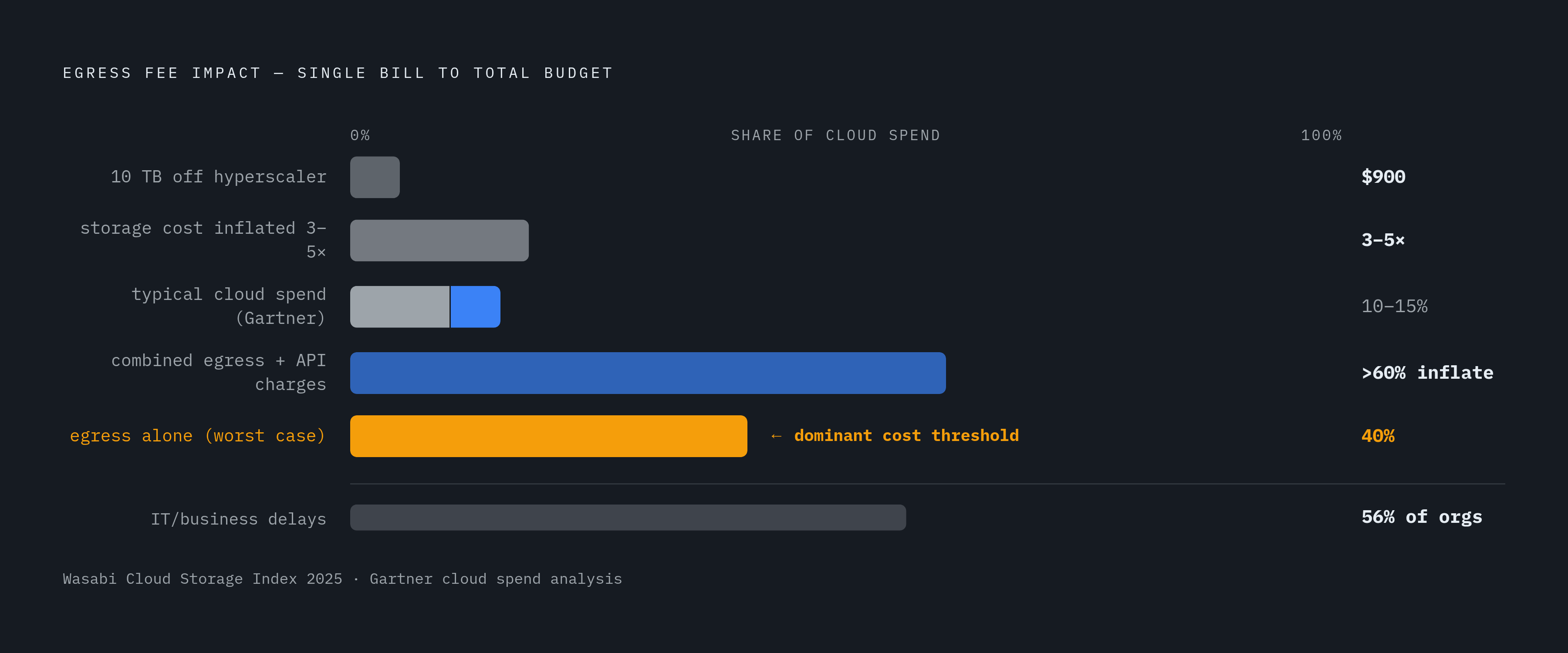
Egress fees are the actual price tag on vendor lock-in, and most teams don't see it until they try to leave. Move 10 terabytes off a major hyperscaler and you're paying somewhere around $900, at the common $0.09-per-gigabyte rate. That's a discrepancy far larger than a rounding error. That's a line item somebody has to explain in a budget meeting.
And it doesn't stop at one bill. Egress can inflate total storage cost by 3 to 5 times, and Gartner puts it at 10 to 15% of overall cloud spend on average, with some organizations seeing it climb past 40%. Forty percent of a cloud bill just to move data from one place to another is a tax on the data itself. It's a toll booth with no exit ramp, and you paid for the road already.
The survey numbers back this up. The 2025 Wasabi Cloud Storage Index found 56% of global respondents hit IT or business delays specifically because of egress and access fees. Backblaze's 2025 survey found 95% of IT leaders ran into unexpected cloud charges that blew up budgets, stalled projects, or forced decisions nobody wanted to make. Ninety-five percent isn't an edge case. That's just about everyone who's opened a cloud invoice and felt their stomach drop.
Here's the mechanism that doesn't show up on the invoice: high egress fees don't only cost money when you actually move data. They make even testing a competitor financially irrational. Want to run a small pilot on another platform, just to compare? That "small test" comes with a punitive price tag attached before you've learned a single thing. So teams don't test. They stay put, not because the incumbent is better, but because leaving hurts too much to even sample.
Hyperscalers built it this way on purpose. Moving data within their own walls is free or close to it. Moving it out costs real money, deliberately. It's a moat around a castle that isn't even that nice inside, and it keeps you circling the walls regardless of whether the provider still fits the workload. A 2025 UK guide from impossiblecloud.com found hidden fees, egress and API charges combined, can inflate a cloud budget by more than 60%, with over 70% of IT departments naming unpredictable egress and API fees as a top pain point.
None of this stems from a storage-API problem. It's a pricing problem sitting on top of the API, and that's exactly why the next question matters: does S3 compatibility protect you from any of it? It doesn't. Here's why.
What S3 compatibility actually guarantees, and where it stops
S3 compatibility does real work, to be fair. Applications and scripts written against the S3 API can talk to a compatible platform without a rewrite. One interface covers the operations that matter day-to-day: PUT, GET, DELETE, list, multipart upload. You also inherit an existing ecosystem, backup tools, client libraries, monitoring integrations, that already speaks fluent S3. Per impossiblecloud.com, S3 compatibility is the single most effective technical step a team can take against lock-in.
But "compatible" covers a wide spectrum, not one fixed guarantee, and treating it as a checkbox is where teams get burned.
Some providers haven't implemented every endpoint in the S3 API. An infrastructure-as-code module that calls one of those missing endpoints doesn't degrade gracefully. It fails, sometimes loudly, sometimes quietly enough that it only surfaces three deploys later. Fixing that requires an architectural overhaul. It's a rewrite of whatever asset made the call.
Security models are the other landmine, and arguably the bigger one. Fine-grained IAM policies and ACLs on AWS S3 don't map cleanly onto every S3-compatible service. Some providers still run on a simple private-or-public model. DigitalOcean Spaces has closed some of that gap, adding bucket policies and per-bucket access keys alongside its original ACL system, but it still doesn't match full AWS IAM parity. Move a workload assuming the permission structure travels with it, and the rebuild lands on your desk: not a config tweak, a full rebuild of authorization logic from scratch.
Then there's what varies quietly in the background: how deep versioning goes, whether object lock behaves the way a compliance policy assumes, which event notification targets are actually supported, how complete lifecycle rule coverage is. None of it shows up until the moment you need it, which is usually the worst possible moment to find out.
A real compatibility checklist, per impossiblecloud.com, covers versioning and lifecycle management, immutable storage through object lock, IAM policies granular enough to enforce least privilege, and event notifications that plug into automated workflows. Various providers sit somewhere on this spectrum, and they pull in different directions: Cloudflare R2 with zero egress, Wasabi with a free egress allowance tied to storage usage, MinIO and Cloudflare leaning into edge integration, AWS S3 and Google Cloud Storage building out AI-native data services.
Picking anything labeled "S3-compatible" and calling the lock-in problem solved is the mistake to avoid here. Compatibility is necessary. It's nowhere near sufficient. What actually decides whether you can leave when you want to is the architecture wrapped around the API, which is exactly where the next problem lives.
The pipeline assumptions that quietly recreate lock-in
Nobody writes this assumption down, but nearly every pipeline makes it anyway: that data lives in one provider's bucket, in one region, in one format, forever. The storage API can be perfectly portable and it won't matter. If the pipeline only knows how to talk to one place, lock-in just got rebuilt one layer up, and API portability becomes a technicality nobody actually benefits from.
The patterns repeat everywhere. Provider-specific endpoints and credential formats get hardcoded into config files because it worked once and nobody circled back. ETL jobs land transformed data into a proprietary analytics format, tying the output to whatever platform reads that format best. Jobs pull data down to local compute before processing, creating a copy that now needs its own lifecycle, its own security review, its own answer to "which version is actually current?" The bucket, instead of staying the source of truth, turns into a waypoint. A rest stop. Once copies start multiplying, someone has to manage which one is real, and that job never ends on its own.
A different architecture, none of it exotic, sidesteps most of this. A 2026 piece from gysp.tech on vendor lock-in strategy notes that teams staying flexible tend to run machine learning pipelines on standard Kubernetes rather than a provider's managed pipeline service (SageMaker Pipelines, Vertex Pipelines). They put foundation model API calls behind a provider-agnostic layer, tools like LiteLLM or PortkeyAI get named specifically. And they serve model weights through open frameworks like vLLM or Ray Serve, instead of routing everything through a managed inference endpoint that only exists on one cloud.
Here's why this matters right now, not someday: 86% of corporate cloud deployments are already hybrid or multicloud, per Wasabi. Most teams are already operating across provider boundaries whether they planned for it or not. Yet plenty of them are still writing pipelines as if everything lives in one place, on one bucket, forever, and that gap is where the pain shows up later.
Treat the bucket as the source of truth, never a cache, never a staging ground. That's the fix, and it's a mindset shift more than a tool purchase. Pipelines built that way can point at a different provider's bucket without touching the underlying logic. Pipelines built the other way get re-architected every time the business wants to renegotiate a contract, and that's a conversation nobody wants to have twice.
This gets sharper once AI workloads enter the picture, not softer, because AI is where these same assumptions get rebuilt fast and at a much bigger scale.
How AI infrastructure is accelerating a new generation of storage lock-in
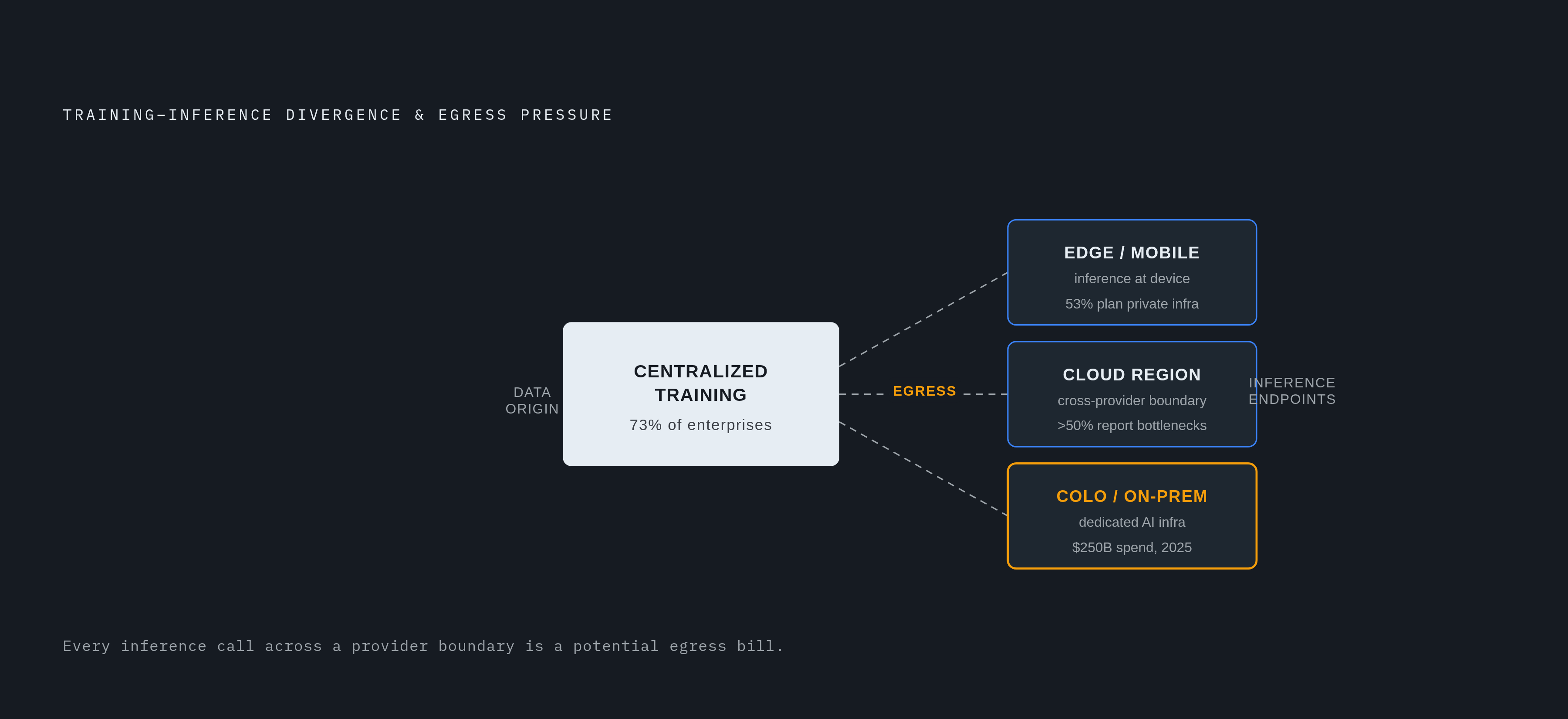
Global AI infrastructure spending crossed $250 billion in 2025, growing sharply in that single year, and storage and networking are scaling up nearly as fast as compute. Whatever lock-in patterns already exist in storage are about to get a lot more expensive to get wrong.
MinIO's 2026 report on AI storage bottlenecks found more than half of organizations report data and storage bottlenecks limiting AI performance and scale, and 57% say their data isn't even AI-ready yet. Experimentation is outrunning the infrastructure meant to support it, and that gap is exactly where expensive mistakes get made.
The new lock-in surface doesn't look like the old one. AWS Bedrock, Azure OpenAI, and Google Vertex AI have all rolled out proprietary orchestration layers, fine-tuning workflows, and agent SDKs over the past 18 months, per gysp.tech. Organizations are signing multi-year capacity commitments before they've validated the unit economics of the workload in production, the exact mistake early cloud adopters made a decade earlier, just with bigger numbers attached this time.
Training and inference are drifting apart geographically too. MinIO's data shows 73% of enterprises expect training to stay centralized while inference spreads across distributed environments. Data now has to cross provider boundaries as routine operation, not exception. At AI data volumes, egress stops being a $900 line item. It becomes a budget conversation with a CFO in the room.
Fifty-three percent of enterprises plan to deploy AI-dedicated private or colocation infrastructure, per MinIO, which multiplies the number of environments any dataset has to move through. Every hop is another egress bill and another chance for a pipeline assumption to snap.
The subtler trap sits one layer above storage entirely. Storage can be perfectly S3-compatible and lock-in still happens anyway, just through a managed fine-tuning service, a proprietary vector database, or an agent SDK that only runs on one vendor's stack. That layer is often harder to walk away from than storage ever was, because the switching cost is measured in workflows rebuilt and integrations rewritten. It's measured in months of engineering time spent reimplementing workflow logic that never needed to be proprietary in the first place.
What AI-era storage infrastructure needs to deliver without creating new dependencies
AI workloads need real throughput, full stop. Specialized compute hardware is expensive, and hardware sitting idle waiting on data is an expensive way to compute nothing. The vendors delivering the best AI-native performance often get there through tightly coupled, proprietary integration, so teams end up weighing performance against portability instead of assuming both come free.
The performance problem is not hypothetical. Published benchmarks have shown training jobs spending a significant share of compute time simply waiting for data before storage acceleration enters the picture. Over a third of expensive, specialized compute time spent doing nothing but waiting on I/O. MinIO's AIStor has been benchmarked past 2.2 TiB/sec on GET and 1.0 TiB/sec on PUT, across 260 nodes of NVMe on a 100GbE network, numbers that make clear this isn't a niche concern anymore. NVIDIA's GPUDirect RDMA support for S3-compatible storage matters here too: it adds a direct, RDMA-accelerated data path while keeping the S3 API intact, proof that the performance-versus-portability tradeoff isn't actually mandatory. Both are possible at once.
A few named options show the range on offer. CoreWeave's AI Object Storage went GA on March 31, 2025 (announced at NVIDIA GTC, March 17 through 21 that year), built on its Local Object Transport Accelerator technology, and it claims a dataset can be accessed anywhere globally without egress charges or per-request fees, at a cost CoreWeave says runs over 75% lower than comparable hyperscaler offerings. MinIO's AIStor stays S3-compatible while hitting the throughput numbers above and supporting GPUDirect RDMA. Cloudian's HyperStore targets exabyte-scale AI and analytics lakes with tight integration into NVIDIA-based pipelines. Pure Storage's FlashBlade//S unifies file and object access and shows up in NVIDIA DGX and "AI Factory" reference architectures for high-throughput training.
A storage-agnostic access layer is the better default here, not one more option on the list. It mounts existing buckets, S3, GCS, R2, Azure Blob, as a POSIX filesystem, with no migration, no ETL step, no code rewrite. Agents and training jobs read from an NVMe cache at low latency, while the bucket itself stays the actual source of truth. Capacity scales with active use instead of sitting pre-provisioned and idle, which matters when workloads swing between a small experiment on a laptop and a training run that needs everything the cluster has.
Whichever route a team picks, one question cuts through the marketing fast: does the underlying bucket stay in your account, under your control? Can you revoke the vendor's access tomorrow and still have your data sitting exactly where it was? If the answer is no, the performance win is just a rebrand of the same lock-in, dressed up with better benchmarks.
Design principles for staying storage-agnostic across providers
Keep the bucket as the source of truth. Never let it become a staging area. Any copy of data sitting outside your bucket and outside your account is a leash, even before it feels like one. Pipelines and access layers should read from and write to the bucket directly. Caches and accelerators can sit in front of it, but they stay invisible to the workflow rather than becoming the canonical copy by accident.
Separate the storage API from the access layer. Applications should call an abstraction that can point at any S3-compatible backend, not a provider's endpoint hardcoded three layers deep in a config file somebody wrote two years ago and forgot about. A filesystem mount or a storage-agnostic SDK earns its keep exactly here: the backend changes, and the application code doesn't notice.
Audit compatibility depth before signing anything, not after the contract's locked. Check which S3 endpoints a provider has actually implemented, not just which ones show up on the marketing page. Map IAM and ACL policies onto the target provider's real security model instead of assuming they'll transfer intact, because plenty of the time they won't. Test lifecycle rules, event notifications, and object lock behavior against real workflows, not a demo environment.
Price egress in from day one. Zero-egress and conditional zero-egress providers exist now, and they change the math on how freely data can actually move. Build that math into the architecture decision itself, before a single pipeline gets written, not after the invoice arrives.
None of this is about avoiding one villain provider or chasing some mythical, perfectly neutral stack. It's about making sure the choice to leave is still a choice, months or years down the line, instead of a decision that got made silently the day someone hardcoded a bucket name into a script and moved on to the next ticket.