Persistent Isolated Workspaces for AI Agents Without Per-Customer Infrastructure Overhead
MicroVMs, forkable disks, and shared compute give each tenant a private workspace.
Sponsored by Archil
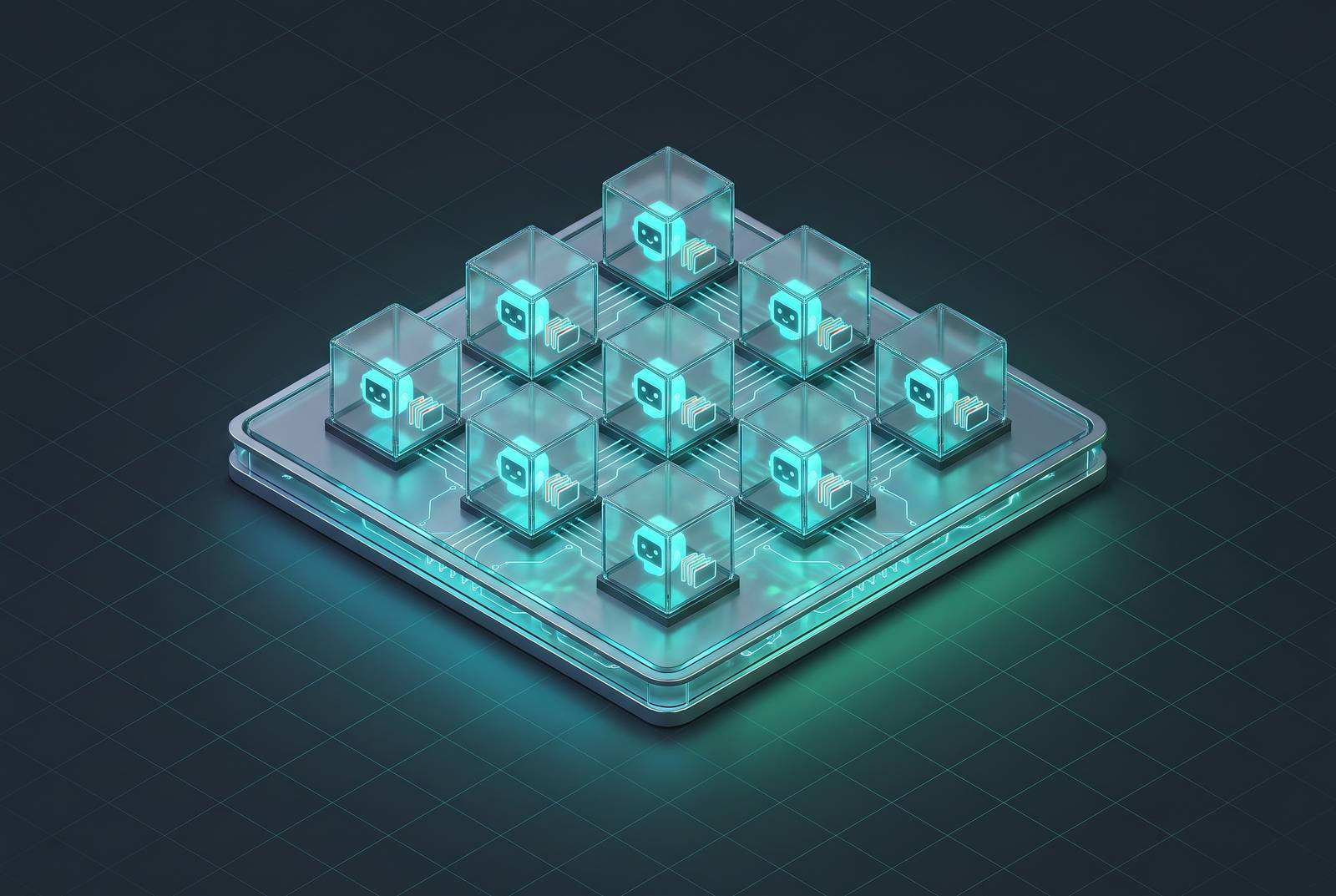
Isolated per-tenant storage for multi-tenant AI agent applications does not require dedicated infrastructure for every customer. The workable model pairs microVM isolation and persistent, forkable disks with shared compute billed on active use. Each tenant gets a private, durable workspace, and storage and network controls keep the boundaries in place outside the agent’s code.
Why agents break when their environment disappears between sessions
The agent logic works, the model is capable, and then a restart throws away the work. An agent that runs code, installs packages, calls APIs, and edits files accumulates an environment across turns. That environment is part of the work product. Losing it means losing more than a chat transcript, because what the agent does next depends on what its earlier actions changed.
Three layers can each fail on their own, including filesystem state, the installed environment, and process memory. A repository may survive while packages, running servers, caches, or open sockets do not. Partial survival can be especially treacherous. An interrupted package install can leave lock files and PATH changes that cause silent import failures, while an agent that finds its source files may assume its database is still running.
Write durability can also fail before a restart. Results sitting in memory without a completed fsync have no durable record when compute stops, whether the interruption is unexpected or imposed by a session limit. Agent logic needs an environment whose survival rules are explicit.
What makes a workspace genuinely persistent, not just file-saving
Filesystem persistence preserves files across pauses, which covers most coding-agent needs but does not preserve running servers or in-memory caches. Full pause-and-resume adds a memory snapshot, allowing processes to continue where they stopped and making the next resume sub-second by avoiding a full boot. Snapshot-based environments offer a third capability, creating new sandboxes from saved state for parallel attempts, RL rollouts, or rollback.
Operators therefore need answers to four questions. What exactly survives a pause? Does a session time cap force a cutoff? Does checkpoint and branch time grow with disk size or remain constant? Are writes durable when fsync returns, or only after background synchronization?
The distinction becomes concrete with disks where writes are durable once fsync returns and are copied to a configured backing bucket in the background. Such disks can checkpoint and branch in about 90 ms regardless of size, and one disk can mount on many machines at once. None should be mistaken for a promise that process memory survives.
Recoverability needs just as much care because persistence can save damage too. A saved mess is still a mess, only now it has tenure.
Why isolation technology determines what persistence can safely promise in a multi-tenant product
A durable workspace is valuable only if neighboring tenants cannot read or corrupt it. Containers share the host kernel, making them suitable for trusted code but an insufficient boundary for untrusted agent-generated code in a multi-tenant product. A kernel exploit can cross that boundary. MicroVM approaches, including Firecracker and Kata Containers, give workloads their own kernels under hardware virtualization, at the cost of operating guest kernels and a virtual machine monitor.
That stronger boundary is not a lifetime security warranty. Three Firecracker advisories published in 2026 mean its earlier clean escape-CVE record is no longer a sound security argument. Defense-in-depth remains necessary even with hardware isolation. Network policy must independently restrict outbound access, with default-deny egress and an allowlist of package registries, git hosts, and model APIs as the baseline for agent-generated code.
Credentials need their own boundary as well. A secret passed through an environment variable is available to generated code through plain printenv. Brokering credentials at an egress proxy instead lets the proxy inject API keys into outbound requests outside the sandbox. With this network-boundary approach, secrets need not enter the Firecracker microVMs.
Application checks cannot substitute for these controls. A tenant_id filter in agent code can fail through prompt injection, bugs, or races, but that code has no power over storage and network enforcement.
How checkpointing and branching turn persistence from a safety net into an agent capability
An agent can fork its current workspace, try draft actions in parallel, discard losing branches, and commit the winner. The common setup runs only once. Persistence then becomes part of planning rather than a recovery service called after something catches fire.
The Crab paper, published in 2026, identifies RL rollout branching as a use case for this approach. Many executions share installed dependencies and warmed-up tests, so a checkpoint after setup avoids repeating that work before every variable step. The same mechanism supports rollback after risky changes. An agent branches, acts, verifies, and either commits the result or discards it.
Columbia DAPLab’s StateFork, presented in June 2026, frames the shift as moving from “how do I reset the container?” to “where should the agent branch?” Parallel branching has also shown measurable gains on coding benchmarks. LangGraph’s state checkpointing supports related needs, including pause/resume, time-travel debugging, and replay, though agent-state checkpointing should not be confused with preserving the whole execution environment.
Checkpoints that take minutes are used for recovery only now and then, while those that take tens of milliseconds can be part of everyday planning. For that to hold as workspaces grow, checkpoint speed must be independent of disk size.
The economics of per-tenant workspaces: why sleeping agents change the unit math
One continuously running VM or container per tenant turns idle time into a standing expense. Most tenants are idle most of the time, so this model charges for a large population of environments doing nothing. The expensive employee is the empty chair. At thousands of tenants, infrastructure needs to serve the concurrent working set rather than keep the entire tenant population running.
This resembles connection pooling in databases, with private workspace state separated from the compute currently using it. A tenant’s disk stays available between sessions while compute goes to work that is active. Isolation requires the tenant boundary to hold whenever compute runs.
A mostly cold workspace incurs a storage charge for bytes rather than a reserved disk, while sleeping agents avoid continuous compute expense. GPU workloads complicate the calculation because GPU sandboxes cannot be cheaply paused and resumed in the same way. The CPU/GPU split between microVM and gVisor approaches therefore reflects a cost distinction as well as an isolation choice.
What operators building multi-tenant agent products need to enforce at the infrastructure layer
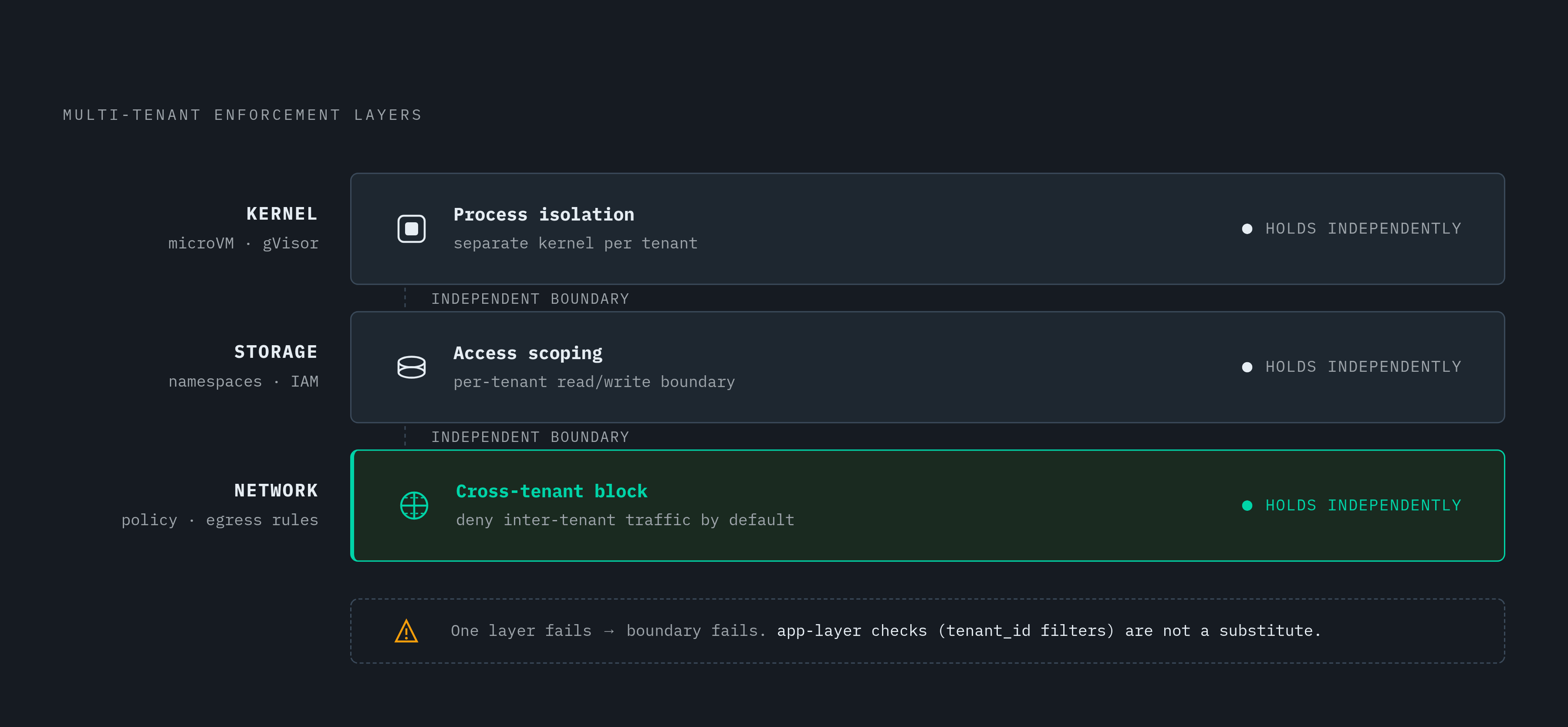
Teams that build this shared model need three enforcement layers that each hold on their own. Kernel-level isolation uses microVMs or gVisor, storage access is scoped through per-tenant namespaces or IAM permissions, and network policy blocks cross-tenant requests. A SaaS baseline also includes per-tenant credential vaults, while namespace isolation with shared inference is usually sufficient for internal tooling.
Credential scope must follow the job without creating a static IAM role for every tenant. Per-job injection through AWS STS provides dynamically scoped access without accumulating those roles. A VPC endpoint policy supplies a second barrier. It can block cross-tenant bucket requests even if an agent obtains another tenant’s credential, keeping the decision outside generated code.
Planner and executor agents may legitimately work on the same files, but their write-coordination rules must be documented. Advisory locks coordinate processes on one machine. Writers on different machines require explicit ownership rather than an assumption that those locks settle the dispute.
Network rules also have timing semantics that operators must understand. A policy change may apply only to new connections while those already open stay open. Dynamically opening access for a data pull and then closing it therefore requires more scrutiny than checking whether the rule changed.
Giving agents file access to large datasets without copying data into every sandbox
Copying a customer’s cloud dataset into every sandbox adds startup latency and duplicates storage. It also leaves the agent working from a stale copy as soon as the source changes. Mounting the bucket as a POSIX filesystem avoids that copy-per-session pattern. The agent uses familiar file tools while the data stays in the customer’s bucket.
Amazon S3 Files, generally available on April 7, 2026, shows one way to do this. AWS built it using Elastic File System technology to provide full filesystem semantics over S3, an alternative to a FUSE workaround. AWS says this supports persistent agent memory and shared state across pipelines. The interface also fits the heavy training models get on bash and file tools, so it needs no bespoke tool definitions that take up context.
Vercel Sandbox added FUSE-based filesystem support in July 2026 for remote storage and custom filesystems. Vercel’s documentation explicitly warns that credentials passed to mount-s3 remain exposed inside the sandbox for the life of the process. A mounted path does not make credential exposure disappear.
The practical decision is where the FUSE daemon runs and where its credentials live. Operators also need a clear source-of-truth contract. Revoking platform access should leave the customer’s data in the customer’s account, rather than reveal that the platform holds the only copy.
How microVM isolation and persistent forkable disks work together for multi-tenant agent workspaces
Persistent sandboxes can combine Firecracker microVMs, each with its own kernel, with durable disks on shared compute. Installed packages and files survive stops and restarts, so the environment setup built up over time does not have to be done again each session, providing filesystem and environment persistence while memory resume remains a separate guarantee. Ports stay private until someone explicitly exposes them, and outbound access has its own controls apart from the kernel boundary.
The Free plan limits outbound traffic to a managed allowlist of package registries, git hosts, and model APIs, while Developer plans and above can set their own firewall rules. Credential brokering supplies the separate secret-handling boundary described earlier.
Its forkable disks connect those controls to agent planning. A disk can be platform-managed or mount an existing S3, GCS, R2, Azure Blob, or S3-compatible bucket as a POSIX filesystem without a migration or separate copy. Each disk is also reachable through an S3-compatible API. Durable writes are stored redundantly across multiple Availability Zones, with background copying to a backing bucket when configured.
Compute and storage each have their own price based on active use, so thousands of idle tenant workspaces do not have to mean thousands of running machines.
What to verify before shipping a multi-tenant agent product on any sandbox platform
Before shipping, operators should turn these distinctions into documented acceptance checks. Require the platform to name its hypervisor, default egress policy, and the location of secrets. “Secure sandbox” is not a testable specification. Ask how long the architecture has actually run under production load, rather than treating the product page’s publication date as infrastructure tenure.
Start with the interruption contract and its consequences. Verify whether a pause preserves only files or also process memory, whether a session cap exists, and what happens to unflushed writes at cutoff. Require checkpoint and branch timings that explain their relationship to disk size.
Then check the boundaries with the tenant model the product will use. Establish whether default egress is open or denied except for an allowlist, whether credentials enter the sandbox, and whether cross-tenant storage access is blocked by storage and network policy independently of application filters. For mounted buckets, verify that revoking platform access leaves the customer’s bucket as the source of truth. Require kernel isolation, storage access control, and network policy together, because any one of these layers can still fail.
This article is sponsored by Archil.