Why Persistent Cloud Filesystems Outperform Bolt-On Object Storage for Agent Shell Layers
Agents need real rename, fsync, and directories, and object storage fakes them.
Sponsored by Archil
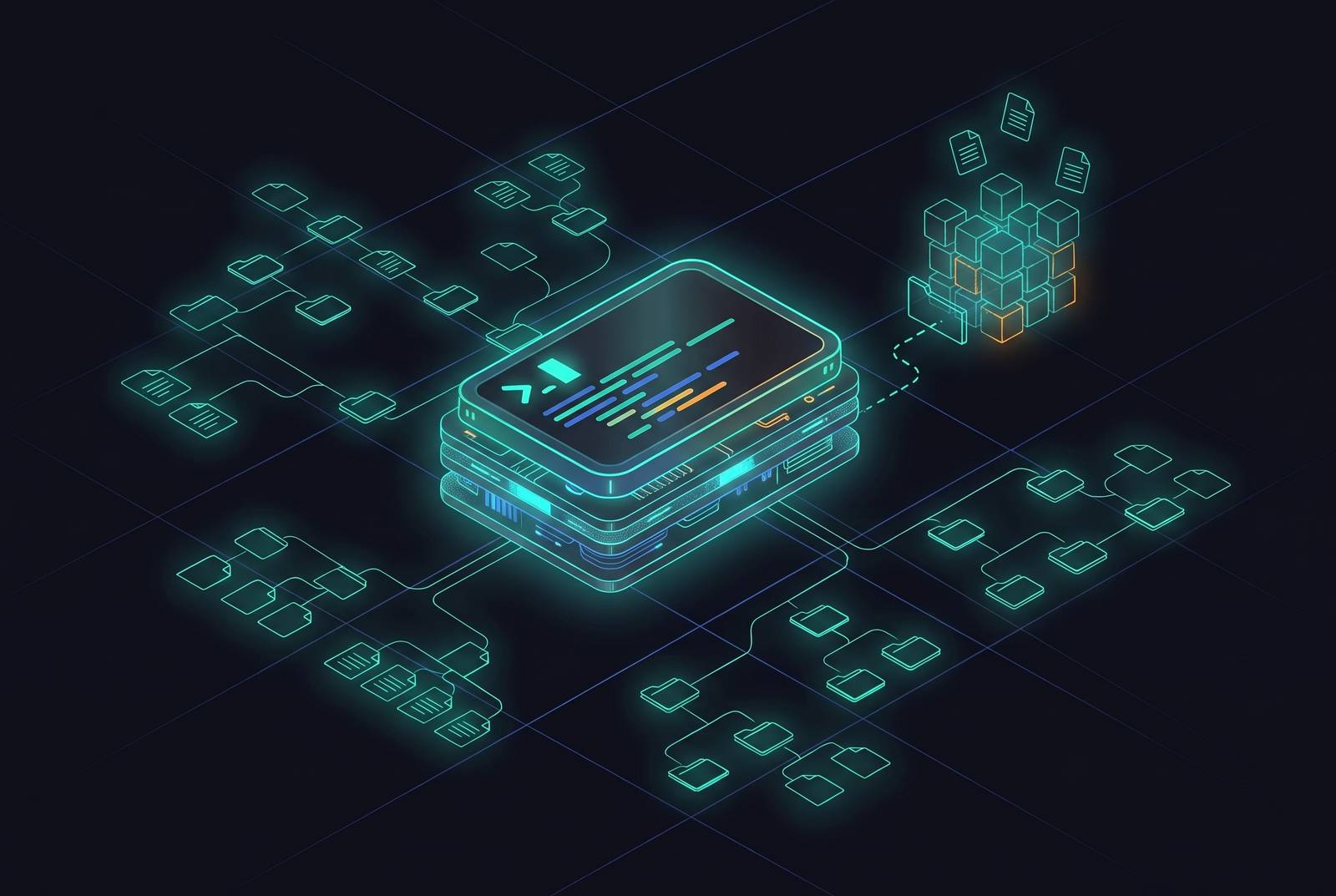
Serverless bash execution with a persistent cloud filesystem gives an AI agent a real working directory that lasts between runs. The filesystem must outlive the sandbox and provide atomic rename, durable writes through fsync, and real directory operations. Bolt-on object storage makes the shell emulate those operations, which adds latency and uses more context. Ephemeral serverless /tmp provides scratch space.
Why object storage's data model fights the operations agents actually issue
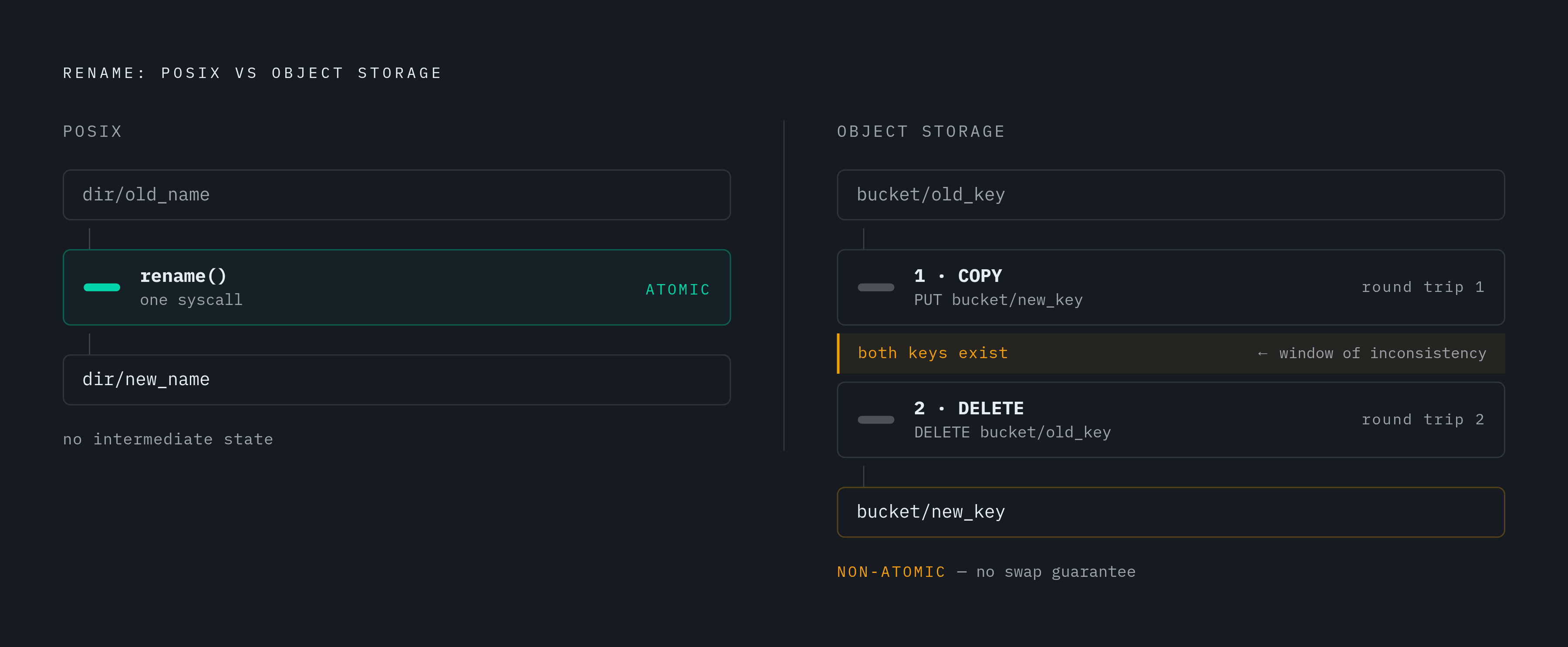
An agent writes a file to a temporary path, then renames it into place so a downstream agent sees either the old version or the new one, never a partial write. On a POSIX filesystem, rename() changes the directory name atomically in a single syscall. Object storage has no equivalent rename primitive. The client must copy the object to a new key and delete the old one. That sequence does not offer an atomic swap, and both keys can exist during the transition.
The trouble begins at the interface the shell expects. Agents issue filesystem operations, including fsync, incremental path traversal, and directory listing, while object storage addresses whole objects through flat keys. Its strengths are simplicity and parallelism at enormous scale. A slash in a key looks like a directory in much the same way a painted door looks like an exit.
Directory traversal exposes the difference without any writes at all. Filesystem calls such as opendir and readdir let a program move through directory entries incrementally. Object APIs instead paginate a flat namespace in lexicographic order. Continuation tokens allow partial traversal, but they are not directory cursors. A shell adapter must synthesize the missing structure, so the mismatch cannot be fixed by tuning a timeout.
How the missing primitives compound into latency and token overhead
A rename over S3 requires at least two API calls, copy and delete, each with network round-trip latency. When an agent must know that one rename succeeded before proceeding with the next write, those waits become serial. Small files do not make the waits disappear. Code generation can therefore spend time managing storage operations.
Listing adds a different kind of overhead. A bolt-on layer issues a prefix-based LIST, receives paginated results, and reconstructs a directory tree in memory. A workspace full of code, markdown, and configuration files can yield thousands of entries the agent does not need. Small-file writes, frequent scans, and in-place updates recur throughout shell-based generation and test cycles.
Not every extra round trip consumes model tokens. The token cost appears when oversized listings enter context or the model must reason through storage state and workarounds. The shell waits for translation, while the model spends context understanding its consequences. That second bill makes this more than a storage engineering problem.
Why agents default to filesystem operations in the first place
Giving the agent an S3 SDK does not erase its working assumptions. Models are trained heavily on bash and file tools, so they reason about paths, directories, and commands. The filesystem is part of their working vocabulary. Replacing it with an object API asks the model to translate while doing the task.
Custom tools put that translation in the open, but it still has to happen. A rename shim or directory-list wrapper gives the model another interface to learn and choose in place of the command it knows. Each indirection creates room for a wrong key or forgotten prefix. The adapter becomes another thing to think about. Context spent navigating that adapter is context unavailable for the actual job.
What purpose-built filesystem semantics deliver instead
A purpose-built persistent filesystem has atomic rename built in, so it can rename without a copy-and-delete routine. The agent can write to a temporary path and rename into place with the expected visibility guarantee. Durability has its own explicit boundary through fsync. When that call returns, the filesystem confirms that the write is durable. Rename governs the name swap, while fsync gives a checkpoint something solid to stand on.
Calls to opendir and readdir return entries from the requested directory rather than requiring the client to assemble one from object keys. An ls result reflects that directory’s contents. Large directories can still give back large results.
Advisory locks, sparse files, hard links, symlinks, and mmap provide the behavior that compilers, interpreters, and test runners expect. Those tools can run unmodified when the required semantics are present. The model needs fewer special instructions as a result. Its context has room to track source changes and test failures.
How do files survive between runs, and what does not?
Filesystem persistence preserves disk state. Packages, generated files, and saved intermediate work can survive, while in-memory state and open sockets do not. Pause-with-memory is a separate persistence tier that preserves a full memory snapshot. The distinction changes what “resume” actually promises. Most agent shell tasks can pick up from a durable filesystem checkpoint without bringing back the previous process.
That checkpoint needs more than a final output folder. The working environment includes installed dependencies and intermediate artifacts that let the next run continue. If packages are lost, they have to be installed again after every restart. That adds latency and reopens the network surface each time. Saving only the finished report while discarding the workshop is an expensive interpretation of persistence.
Decoupling the disk from the sandbox lifecycle lets a new runtime mount the same workspace. Workspace continuity then depends on durable storage. Correct use of fsync establishes which writes survive. The application still needs a useful point from which to continue, but it need not invent a separate storage-durability protocol.
Branching and checkpointing as normal agent workflow, not a recovery mechanism
A durable workspace becomes more useful when its state can branch without a full copy. With metadata-level checkpoints and branches that take milliseconds regardless of workspace size, parallel attempts no longer require duplicating all their starting data. Object storage has no native fork operation. Creating an independent workspace by copying a bucket prefix instead ties preparation to workspace size. That is a poor fit for frequent, small experiments.
Metadata branching changes what an agent can afford to try. Ten parallel agents can replace ten full copies with ten mount calls to start from the same checkpoint. A promising intermediate result can also become a reusable checkpoint. Later runs or other agents can branch from it.
Rollback then becomes another use of the same mechanism. When an attempt makes the workspace worse, returning to a previous checkpoint is a metadata operation. This makes it practical for the storage layer to support tree-search rollouts and parallel agent swarms. For an agent developer, branching can be a normal workflow primitive.
Accessing large datasets without copying them into the agent's workspace
Mounting an existing bucket as a POSIX filesystem avoids staging the dataset in the agent’s workspace. The agent can work with the data as files while the bucket stays the source of truth. A filesystem layer can expose S3, GCS, R2, or Azure Blob through a path that ordinary shell tools understand.
That path lets the agent use find, grep, and cat without translating each action into an object API request. It removes the preliminary duplication that otherwise takes time in proportion to dataset size. In this access pattern, writes sync back to the bucket in the background. When the mount is revoked, the data stays in the bucket without being left in a replacement store.
The same arrangement avoids moving tenant data into a shared sandbox’s security boundary. Each tenant’s bucket can be mounted only into that tenant’s sandbox, keeping the data path scoped even when sandboxes share a host. CTERA describes file and object interfaces as two views of the same underlying data, with bidirectional access. The filesystem is an access layer. Large datasets can stay where they are.
Per-tenant isolation at scale: why a shared bucket key is the wrong primitive
Per-agent IAM becomes application infrastructure when a multi-tenant product scopes shared-bucket access through prefixes and verbs. The team must write policies, keep them up to date, and rotate tenant credentials. A prefix policy can enforce a boundary, but gaps leave reach beyond it. A misdirected tool call can then become a security incident. With a shared bucket key, the blast radius of a misconfiguration can extend across the bucket.
A disk-per-tenant model aligns the visible filesystem with the tenant boundary. Each sandbox has its own disk and identity, so another tenant’s disk is not a path the agent can discover by guessing a prefix. Isolation does not depend on persuading the model to stay in its assigned folder.
The recommended credential model keeps raw API keys out of the agent’s environment. The agent makes a request, and infrastructure attaches the credential at the network boundary before forwarding it. Outbound access should also be default-deny, with package registries, git hosts, and model APIs explicitly allowed. Neither control belongs in a polite prompt. Together, scoped disks and network controls make isolation a platform invariant rather than a bespoke security project repeated at thousands of tenants.
The convergence position: filesystem semantics above object storage, not instead of it
MinIO’s 2026 storage analysis argues that object storage is the system of record for high-performance AI because it supports massive parallelism, horizontal scalability, and independent scaling of compute and storage. That is a strong argument for training pipelines and large-scale ingestion. It is not an argument against persistent agent filesystems. The workloads ask different questions of storage. A distributed training job needs a scalable data plane, while an agent running shell commands needs a mutable working environment.
The distinction also leaves a clear role for databases. Data that fits a clean schema belongs in a database, including structured relational state that a filesystem is not designed to manage. Filesystem semantics suit unstructured working data, generated artifacts, and agent context. No single interface wins every job. Convergence means preserving the right interface for each workload without maintaining duplicate datasets merely to bridge them.
In production, that means serverless bash runtimes attached to persistent disks, with storage independent of runtime lifetime. Existing S3, GCS, R2, and Azure Blob buckets can remain the durable backing store and appear through POSIX filesystem paths without migration, ETL, or dataset copies. The working layer supplies atomic rename, durable writes, directory operations, and workspace continuity. Object storage supplies the scalable foundation underneath. Compute can stop and restart without taking the agent’s working directory with it.
This article is sponsored by Archil.