One Disk per Tenant as the Multi-Tenant Storage Primitive That Kills Bucket Sprawl
Per-tenant disks make storage enforce tenant isolation.
Sponsored by Archil
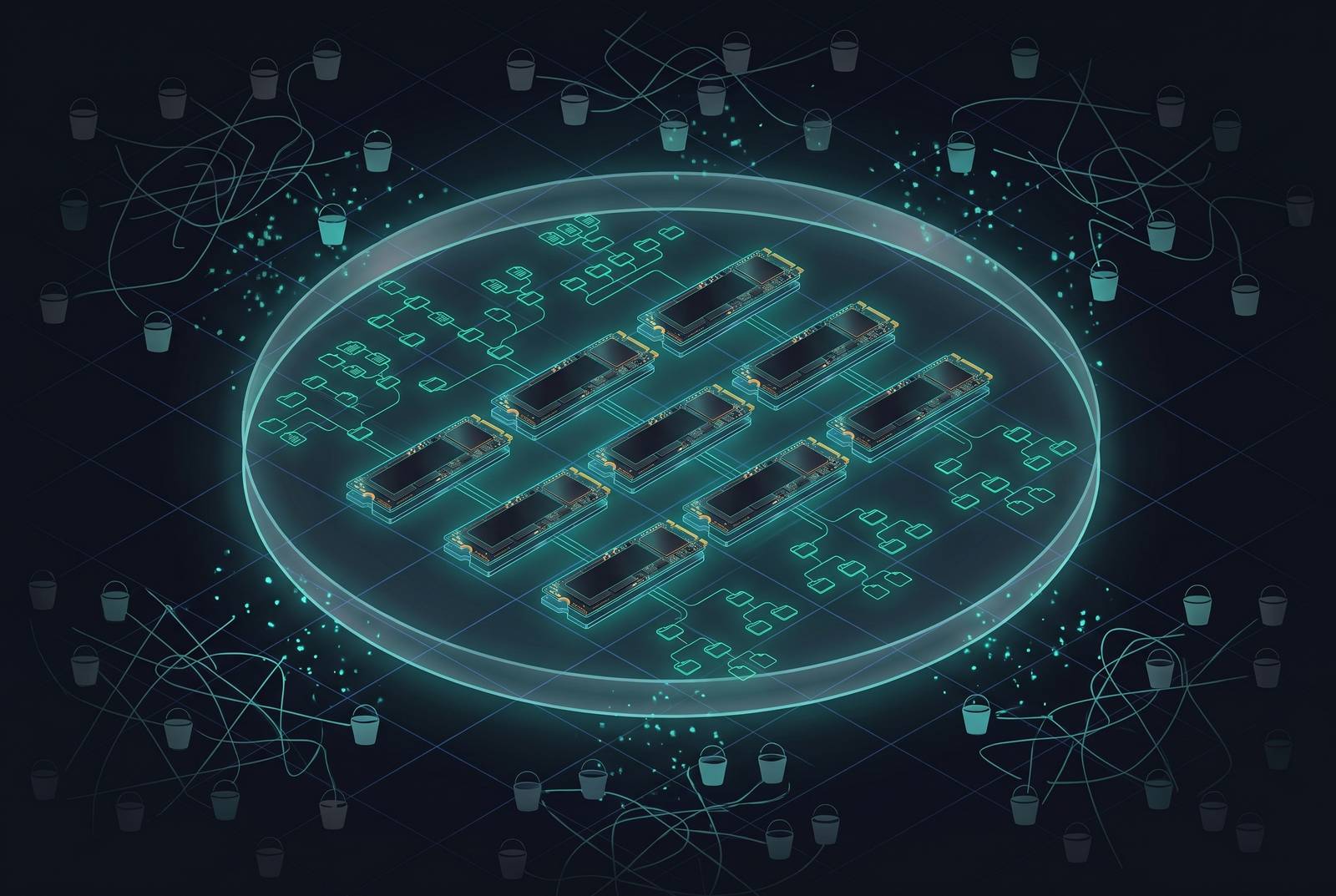
Isolated per-tenant storage for multi-tenant AI agent applications works when storage, execution, and credentials all enforce the same tenant boundary. One disk per tenant makes the workspace a storage-enforced unit rather than a collection of prefix checks and shared-bucket policies. When paired with a tenant-scoped sandbox, it lets agents work with files without leaving every tool call to prevent cross-tenant access.
Why object storage primitives break down at thousands of tenants
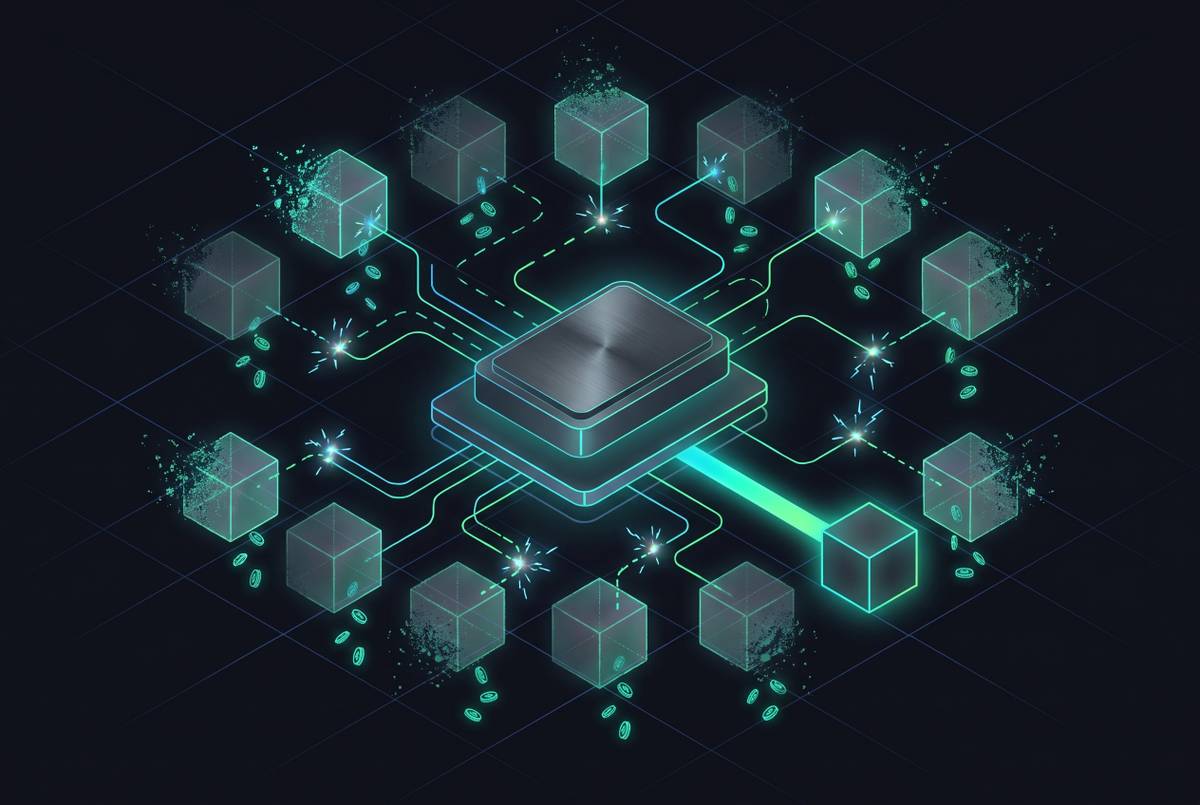
At thousands of tenants, bucket quotas and policy-size limits become architecture constraints. Bucket-per-tenant fleets do provide useful separation, including separate credentials and independent restores. That is a real advantage over shared paths. But provisioning work grows with tenant count, while bucket limits constrain how far the fleet can expand. Moving to a shared bucket cuts the number of resources, but each tenant’s permissions still have to be set out and kept up to date.
That shared bucket moves the pressure into policy documents. Prefix-scoped IAM can enforce access rules, but the prefix itself grants no protection. It is a naming convention wearing a security badge. Every path that is allowed must stay within the intended tenant boundary, and policy-size limits cap how much can go into that shared document. S3 Access Points offer another way to scope access, but they have quotas of their own.
The storage primitive is mismatched with the unit being isolated. Buckets, prefixes, and access policies can be assembled into tenant boundaries, but they do not make a tenant workspace a first-class resource. The same distinction applies to shared buckets on GCP. When application code supplies the tenant prefix, isolation depends on that code supplying it correctly. Bucket sprawl and prefix fragility are different symptoms of the same mismatch.
Why application-layer enforcement cannot close the gap object storage leaves
Application checks protect only the paths that use them. A shared embeddings index can return another tenant’s vectors when a similarity query omits its tenant filter. A shared knowledge graph can merge two employees with the same name into one canonical node. Both failures can happen without a malicious user or a broken bucket policy. The storage request can be authorized while the data selection is wrong.
Signed URLs expose another gap in the request path. A service that signs whatever object key an agent supplies, without checking ownership, can grant access to the wrong tenant’s file. Summarization, reindexing, and graph enrichment jobs often use elevated credentials, and they can lose tenant context when the work leaves the interactive session.
Database row-level security deserves a distinction here. It provides database-enforced policy beyond a helpful WHERE clause, but it does not govern an object store or a path that bypasses that policy. AWS’s re:Invent 2025 session CNS381 presented Lambda’s Tenant Isolation Mode as platform-managed compute separation. Storage needs the same shift in responsibility. Access rules must be enforced where access is granted, with a structural boundary that holds even when the application leaves out a predicate.
What a disk-per-tenant primitive actually provides that bucket workarounds do not
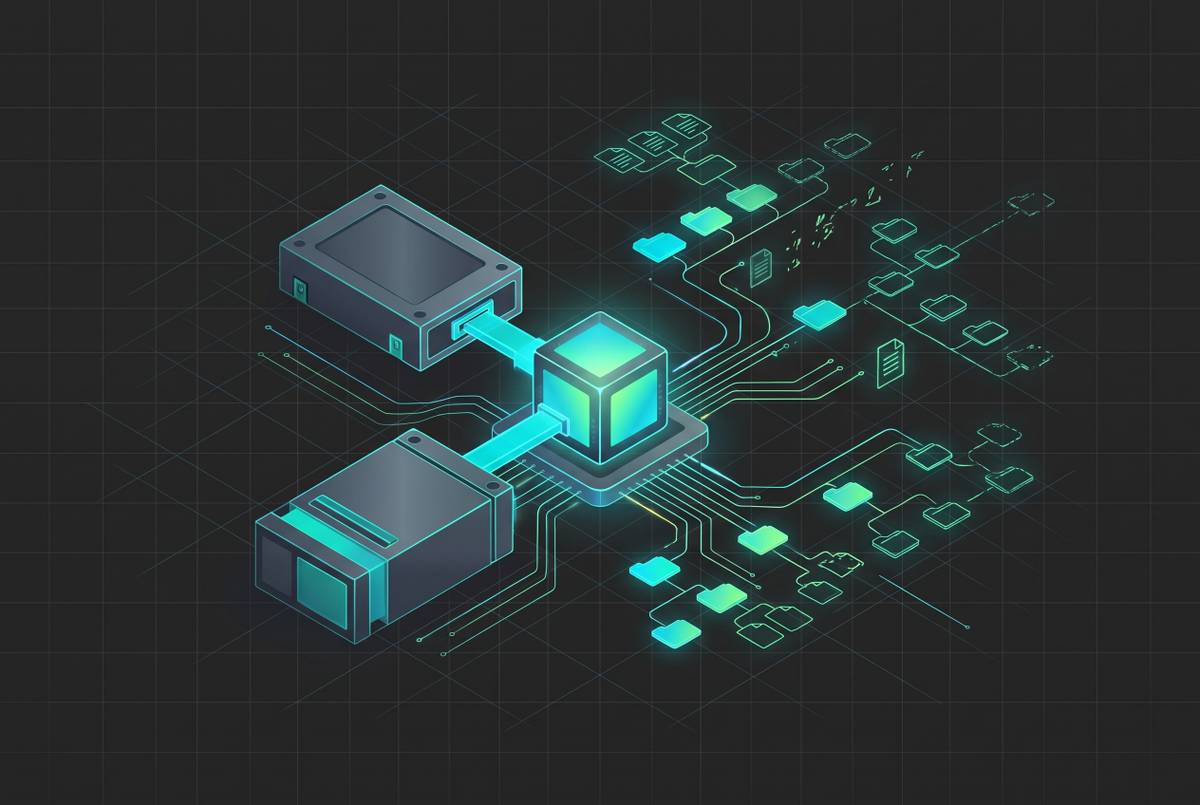
With a disk-per-tenant model, each tenant’s workspace is its own storage unit. An agent or background job receives access to that unit rather than a shared namespace it must filter correctly. Isolation, provisioning, and access control can then follow one resource boundary. The application still has responsibilities, but remembering a tenant predicate on every file operation is no longer one of them. The distinction is between selecting the right room and remembering not to open every cupboard in a shared one.
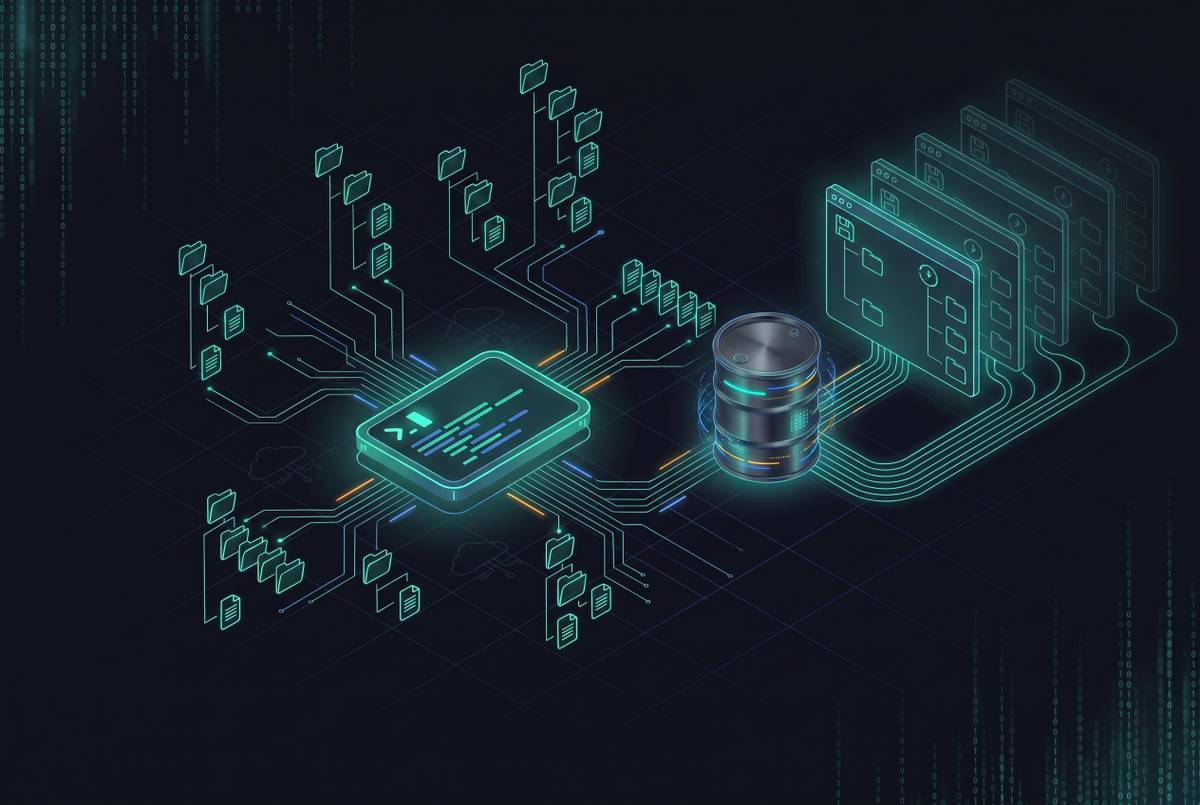
Archil implements this approach with per-tenant disks that mount existing S3, GCS, R2, Azure Blob, or S3-compatible buckets as POSIX filesystems without migration. The bucket remains the source of truth. Synchronization runs in both directions, and revoking access leaves the tenant’s data in its own account. The tenant boundary sits at the disk rather than depending on application prefix conventions. This separates the agent’s workspace from the question of where the underlying objects already live.
Provisioning and credential lifecycle are related capabilities, but their implementation needs separate scrutiny. Tigris’s Partner API documents how to create an organization, bucket, user, and scoped credentials with a single call. Its keys are organization-scoped, can be restricted further to particular buckets, and are revoked when the tenant is deactivated. Those concrete properties depend on the implementation behind the word “disk. AWS S3 Files offers a comparable filesystem route for AWS-native stacks that reduces copying into compute environments, while leaving the central comparison intact. The comparison turns on where access is enforced and what each credential can reach.
Why AI agents specifically stress tenant boundaries that traditional SaaS applications leave stable
Traditional SaaS applications often expose a constrained interface with known request paths. Agents loosen that constraint by generating code, calling tools autonomously, and traversing filesystems. The interface stops being the fence. A tenant_id in a prompt or model-generated argument describes intended scope, but it does not restrict a credential or a mounted path. As work passes through tools, queues, caches, artifacts, and logs, the original login context can lose its authority over what happens next.
Two tenants may both have resources called “production,” “orders,” or “main,” and selecting one from context can resolve to the wrong object. No attacker needs to attend this meeting. The failure comes from treating a familiar name as sufficient authority in shared infrastructure. A tenant-scoped namespace removes that ambiguity from file access.
Copying data into a shared sandbox introduces another boundary change. The copies leave the tenant path and inherit the execution environment’s isolation, even if the original objects were carefully partitioned. Mounting storage in place avoids that copy and preserves the path. However, a correct storage path cannot compensate for an execution environment that exposes other tenants’ mounts. Agent workloads make the connection between storage and compute isolation unavoidable.
How execution isolation and storage isolation must enforce the same tenant boundary
Each tenant’s sandbox must have access only to the workspace and credentials that belong to that tenant. A tenant_id supplied by generated code cannot substitute for those restrictions. If a process can reach another tenant’s mounted files, separate disks have not completed the job. Storage and execution must agree on who is inside the fence.
Standard containers share the host kernel, so a container escape can expose the host and neighboring tenants. They are insufficient for untrusted or agent-generated code. gVisor intercepts system calls without a full virtual machine and offers stronger separation where container-like density suits more predictable workloads. MicroVMs, including Firecracker and Kata Containers, place a dedicated guest kernel behind hardware virtualization. They are the default choice here for untrusted code on shared hardware or agents needing a full Linux environment.
Network access requires a control separate from sandbox isolation. An agent that reaches the instance metadata service at 169.254.169.254 can get host instance credentials, so default-deny egress is an important way to guard against that access. Prompt injection needs no escape if it can persuade an agent with valid credentials to send data out. Archil’s Free plan limits outbound traffic to a managed allowlist, while Developer plans and above support custom firewall rules and brokered credentials keep secrets outside the sandbox. Multi-attach does not itself weaken tenant separation because microVM and credential isolation still govern access to the disk.
Performance isolation as the second half of multi-tenant storage that bucket models ignore
A tenant running a large restore can consume disk and network capacity while other tenants’ jobs slow or miss their windows. Capacity quotas limit how much a tenant can store while leaving how aggressively it can occupy shared resources unconstrained. Prefix permissions answer an access question, while the noisy neighbor is asking for all the bandwidth.
The University of California, Berkeley’s 2026 Delta Fair Sharing paper explains why ordinary fair sharing is insufficient for storage resources with high preemption delays. Write buffers and read caches cannot always be reclaimed promptly. A client waiting for its share of a write buffer may have to wait for dirty pages to flush to disk. The paper’s δ-fairness model bounds the delay in receiving a fair share.
For a disk-per-tenant design, the practical requirement is storage-enforced control over request rate and bandwidth. Those controls belong in the design from the first tenant. A disk boundary makes the tenant a clear unit for enforcement, but does not prove that performance isolation exists. Buyers still need to distinguish separate access from separate resource guarantees. Otherwise, the files have private offices but everyone shares one very slow lift.
How per-tenant disks enable the agent workflows that shared storage makes fragile
Persistent storage separates an agent’s working environment from the lifetime of its sandbox. Repositories, working files, generated artifacts, installed packages, language runtimes, and system dependencies can survive eviction and restarts. In a serverless runtime, a persistent, shareable disk can pair with a sandbox per tenant and mount on many machines for parallel runs. An S3-compatible API also lets the rest of the stack reach the same data.
One agent can produce outputs that another consumes, while multiple sessions work against the same tenant’s dataset. Amazon Bedrock AgentCore Runtime provides another managed route through bring-your-own filesystems, with S3 Files and EFS access points attached directly to agent runtimes. The filesystem mounts into each session at a specified path. Agents then use standard file operations rather than a separate copy-in and copy-out routine for each session.
Branching changes how parallel attempts and rollbacks fit into this model. Disks that checkpoint and branch quickly no matter how large they are let another attempt start without a full copy. Persistence and branching solve different problems. At the other end of the lifecycle, credential revocation ends access, while a separate per-tenant encryption key supports cryptographic deletion by making the data unreadable when that key is destroyed.
Deciding when disk-per-tenant is the right isolation tier and when lower tiers still fit
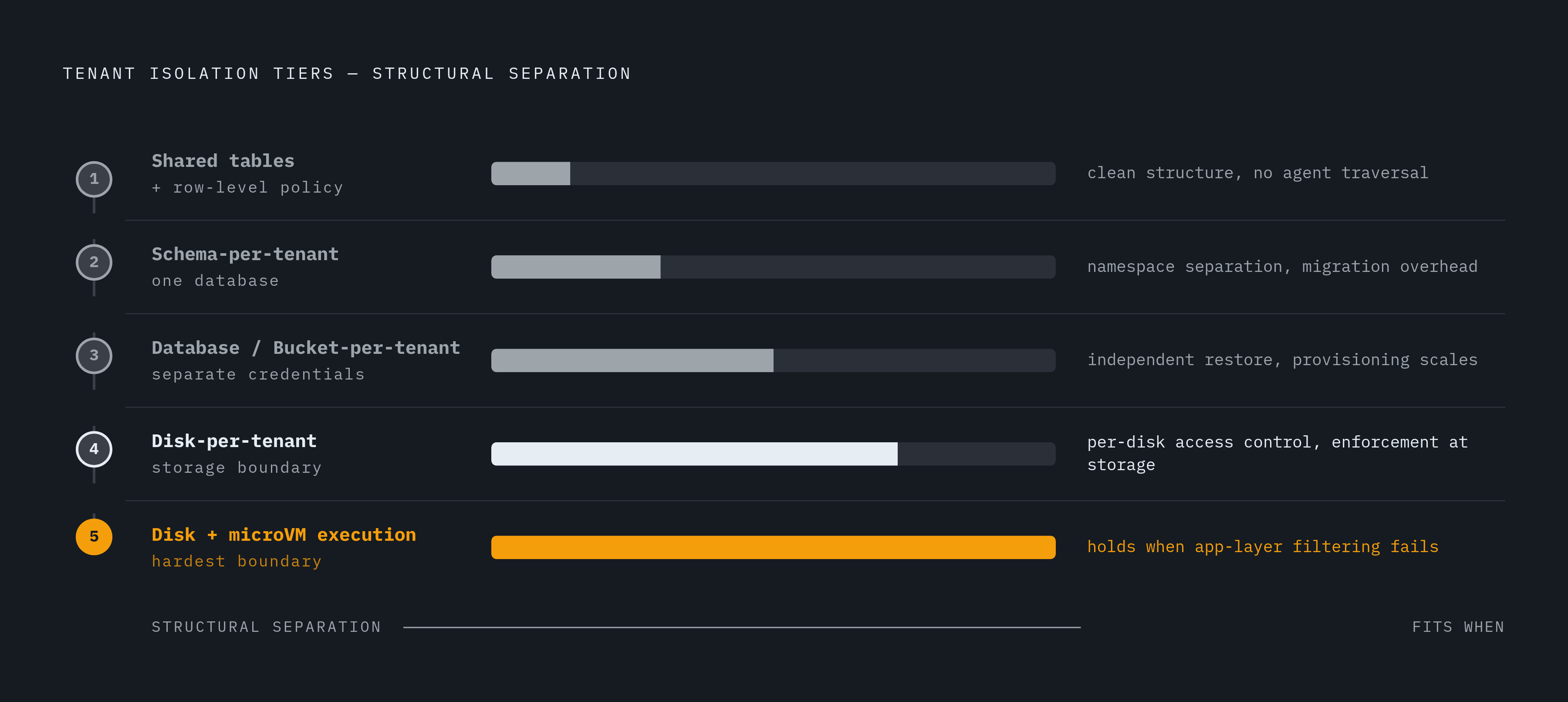
The right isolation tier depends on workload, regulation, tenant size, and operating cost. This is not a security beauty contest. Shared tables with row-level policy remain a low-cost fit for cleanly structured data when agent-generated code does not traverse storage. Schema-per-tenant adds a separate namespace inside one database, at the cost of migration and connection work. Database-per-tenant or bucket-per-tenant adds separate credentials and independent restores, while provisioning and maintenance grow with the tenant count.
Disk-per-tenant with microVM execution fits a different set of demands. It is appropriate when agents generate code, tenants need independent restore or customer-managed encryption, workloads are unusually large, or isolation must survive a misconfigured application filter. Production platforms can mix these tiers. Logical scoping can serve most tenants while dedicated storage serves heavy or regulated ones. Filesystems and databases also remain complements, with disks handling the unstructured, agent-traversed, session-persistent workspace rather than replacing a database that already fits the data.
Thousands of tenant-specific CloudFormation stacks made stronger separation expensive to operate. Single-call provisioning, as documented by the Partner API, and per-tenant disk primitives change that calculation by reducing the machinery needed to create a workspace and scope its access. Isolation tiers remain distinct, but these capabilities weaken the argument that a structural tenant boundary must come with an unmanageable fleet of provisioning workflows.
This article is sponsored by Archil.