POSIX Fluency in Pretrained Models as a Storage Architecture Signal
Models know POSIX, but agents need storage that keeps its promises.
Sponsored by Archil
Serverless bash execution integrated with a persistent cloud filesystem gives an AI agent a working directory that survives between runs. The architecture needs real POSIX semantics, an isolated sandbox, and persistence for the state the workflow uses. POSIX fluency in pretrained models makes this more than a convenience choice. Storage should match how the model already reasons.
How frontier models came to think in POSIX idioms
An agent reaches for ls to inspect a directory and cat to read a sample before reaching for an API or a schema. That instinct has a training history. Most of this training material is Unix/Linux code, shell scripts, and documentation that use the file system as the common interface to data. Because open-source and proprietary frontier models learn from so much of this material, paths and shell commands are familiar ways for them to get work done.
He et al.'s systematic review, Bridging Generation and Training, connects training-data quality in code LLMs to generated-code quality, showing how corpus composition shapes reproduced patterns and defects. Familiarity cuts both ways. A model learns useful programming habits from public repositories, but also inherits gaps and faulty assumptions. POSIX fluency therefore provides a strong starting point for interface design.
What φ-Bench reveals about where POSIX fluency holds and where it breaks
φ-Bench, developed by Yuqi Xue, Daixuan Li, and Jian Huang at the University of Illinois Urbana-Champaign, is the first benchmarking framework purpose-built for file system design and implementation tasks. It tests basic understanding, basic implementation, performance modeling, debugging, optimization, and new feature development. Its evaluation covers open-source models DeepSeek-V4-Flash, GLM-5.1, and MiniMax-M2.7, and proprietary models Claude-Opus-4.7, GPT-5.2, and Gemini-3.1-Pro. The performance gradient is clear. Models do well on basics, then struggle sharply more with debugging, optimization, and new features.
Models often fail the benchmark's reasoning tasks because they do not think them through fully, especially when they miss edge cases. Knowing the pattern is not the same as knowing its limits. In its sharpest illustration, a model implementing POSIX read() failed to handle a read offset beyond the file size. The call had the right shape, but the boundary logic was wrong. That difference causes trouble for infrastructure when an agent uses a familiar call on storage that does not keep the call's promises.
Why confident but incomplete POSIX reasoning breaks agents when the storage layer does not hold its end
Consider an agent writing a temporary file and calling os.rename(tmp, final) to put it in place. This is a standard atomic-write pattern in Python and Linux programming. On a storage layer that silently violates rename semantics, however, the familiar pattern can produce corruption without an error signal. S3 does not implement atomic rename, so translating the operation into object-store actions does not preserve that promise.
The benchmark shows that models struggle to spot storage mismatches when they have to reason through exceptions. Zhang and Kothari's 2026 iterative feedback study at Iowa State finds that reasoning models improve through feedback on syntax and runtime errors, while logical and algorithmic failures are much less tractable. Silent corruption belongs to the harder category. There may be no useful complaint for the agent to act on.
An instruction to avoid rename or use S3-aware libraries can steer a particular task. But it competes with a deeply learned default and adds exceptions the agent must retain throughout a long session. The prompt becomes a warranty disclaimer for the disk. That is not a dependable correctness boundary. The fix has to sit in the storage layer, where the operation's behavior is decided.
What "matching the cognitive shape of the model" demands of the storage layer
The architectural requirement is a file system whose operations mean what the agent expects them to mean. That includes atomic rename, fsync durability guarantees, mmap, hard links, symlinks, sparse files, and correct offset-boundary behavior for read() and write(). These semantics let the model use patterns it has learned without working through special rules for storage every time it opens a file.
Mountpoint for Amazon S3 provides a mounted interface with partial POSIX support. It does not support random writes or in-place modification of existing files, although truncation through O_TRUNC is supported with --allow-overwrite. It is designed to fail fast on unsupported operations. That is preferable to silent misbehavior, but it still leaves gaps in the interface the model assumes. A FUSE mount alone cannot give guarantees that the service beneath it does not implement.
AWS S3 Files, generally available April 7, 2026, shows that the industry is moving toward using files to reach object data. Product endorsement and verification of every POSIX guarantee remain separate from evidence of industry direction. The distinction is important for architecture selection. Using files to connect agents to data means fewer instructions for the agent, but the service still has to keep the semantics those files promise.
Why object-store semantics create a second failure mode specific to agents: session-state loss
Object APIs introduce another failure mode beyond incorrect operations. The agent must track what it has downloaded locally while accounting for prefixes rather than directories, copy-then-delete renames, and the absence of file locking. That tracking often lives in its context. When context compaction removes the staging record, later steps can assume a download happened when it did not. This time the failure is amnesia.
AWS describes S3 Files as eliminating “data silos, synchronization complexity, and manual data movement between objects and files”. For agents, removing manual staging also removes state that would otherwise need to survive in the conversation. The file is available at the expected path instead. This differs from repairing a runtime error through feedback, because lost session state can sever the feedback loop itself. Telling an agent to remember downloads cannot fix a design that keeps essential storage state in context it can lose.
What POSIX compliance requires of the sandbox, not just the storage layer
Storage correctness also depends on what can interfere with storage. Standard containers share the host kernel, and runc vulnerabilities disclosed in 2024 and 2025 allowed escapes to the host. A compromised workload can therefore threaten the environment behind the file system interface. Isolation and correctness are coupled.
gVisor intercepts system calls in user space without full virtual machines, and Anthropic identifies it as the isolation layer for code execution in claude.ai. Firecracker microVMs instead provide hardware-enforced isolation, a dedicated kernel per workload, and a full Linux guest. Many teams use gVisor for routine execution and microVMs for builds and third-party code. Neither label ends the security discussion. Firecracker's 2026 escape-class vulnerabilities include CVE-2026-5747, an out-of-bounds write in virtio PCI transport, and CVE-2026-1386, a host-file overwrite through a symlink in jailer. Continued use of microVMs requires verifying and patching the perimeter.
For teams implementing that perimeter, default-deny egress is the starting point, with explicit allowlists for package registries, model APIs, and required domains. Everything else is dropped and logged. Credentials should be brokered at the network boundary rather than placed in environment variables, where printenv can expose them. Instance metadata access on EC2, GKE, and AKS also needs blocking at the network-policy layer. Otherwise, outbound HTTP can become a route to node credentials outside the platform's authorization model.
How do you give an AI agent a persistent working directory between runs?
A correct file system loses much of its value if every invocation rebuilds the agent's environment. Installed packages, intermediate outputs, and working files help it carry its reasoning from one run to the next. Ephemeral execution still has a legitimate role. It suits isolated, one-shot code execution and short-lived analysis, but an ephemeral serverless workspace is not a persistent working directory. Coding agents, research workflows, and multi-step pipelines need state that outlives an invocation.
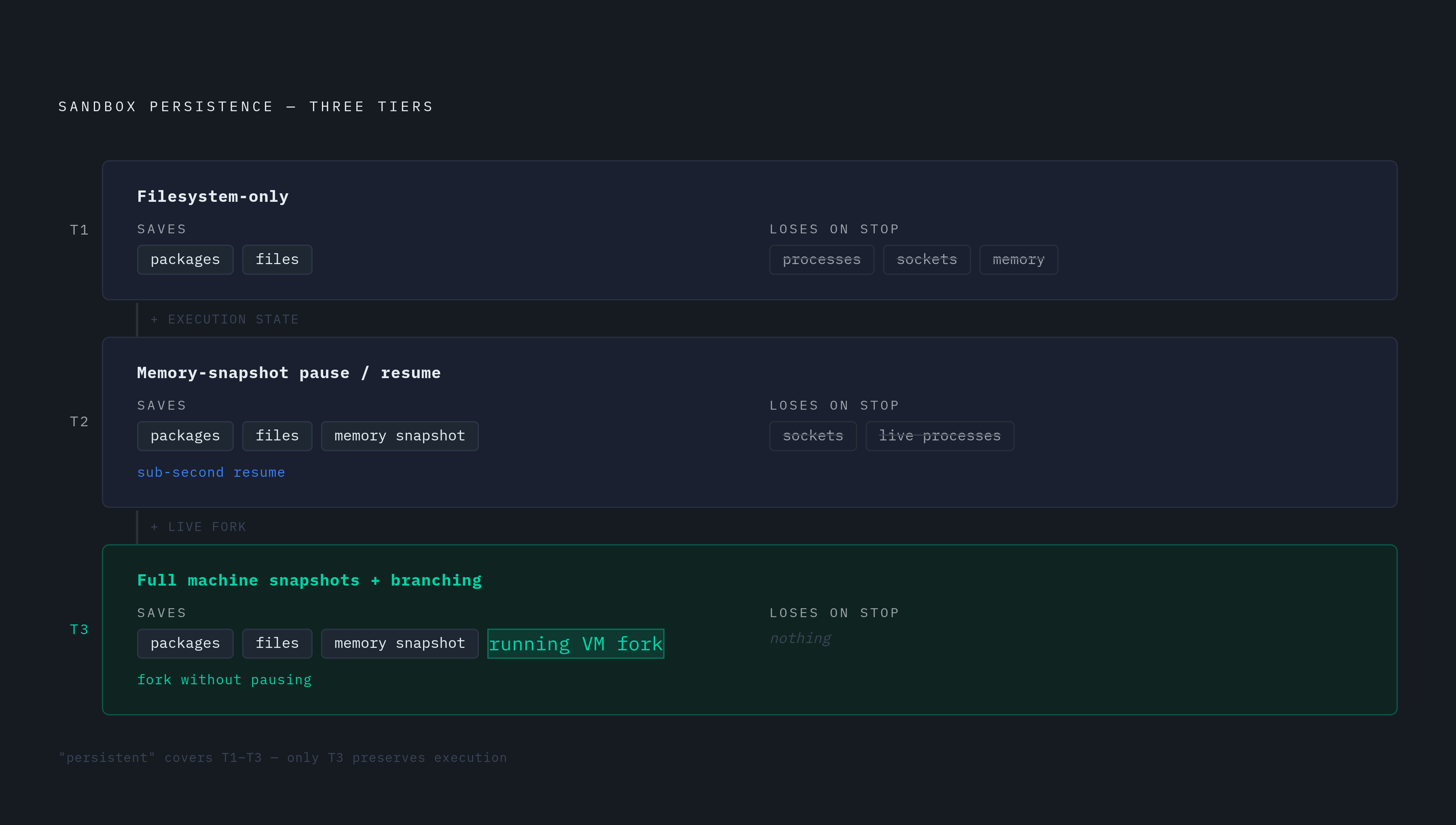
The persistence choice depends on which state must survive. Filesystem-only persistence preserves packages and files but loses processes, open sockets, and memory on stop. Memory-snapshot pause/resume preserves the filesystem and a memory snapshot, allowing sub-second resume. Full machine snapshots with branching add the ability to fork a running VM without pausing it. Saving files and preserving execution are different promises, even when both appear under a “persistent” label.
DeltaBox is designed around millisecond-level sandbox checkpoint and rollback for stateful AI agents. Its purpose extends beyond avoiding a rebuild. An agent can explore concurrent solution branches and return to a checkpoint when one fails. Persistence then becomes more than continuity along one path. It provides the branching point for trying another.
Forking the agent's environment as a routine operation, not an emergency measure
Traditionally, copying a large environment meant copying gigabytes of state, so forks cost enough that teams saved them for rare cases. Fast checkpointing changes that tradeoff. When branches are cheap enough, speculative attempts can become part of normal agent work. The established checkpointing primitives support this direction, without implying that every sandbox offers the same performance or disk-size behavior.
A planner and several executor agents can share a base disk while each executor works in its own branch. The branch boundary becomes the isolation boundary. Root disks have a single owner by default to keep others from interfering, while extra disks can use read-only or conditional mounts to share data. Within those boundaries, familiar operations such as modifying files, renaming into place, and calling fsync fit the branching workflow. The agent need not learn an entirely new storage language before it can attempt a safer experiment.
What this means for multi-tenant agent products and per-tenant storage
For a team shipping an agent product to thousands of customers, these requirements become simultaneous obligations. Each tenant needs file-system correctness without exposing its files or credentials to another tenant's code. A shared prefix is not that boundary. The design calls for a disk per tenant, with separation enforced at the disk boundary rather than relying on application-layer ACLs that agent code could bypass. Isolation must remain intact as workloads multiply.
Data in S3, GCS, R2, or Azure Blob should be accessible as a POSIX path without an ETL pipeline, migration, or copy, while the bucket remains the source of truth and the customer controls access revocation. Mounting the bucket must not quietly exchange familiar file semantics for object-store exceptions. S3 Files demonstrates the scale of file access, supporting up to tens of thousands of concurrent NFS connections per filesystem through NFS v4.1/v4.2.
Vercel Sandbox's FUSE support, dated July 3, 2026, shows how platforms are moving toward mounting remote storage as normal paths inside a running sandbox. Vercel also warns that credentials passed to mount-s3 stay exposed inside the sandbox for as long as the process runs. For product builders, storage billing should likewise follow active use rather than oversized provisioned volumes or artificial limits on intermediate work. A tenant needing 1 MB should not have to pay for a provisioned 100 GB volume.
The architectural conclusion: storage that matches the model's cognitive shape
Models supply strong familiarity with common POSIX patterns, but cannot reliably compensate for storage that changes those patterns' meaning. Infrastructure must uphold its end. That means judging serverless bash execution by semantic correctness, isolation, credential handling, and persistence together, rather than treating a working shell as the whole product.
None of this asks the model to become a better storage administrator. It gives the model an environment in which its existing skills are useful and its known weaknesses are less dangerous. Matching the cognitive shape the model already has is an engineering constraint for the storage layer.
This article is sponsored by Archil.