Recovery Point Objective and Recovery Time Objective for S3 Architectures
Define RPO and RTO targets before choosing S3 disaster recovery tools.

A sequencing mistake shows up across S3 disaster recovery projects: teams pick replication tools and backup schedules first, then test those choices against recovery targets afterward. Recovery Point Objective and Recovery Time Objective should decide which tools are even allowed on the table before a single bucket policy gets written.
RPO and RTO measure different things and pull on different levers. An RPO of 24 hours means a nightly backup job does the whole job. Those are two very different engineering problems wearing the same acronym family.
The gap between what a company writes down as its target and what it can actually deliver almost never appears on the RPO side. What teams consistently get wrong is how long it actually takes to stand everything back up, because restoring data and restoring a working system are not the same task.
Before any numbers get set, a Business Impact Analysis has to happen. That means pricing out what an hour of downtime costs for each system, sorting which systems are mission-critical versus which ones can wait, and checking whether seasonal peaks change the math (a retailer's checkout system in December is not the same risk as the same system in February). That analysis sorts systems into tiers, and each tier carries its own RTO and RPO tolerance. A customer-facing application in AWS might lean on authentication services, a database, and S3 all at once. Recovery has to be mapped at the workload level, not the service level.
The four DR strategies AWS offers
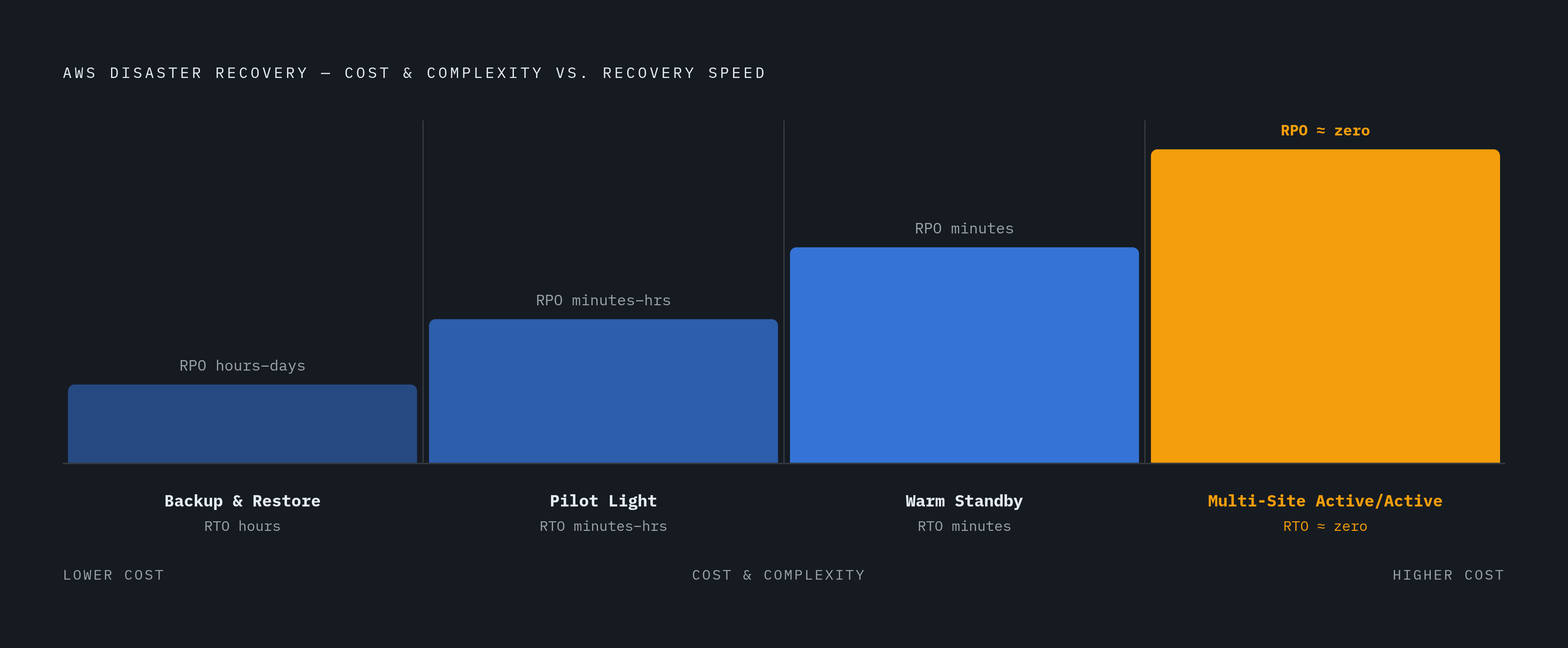
AWS's disaster recovery whitepaper lays out four strategies on a single cost-complexity spectrum, and the right one for any given workload falls out directly from its RPO and RTO numbers, not from which option sounds the most impressive in a planning meeting.
Backup and restore is the low-cost, low-complexity end. S3 is the natural home for this backup data: it's durable, reachable from any server over plain HTTP without needing a volume mounted, and cheap enough that keeping years of history doesn't wreck a budget. AWS CodePipeline can automate the redeployment of code and configuration, which takes a chunk of that manual effort off the table.
Pilot light keeps a minimal version of the secondary environment running at all times, small enough to be cheap but ready to scale up the moment a failover gets triggered. S3 Cross-Region Replication is the natural data layer for this pattern, because objects replicate asynchronously and continuously to the DR region, so the data is already sitting there waiting when failover happens.
Warm standby goes a step further: a scaled-down but fully functional copy of production runs in the DR region continuously. Replication keeps the data layer current, so the only job left during failover is scaling compute and application layers up, not rebuilding them from nothing.
Multi-site active/active has both regions serving live traffic at the same time. S3's job changes shape here too: replication has to run in both directions and conflict resolution has to be designed on purpose, not assumed. This is the most expensive topology on the list, and it only makes sense when the business genuinely cannot absorb any downtime.
The three strategies short of full active/active all depend on a passive site that sits idle until something goes wrong. AWS Resilience Hub exists specifically to track, on an ongoing basis, whether a workload is actually on track to meet its RTO and RPO targets.
S3 versioning, Object Lock, and the RPO floor
Versioning and Object Lock are the two features that decide what recovery points even exist on S3, and whether those recovery points can be wiped out by accident or by someone who wants them wiped out.
S3 versioning keeps the original copy of an object around after it's been changed or deleted, which makes it a solid defense against the most common disaster of all: a person making a mistake. Versioning also enables point-in-time restore at the bucket level, and pairing it with Amazon EventBridge lets operators build near real-time event streams off S3 activity to support that kind of restore.
Object Lock adds immutability on top. Objects under Lock cannot be deleted or overwritten for a set retention period, full stop, regardless of who's asking or how they're asking. The STG338 session at re:Invent 2025, "Data Protection and Resilience with AWS Storage," covers ransomware protection and compliance controls specifically through this combination: versioning, Object Lock, cross-region replication, and the DR architectures built on top of them.
A corrupted or ransomed object gets written to the source bucket, and because replication is continuous and asynchronous, that bad object copies straight over to the DR bucket before anyone notices anything is wrong, which is how teams find out the hard way that continuous replication alone isn't a backup strategy. Versioning and Object Lock are what turn S3 into a trustworthy RPO anchor instead of a very efficient way to propagate a problem to a second region.
AWS Backup for S3 and S3 Cross-Region Replication
AWS Backup for S3 and S3 Cross-Region Replication solve overlapping but genuinely different problems, and a mature architecture generally needs both rather than picking one as a substitute for the other.
AWS Backup for S3 runs in two modes. Backup brings real operational benefits that replication doesn't: built-in traceability for tracking backup and restore activity and generating compliance reports an auditor will actually accept, and central management that lets a team configure, schedule, and monitor backup policies across S3, EBS, RDS, DynamoDB, EFS, FSx, and more from a single console. The restore experience is single-click, and it supports cross-region and cross-account backup copies. It's built to protect an application, not speed it up, and metadata tracking can miss intermediate states if an object's tags or ACL change more than once within the same minute.
S3 Cross-Region Replication works differently. It preserves all object metadata, including original creation times and version IDs, which matters when the DR copy needs to be byte-identical to the source. It also has no per-bucket object ceiling, where AWS Backup tops out around 30 billion objects per bucket.
S3 Replication Time Control sits on top of CRR as an upgrade for teams with a tighter RPO. It replicates most objects within seconds, and AWS documentation states that 99.99% of objects replicate within 15 minutes. RTC closes the gap for teams whose RPO target is measured in minutes. Same-Region Replication, by contrast, copies objects across buckets within one region and is built for things like log aggregation or keeping environments in sync, not for regional disaster recovery.
The honest summary: CRR, especially paired with RTC, keeps the DR bucket current and minimizes RPO. Neither one replaces the other.
Matching an RPO target to replication and backup configuration
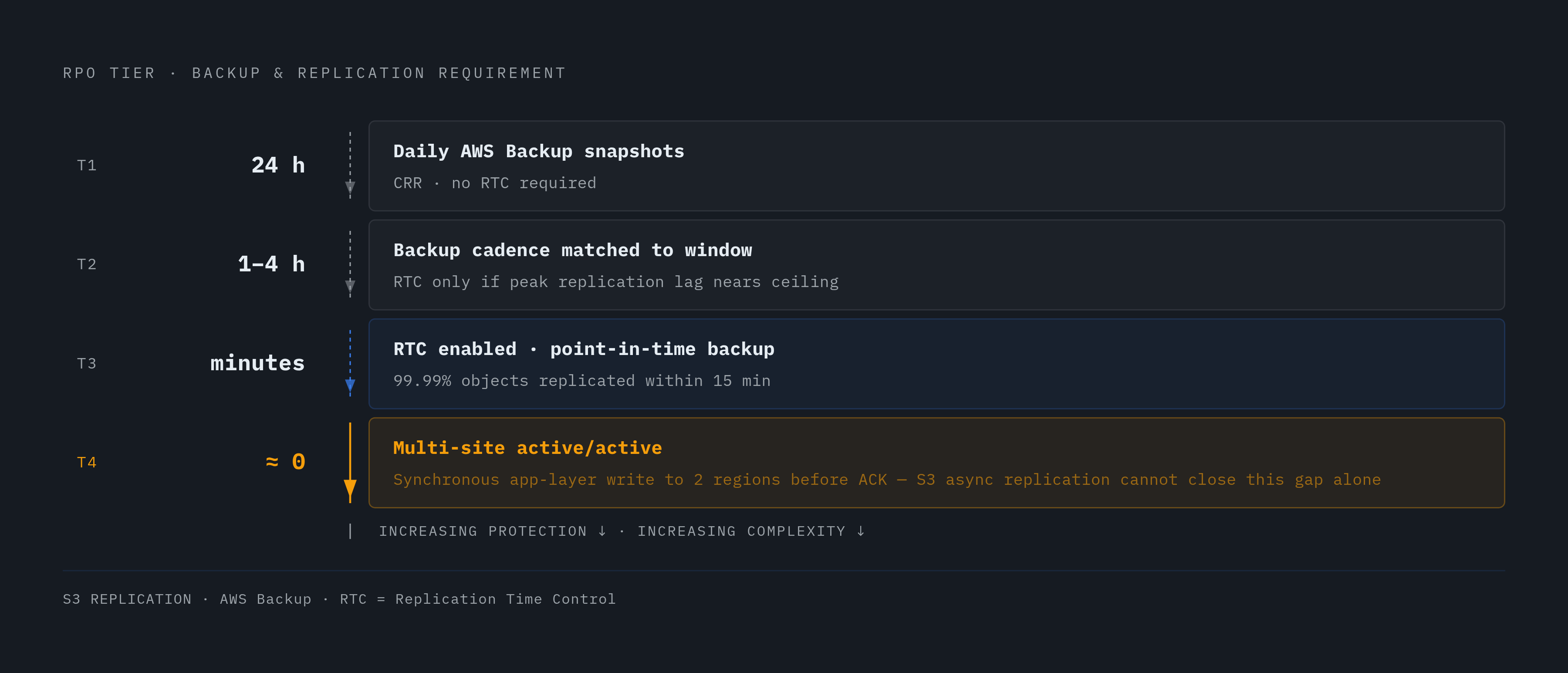
An RPO target is a number that should be read as a direct instruction for backup frequency, replication mode, and whether RTC belongs in the architecture. There's no universal configuration that fits every target, so the right move is to work outward from the number itself.
At an RPO of 24 hours, daily scheduled AWS Backup snapshots are enough, and CRR without RTC does the job too. Asynchronous replication, running under normal conditions, will keep the data gap well inside a 24-hour window without extra tuning. This tier suits non-critical archives, content libraries, and any workload where paying for a tighter recovery window isn't justified by what's actually at stake.
At an RPO of one to four hours, the backup cadence has to match or beat that window. RTC becomes worth paying for only if replication lag gets measured under peak load and it's found to be creeping up toward the RPO ceiling, not as a default precaution.
At an RPO measured in minutes, RTC is the right call. AWS states that RTC replicates 99.99% of objects within 15 minutes, and that's the realistic floor achievable with it turned on. Point-in-time backup still needs to run on a cadence that fits inside that RPO window, because leaning on CRR by itself reopens the corruption-propagation risk described earlier: fast replication of bad data is still bad data, just delivered quickly.
At an RPO near zero, the requirements change category. True zero RPO needs synchronous writes confirmed in a secondary location before the write is acknowledged, and S3's native replication is asynchronous by design, so it cannot get there alone. The only S3-native route toward this target is a multi-site active/active topology with bidirectional replication and deliberate conflict resolution, and the cost jumps accordingly. The actual mechanism is application-layer write confirmation to two regions before the write is acknowledged to the caller, a genuine architecture decision that teams must build deliberately.
RTO is governed by recovery automation, not just data availability
The most common reason teams blow past their RTO has nothing to do with missing data. That gap inflates actual recovery time well past the target even when the backup sitting in S3 is perfect.
Infrastructure as Code is the single biggest lever on RTO. IaC coverage has to extend past the application layer too, into AMIs, network configuration, IAM policies, and S3 bucket configuration. A gap in any one of those layers means someone is doing manual cleanup by hand during an outage, which is exactly the moment manual work is least welcome.
A DR runbook is the operational partner to IaC, and a DR plan without a tested runbook is really just an assumption that hasn't been checked. The core steps stay consistent: assess whether the situation is a recoverable incident or a genuine DR event, provision replacement infrastructure, restore data from the right backup point, restore configuration from its own backup, then validate everything before cutting traffic over.
AWS Resilience Hub provides the ongoing check on all of this, continuously validating whether a workload is actually likely to meet its RTO and RPO targets, which catches drift before a real event forces the question. A strategy nobody has tested is a hope, not a plan.
AI training workloads and the RTO calculus on S3
AI training workloads break the standard RTO playbook, because recovering from a failure isn't just restoring files.
Checkpoints are the center of this problem. Recovery speed drops off a cliff moving through those tiers, from sub-minute on NVMe to a longer wait once S3 is the source.
Training recovery also can't happen piecemeal the way a web application's recovery can. That changes what "RTO" should even mean for this kind of workload: resuming at the exact point of failure may not be achievable at all, so the realistic target is resuming from the most recent valid checkpoint instead.
S3 provides the durable anchor that everything else in the recovery architecture depends on. The STG338 session at re:Invent 2025 covers DR architectures built for regulated and mission-critical workloads, a category AI training pipelines increasingly fall into. S3's eleven nines of durability make it the right home for training corpora that, if lost, can't simply be regenerated. If the dataset disappears, the pipeline has nothing to run on.
There's also a latency dimension that's easy to miss. Training pipelines read the same dataset repeatedly across many GPU nodes, so the time it takes to restore access to that data on S3 after a failure counts directly against RTO. Architectures that give direct filesystem-style access to S3 data, skipping the copy step, cut that phase out of recovery. Training can resume reading straight from S3 as soon as compute comes back online.
Multi-region and active/active S3 topologies
Multi-site active/active is the only S3 topology that gets close to zero RTO, because there's no failover step at all, just traffic getting rerouted to a region that's already live. That comes at the highest cost and the highest architectural complexity on the spectrum, and most workloads simply don't need it.
Two conditions tend to justify it. The second is geography: when users are spread across the globe such that a single active region adds meaningful latency for a large share of traffic, active/active delivers a performance win alongside the DR benefit, not just insurance.
Building it on S3 means setting up bidirectional replication between two or more regions, with S3 Replica Modification Sync letting metadata changes on replicas flow back to the source to keep both sides consistent. Traffic routing, whether DNS-based or handled through a load balancer, has to be pre-configured to redirect requests to the healthy region automatically, without anyone needing to intervene by hand mid-failure.
Regional choice isn't free, either. AWS launched its European Sovereign Cloud in January 2026 with more than 90 services, a meaningfully smaller set than the 200-plus available in standard AWS regions, a gap that comes from the security checks required for compliance. On the portability side, the fact that S3's API functions as a vendor-neutral standard means replication and access patterns built for AWS S3 generally carry over to other S3-compatible storage, which opens the door to cloud-agnostic DR designs without rewriting application code from scratch.
Choosing among the patterns, mapping targets to the decision
The right S3 disaster recovery pattern is the one whose cost and complexity are actually justified by what the failure it's guarding against would cost the business.
The decision logic maps cleanly onto the tiers covered earlier. For an RPO measured in hours and an RTO measured in hours, backup and restore with AWS Backup for S3, scheduled snapshots, and CRR without RTC covers the need, with an IaC-driven recovery runbook doing the real work of hitting the RTO target; this tier fits non-critical data, content archives, and workloads where cost sensitivity rules. For an RPO measured in minutes and an RTO of 15 to 60 minutes, the right build is CRR paired with S3 RTC (which AWS states replicates 99.99% of objects within 15 minutes), versioning and Object Lock on the DR bucket, and a pilot light or warm standby compute layer, all backed by pre-validated IaC and a runbook that's actually been tested. For an RPO near zero and an RTO measured in minutes, multi-site active/active with bidirectional replication is the only path, built with application-layer write confirmation to two regions, DNS failover pre-positioned and ready, and sovereignty constraints resolved before the topology gets finalized.
A few decisions apply no matter which tier a workload lands in. Versioning belongs on the source and destination bucket at every tier, since it's the baseline that makes point-in-time restore possible and keeps corruption from quietly destroying the one recovery point a team has. Object Lock on the DR bucket stops malicious or accidental deletion of that recovery copy. For AI training workloads specifically, the decision framework needs two extra variables folded in: checkpoint cadence as the RPO lever, and data access latency as the RTO lever. Restoring access to training data without a prior copy step is a real RTO advantage, and architectures that mount S3 directly, cutting out the copy-before-training phase, shrink the time between infrastructure coming back online and actual work resuming.
The strongest pushback against all of this is cost. Start with a rigorous Business Impact Analysis that puts a real number on what downtime costs, then size the DR investment to match that number. AWS's own DR whitepaper is blunt about the last piece of this: regularly assessing and testing the strategy is critical to trusting it when the moment actually arrives. An architecture that has never been tested is a guess with good intentions.
Sources
- Disaster recovery options in the cloud - Disaster Recovery of Workloads on AWS: Recovery in the Cloud
- Designing a resilient and cost-effective backup strategy for Amazon S3
- AWS Storage at re:Invent 2025: Every session, organized by topic
- Validating and Improving the RTO and RPO Using AWS Resilience Hub