Object storage platforms purpose-built for AI agent sandboxing
Storage layers must bridge the gap between ephemeral sandboxes and stateful agent workflows.
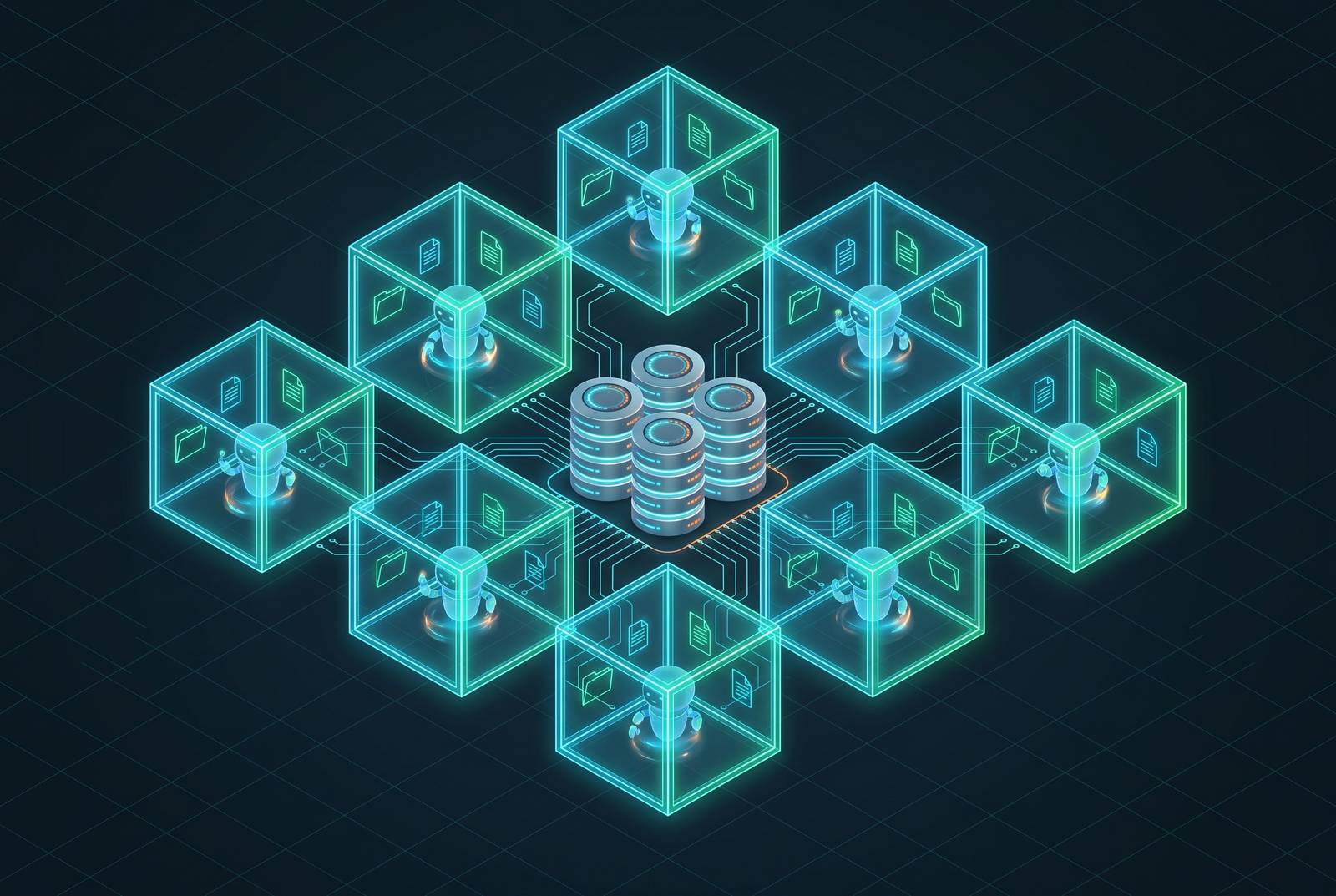
Agent sandboxes are a security primitive. They are not a data architecture, and treating them as one is why multi-agent pipelines keep breaking in production. A sandbox draws a line around what an agent could do and what it is allowed to do: isolation, resource caps, scoped capabilities, an audit trail, a teardown you can count on. That line matters because the threats are not theoretical. Tool poisoning, prompt injection that leads to file exfiltration, credential theft through MCP, and lateral movement across systems are documented attack patterns that have already happened, not scare stories for a conference talk.
Docker's President and COO Mark Cavage said as much at WeAreDevelopers, and he said it carefully: "Sandboxes are part of the containment story, but not all of it, they're the deterministic base layer, while policies are what govern the agent's intent". Read that twice, because it is the hinge the rest of this piece turns on. A sandbox is a wall. It was never meant to be a warehouse.
Here is where that distinction turns into an operational problem. Picture Agent A finishing a task and producing a file, a dataset, a result, anything the next agent in line needs to pick up. Agent B runs in its own sandbox, separate and disposable, the way good security design wants it to be. Something has to move that artifact from A to B, and the sandbox itself offers no mechanism to do it. It was built to isolate, not to hand off. So a coordinating storage layer becomes mandatory the moment you have more than one agent doing real work together, and most teams did not budget for that layer because nobody told them it was coming.
A second problem causes just as much cost and is harder to see: when a large language model acts as a trusted process, it inherits whatever ambient authority that process holds, credentials, filesystem access, network reach, the works. That is the classic confused deputy problem, dressed up in a new costume. Which means the question of what an agent can reach into, from inside its sandbox, is just as important as how strong the sandbox wall is. A perfectly sealed container guarding a door that opens onto everything is just a formality, not security.
So the sandbox does its job, security-wise, and leaves a second job completely untouched: where does shared data actually live, and who is responsible for moving it. That second job is storage, and it does not solve itself just because the first one got solved well.
Why the execution boundary and the storage boundary split
Agents are trained on bash. They reach for files, they ls, they cat, they assume a path exists because that is the entire shape of their training data. Enterprise data, meanwhile, mostly lives in object stores, served through API calls rather than file paths. That mismatch used to be bridgeable by bolting a separate file system onto S3, which worked, except it meant duplicating data and running sync pipelines to keep the copies honest. It is a patch, not a fix, and patches have a way of becoming permanent.
The mismatch appears in real engineering teams in a specific, avoidable way. At AWS, teams using tools like Kiro and Claude Code kept hitting the same wall: agents defaulted to local file tools even when the actual data lived in S3. Downloading a local copy worked fine, right up until the agent's context window compacted and the session state vanished with it. The agent did what it was trained to do. The infrastructure underneath just was not built to remember what the agent had done.
Disposable sandboxes make the problem sharper, not softer. Ephemeral teardown is the whole point of a sandbox, the clean, deterministic end of a session, and that means anything an agent wrote to its local filesystem during that session disappears when the sandbox closes. State loss here is the sandbox doing its job, since the job was never to remember things, not a defect anyone needs to file a bug for.
The real question when you zoom out is which layer owns context: process memory, filesystem state, object metadata, take your pick. None of those map cleanly onto a sandbox's lifecycle defaults, because the sandbox lifecycle was designed around clean teardown, not continuity. That is precisely why persistence stopped being a niche ask from a handful of edge-case teams and became something every production agent team now has to evaluate on purpose. Agents that build a working environment step by step, or that run tasks stretching across hours or days, need somewhere to put things down that will not vanish the moment the lights go off.
Persistence across the 2026 sandbox platforms
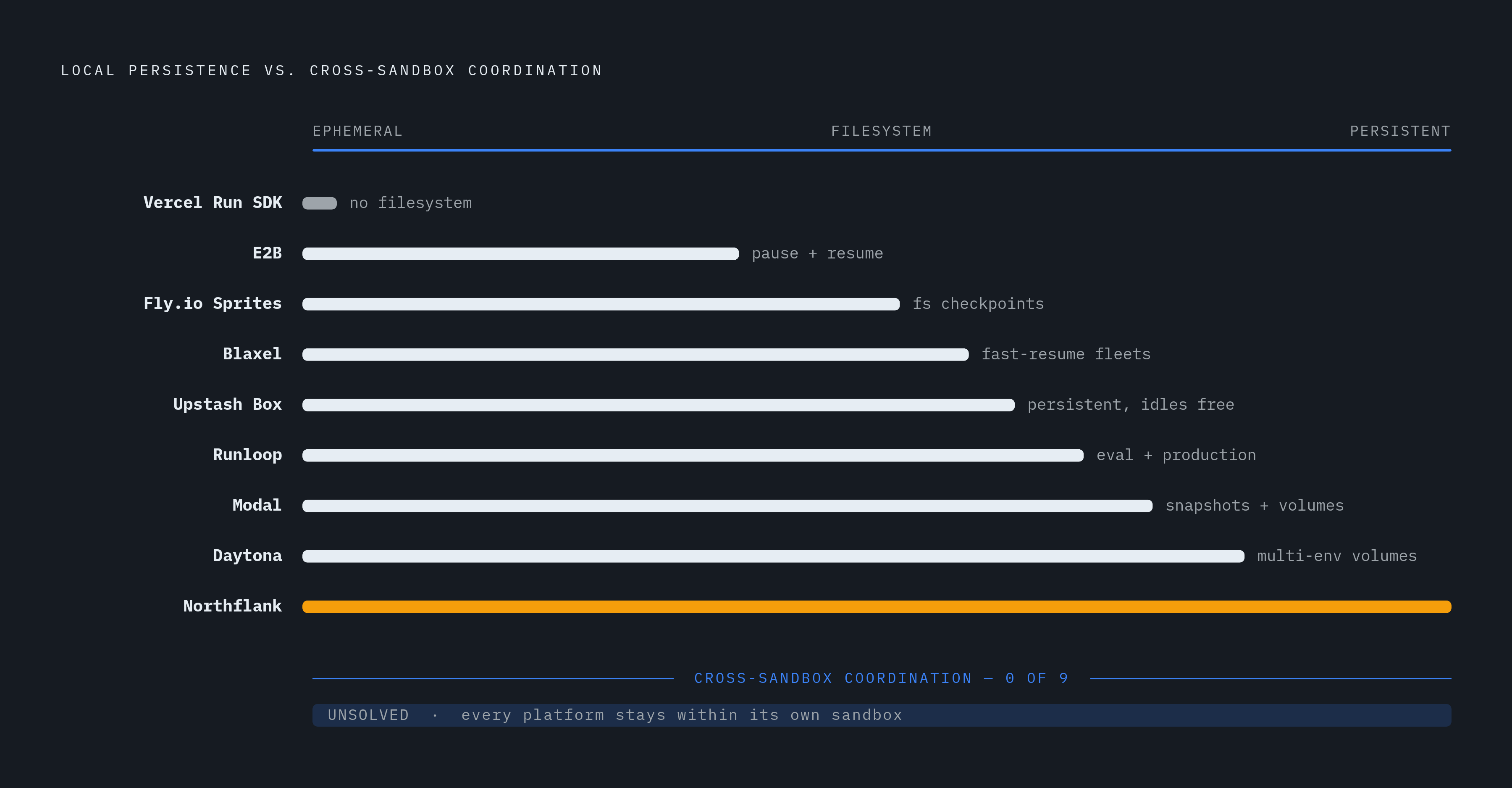
The honest way to describe the 2026 sandbox market is a set of platforms each solving a different slice of persistence, with none of them resolving the cross-sandbox storage coordination problem on their own. Northflank offers isolated sandbox environments with fast startup and room for thousands of concurrent sessions, persistence through attached volumes up to 64 TB with multi-read-write support, and S3-compatible object storage for artifacts, running on microVMs (Kata Containers, Firecracker, Cloud Hypervisor) where nested virtualization is available and falling back to gVisor where it is not, with no fixed session time limit, priced at $0.01667 per vCPU-hour and $0.00833 per GB-hour, with BYOC available and SOC 2 Type II and HIPAA compliance, best suited to teams that need isolation without a session clock running out from under them.
E2B runs general remote Linux microVMs with pause-and-resume that retains process state, including memory, on a $0 Hobby tier plus usage, and it is the natural choice for agents that need to clone repositories, install arbitrary packages, or compile code in any Linux-compatible language. Fly.io Sprites gives agents persistent Linux workspaces that idle between tasks, with filesystem checkpoints for rollback, on a $0 pay-as-you-go tier plus usage and a $30 credit, built for project files and installed tools that need to survive inactivity. Daytona runs fast multi-runtime and GPU sandboxes with persistent volumes that exist independently of any single sandbox and can be mounted across multiple environments, which matters when agents need to share datasets, dependencies, or files across tasks without copying everything into each new sandbox, priced from $0.0504 per vCPU-hour with $200 in compute credits available.
Modal Sandboxes targets agent environments and GPU workloads with reusable filesystem snapshots, directory snapshots in beta, and persistent volumes, on a $0 Starter tier plus usage and a $30 monthly credit. Vercel's Run SDK takes a different shape entirely: bounded JavaScript and TypeScript orchestration inside a hardened QuickJS context, no Linux OS, no package installation, a $0 open-source SDK license with host compute billed separately. It is not a machine sandbox at all but a tool-boundary primitive, and it removes the remote-sandbox line from architectures where generated code only needs to call approved host functions.
Upstash Box offers persistent containers paired with a coding agent, a $0 free tier, usage from $0.10 per active CPU-hour, and it idles without charging during inactive stretches. Blaxel Sandboxes run fast-resume stateful fleets on usage-based pricing with up to $200 in credits. Runloop Devboxes are built for coding-agent evaluation and production use, with a $0 Basic tier plus usage and a $50 Pro-trial credit.
Laid side by side, the pattern is consistent across every platform on this list: filesystem persistence, through volumes, snapshots, or checkpoints, is a solved problem. Cross-sandbox data coordination is not. Each platform defers that question to whatever storage the team bolts on afterward, and the platform itself stays agnostic about what that storage is or how well it performs. Choosing a sandbox platform resolves isolation but not storage, and the two keep getting confused because they arrive bundled in the same sales pitch.
The I/O wait problem: why the storage layer underneath sandboxes determines whether GPU compute is used or wasted
Sandbox choice is an architecture decision. Storage performance is an economics decision visible directly on the bill, because a wrong call here becomes measurable in wasted GPU hours rather than just a slower response time. That distinction is where a lot of teams get surprised, usually around the time finance asks why the GPU cluster costs what it costs for the output it produced.
The mechanism has a name in the industry: the "I/O wait" problem, where expensive GPU resources sit idle waiting for data to arrive from storage systems that were never built for this kind of load. Legacy NAS and traditional file systems choke on exactly the pattern agentic workloads produce: huge numbers of small files, arriving with the kind of massive concurrency that modern deep learning frameworks generate as a matter of course. GPUs have gotten faster, generation over generation, while the storage feeding them has not kept pace, and that growing gap is the structural reason compute sits idle instead of working.
At smaller scale, inside an individual agent sandbox, the physics do not change, only the unit size does. An agent waiting on a storage read is an idle execution environment, full stop, and at the concurrency levels real production pipelines run at, those idle stretches stack up into real money. One slow read is a rounding error. Thousands of agents hitting thousands of slow reads, all day, every day, is a budget line.
It is tempting to wave this off with "agents don't need training-grade throughput," and that objection undersells the actual shape of the problem. Multi-agent pipelines built around shared artifact stores, retrieval-augmented generation, KV cache offload, and checkpoint-style context saves are all I/O-bound by nature, and I/O-bound workloads compound as they scale rather than averaging out. The storage layer decides whether the GPU budget bought actual work or bought a very expensive waiting room, not a background detail.
The storage industry's response to agentic I/O demands in 2026
The scale of that waiting-room problem is why 2026 has seen vendors treat it as an architecture question rather than a tuning question. The response across the industry has not been incremental, it has been a genuine rearchitecting of how data reaches the accelerator.
NVIDIA's cuObject client and server libraries, now generally available, attack the oldest bottleneck directly: traditional data transfer routes through a server's CPU, and that routing is the chokepoint. cuObject uses RDMA through NVIDIA ConnectX NICs and BlueField DPUs to move data straight between accelerators and storage with zero copying in between, cutting latency and lifting throughput in the process. The xio-sig storage interoperability initiative has expanded to fold cuObject in alongside the existing cuFile standard, giving developers a common RDMA wire protocol so accelerated object-storage applications stay interoperable across different vendors' server implementations. Google Cloud is weighing deeper participation, and Microsoft has signaled it intends to join the xio-sig Board.
One result of this direction is already running in production rather than sitting in a slide deck. Dell Technologies and NVIDIA built an accelerated engine for the NIXL OBJ plugin, now merged upstream, letting vLLM, LMCache, and NIXL offload KV cache to Dell ObjectScale over RDMA and land it directly in GPU memory. The reported effect: the GPU time once spent rebuilding context from scratch gets replaced by a fraction of that time spent retrieving it from storage instead.
Google Cloud brought Managed Lustre to Next '26 with bandwidth the company describes as a substantial jump over the prior year and well ahead of other hyperscalers, alongside expanded capacity aimed squarely at the largest training runs. Dell unveiled its AI Data Platform and Lightning File System at NVIDIA GTC 2026, a unified stack for pulling together data from scattered sources, with Lightning File System delivering up to 150 GB/s per rack to keep GPUs fed at scale. NetApp's StorageGRID 12.1 added S3 Bucket Change Tracking, letting teams process only what actually changed instead of reprocessing entire datasets, which cuts straight into wasted cycles in RAG pipelines and inference workflows. AWS introduced S3 Files in April 2026, mounting any S3 bucket directly into an agent's local environment so agents get native filesystem access to enterprise data without standing up a separate storage layer. AWS says this closes the exact session-state loss and shared-state failures described earlier in this piece.
Different vendors, different angles, same underlying move. Every one of these responses shortens the distance between where data sits and where the agent actually consumes it, cutting out translation layers along the way. That consistency, across companies that otherwise compete hard, is itself evidence of how real the problem is.
Requirements for agentic object storage beyond throughput
Throughput gets the headlines, but it is not the whole job. Object storage built for agentic workloads has to deliver POSIX semantics, elastic capacity, persistent shared context, and cloud-agnostic access, because agents fail at the seams between these requirements just as often as they fail from running out of bandwidth.
Start with POSIX, because agents are trained on bash and file manipulation as their native language, not as a fallback. That means atomic rename needs to work the way an agent expects it to, flock and fcntl need to behave, mmap needs to map, and fsync needs to actually flush to durable storage rather than just pretending to. Skipping any one of those leaves an agent hitting a wall it has no idea how to reason about, because nothing in its training ever told it that storage could behave differently than a normal filesystem does.
Elastic capacity matters because agent workloads do not arrive in predictable, steady shapes the way a traditional application's load does. A single agent might read a few megabytes one minute and then spin up a swarm of sub-agents the next, each one wanting to write concurrently, and the storage layer underneath has to absorb that swing.
Persistent shared context is the piece this entire piece has been circling. It is the answer to the Agent A, Agent B handoff problem raised at the very top: a place both sandboxes can reach that survives teardown, that does not require a sync pipeline bolted on as an afterthought, and that does not force an engineering team to choose between local file speed and object store durability.
Cloud-agnostic access closes the loop. Sandbox platforms span providers, agents get scheduled onto whatever compute is available, and storage that only speaks one cloud's native dialect turns into the next bottleneck the moment a workload needs to move. The sandbox solved isolation. The accelerated storage layer is solving throughput.