Data Migration Strategy from Block Storage to Object Storage
Assess which workloads truly need block storage before redesigning applications for object storage.
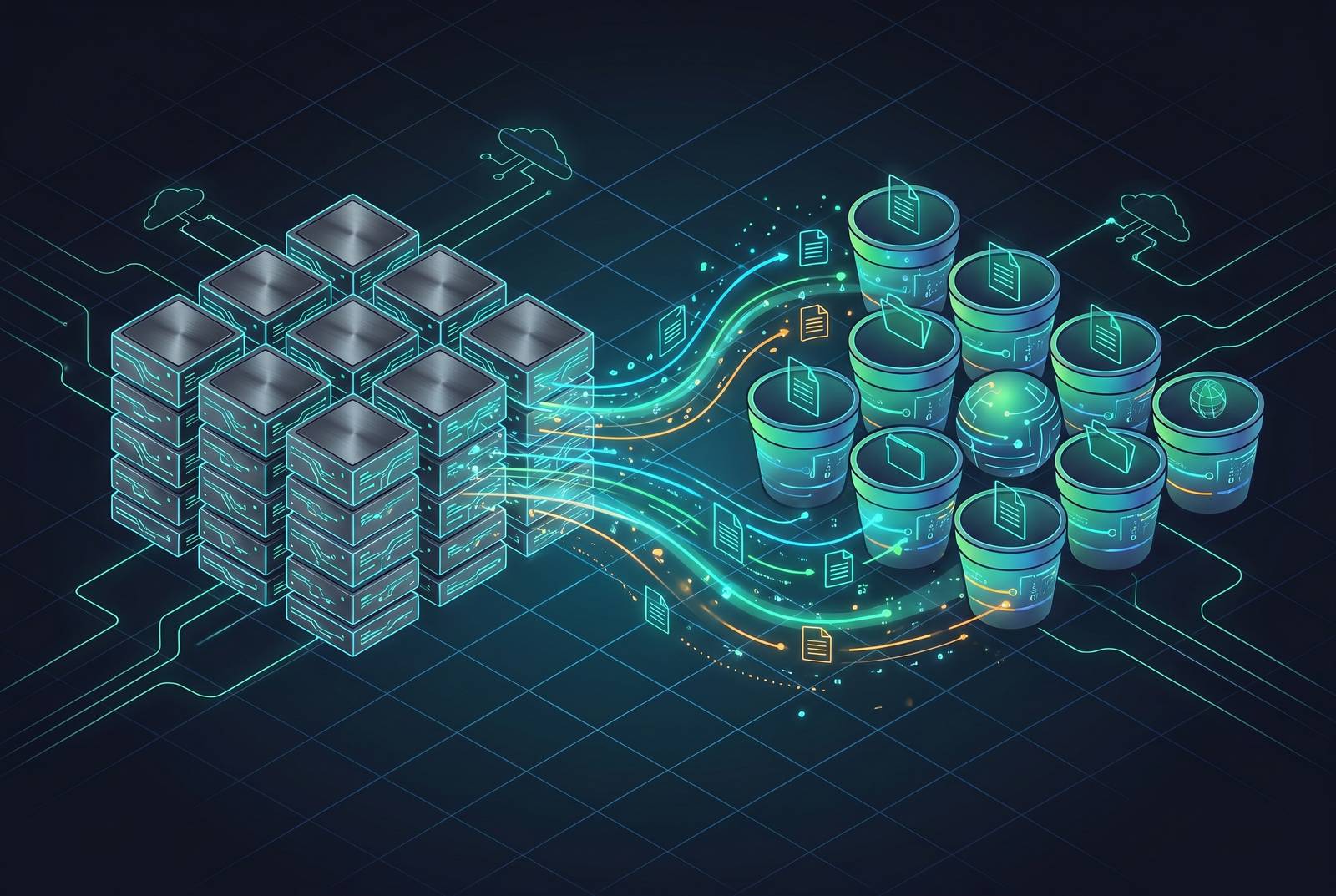
Block storage runs a database like a race car runs on a track: one lane, low latency, no surprises. Object storage runs like a warehouse with a really good inventory system. Migrating from one to the other isn't a lift-and-shove job. It's a redesign of how applications find, read, and write data in the first place, and the order you make those decisions in determines whether the migration is boring (good) or a multi-week incident report (bad).
Block storage was built for single-server jobs that need low latency and tight consistency: transactional databases, active VMs, inference serving where model weights need to load fast and locally. The problem is architectural, not a matter of taste. Block ties compute and storage together at the hip, so scaling one means requalifying the other. Try running a distributed, concurrent AI pipeline on that setup and it buckles, not all at once, but slowly. Performance bottlenecks creep in. Costs creep up. Someone builds a workaround, then another workaround gets bolted onto that one, and eventually a team looks up and realizes the duct tape has its own duct tape.
That moment is already here for a lot of enterprises. MinIO's 2025 survey of over 600 enterprise IT leaders found object storage is already the dominant storage technology in enterprise environments, not an emerging one. This isn't a pitch for replacing block storage across the board. It's a note on when block stops being the right tool for a given job, and how to tell.
Workload assessment: which of your workloads are block-native and which are block by default
The single most common mistake in this whole process: treating every workload like it's the same species and either migrating everything or migrating nothing. Neither works.
Some workloads are genuinely block-native and should stay put:
- Transactional databases doing frequent, random reads and writes at low latency
- Real-time AI inference serving, where model weights need to load from fast local storage in sub-millisecond time
- Running VMs with active I/O dependencies
- Anything requiring fine-grained consistency, atomic rename, file locking, fsync, the stuff object storage doesn't guarantee natively
Other workloads are only on block storage because that's where they landed first, not because they need to be there:
- Large unstructured datasets: images, video, audio, logs, model checkpoints, Parquet files, anything without a uniform schema
- AI training pipelines that are read-heavy, batch-oriented, and hit by many GPU nodes at once
- Write-once, read-many data: crawled web data, raw ingest, archived experiment output
- Spark-style data prep jobs that read large objects sequentially, chew on them in memory, and write back, with no random access happening inside the object
- Model checkpoints. Checkpoints are large, sequential block writes that get zero benefit from directory structure or fine-grained consistency
The output of this phase is a two-column map: migrate, or leave in place. Everything downstream depends on getting this map right first. A rough rule of thumb: if the I/O pattern looks like millions of small random reads, block keeps it. If it looks like large sequential reads hit by a pile of concurrent workers, object storage wants it.
How access patterns change when you move from block to object (and what that means for application code)
Block storage is addressed by logical block number inside a volume. Object storage is addressed by key inside a flat namespace. That difference sounds abstract right up until an application built around directory trees and file paths hits it and breaks, often quietly, which is worse than breaking loudly.
A few things need to change on purpose:
- Directory-path logic gets replaced with key-prefix conventions, something like
training/2025/run-42/shard-001.parquet - File-open, seek, and read patterns get replaced with GET-object or multipart-download calls
- Any code leaning on POSIX behavior, directory listing, atomic rename, hard links, needs a rewrite, because object storage doesn't promise any of that natively
There's one exception worth naming plainly: a POSIX-compliant filesystem layer that mounts object storage and presents it like a local disk lets existing code run unmodified. That's a legitimate path. But it has to be a decision made on purpose, not a default fallen into because nobody wanted to touch the redesign.
The good news is that major AI/ML frameworks have mostly already solved half this problem. TensorFlow, PyTorch, Spark, MLflow, and Kubeflow all ship with native S3 API support. The object storage API stopped being a single vendor's thing a while back; it's the closest thing storage has to a common language across vendors.
Even with that support built in, a few things still need explicit redesign:
- Metadata handling, since object metadata now has to carry information that a directory structure used to imply for free
- Versioning strategy, since object versioning takes over the job that filesystem snapshots used to do
- Consistency expectations, since object storage under concurrent writes tends to behave last-write-wins, and the application has to own its own consistency guarantees instead of leaning on the storage layer
This phase produces two deliverables: a revised data model (key schema, bucket layout) and a punch list of application components that need code changes before cutover day.
Organizing the target object storage architecture before any data moves
Bucket and prefix design is the object-storage version of picking volume and directory layout, and getting it wrong here is the kind of mistake that's cheap to make and expensive to undo later.
A three-zone data lake structure is the reference model worth building toward:
- Raw zone: everything lands here unmodified, logs, camera frames, database exports, streaming events. Schema-agnostic, format-agnostic, no judgment
- Processed zone: cleaned and normalized data, serialized into Parquet or ORC. Spark reads straight from here over the S3 API, no separate data-movement step needed
- Curated zone: training-ready data, feature vectors, labeled sets, augmented datasets, read by MLflow, Kubeflow, and the GPU training cluster
All three zones can live in a single bucket, separated by key prefix and metadata tags. No need to stand up three separate storage systems for this.
Build temperature tiering into the design from day one, not as an afterthought:
- Hot: actively ingested raw data and current-run checkpoints, on the highest-performance tier
- Warm: processed datasets and recent model artifacts, standard tier
- Cold: stale logs and inactive experiment archives, archival tier
Lifecycle policies handle the transitions automatically. The file path doesn't change when the data moves tiers, which matters more than it sounds like it should.
Object versioning preserves every historical version of a dataset or artifact, which solves reproducibility and compliance with the same mechanism. And once compute and storage are properly decoupled, a data team can dump another 50TB into ingest without anyone touching the GPU fleet, and the GPU team can scale up training without waiting on a storage conversation. That kind of independence is structurally out of reach on a SAN or NAS setup. Whatever gets built here is the contract that tooling and cutover planning have to honor later.
Tooling choices: what actually moves the data and what governs the transition
Two separate jobs get lumped together under "tooling" and shouldn't be: the thing that actually copies bytes, and the thing that governs sequencing, validation, and rollback.
For moving data:
- Cloud-native sync tools (AWS DataSync,
gcloud storage, rclone) handle the initial bulk transfer well. Judge them on throughput, checksum verification, and how they behave on retry - Framework-native transfer skips a separate tool entirely: a Spark job already reading from block can just write to object as part of its normal run
- Parallel multipart upload is where object storage actually shows its strength. A well-tuned cluster moving a 500GB dataset can sustain tens of gigabytes per second, but only if the tooling is configured to use that parallelism instead of quietly serializing the transfer
For governing the transition:
- Cutover has to look atomic from the application's point of view, which means the tooling needs to support a dual-write or shadow-read phase where block and object are both live at once
- Lifecycle policies should be configured on the target system before data shows up, not bolted on after. Retroactive policy application is a good way to create a mess
- Access control, IAM policies, bucket policies, pre-signed URL patterns, all of that needs to be locked in at the architecture stage, not improvised during migration
One practical filter worth applying heavily: the S3 API is genuinely vendor-neutral, and tooling built against S3-compatible endpoints works across AWS, GCS, Cloudflare R2, and on-prem object stores without a rewrite. Azure Blob Storage is the exception; it doesn't speak S3 natively and needs a third-party gateway (Flexify.IO, for instance) to bridge the gap. Worth knowing before committing to a target.
A few anti-patterns show up often enough to name directly. Single-threaded sequential copy on a large dataset throws away the exact throughput advantage object storage offers. Copying metadata as a separate step from the objects themselves creates a gap that breaks downstream pipeline assumptions. And skipping checksum validation is the single highest-risk move on this list, because silent corruption during transfer doesn't announce itself, it just waits.
Cutover planning: sequencing the switch so production does not stall
Storage changes and application changes should never happen at the same time. Keep them as separate, reversible steps, full stop.
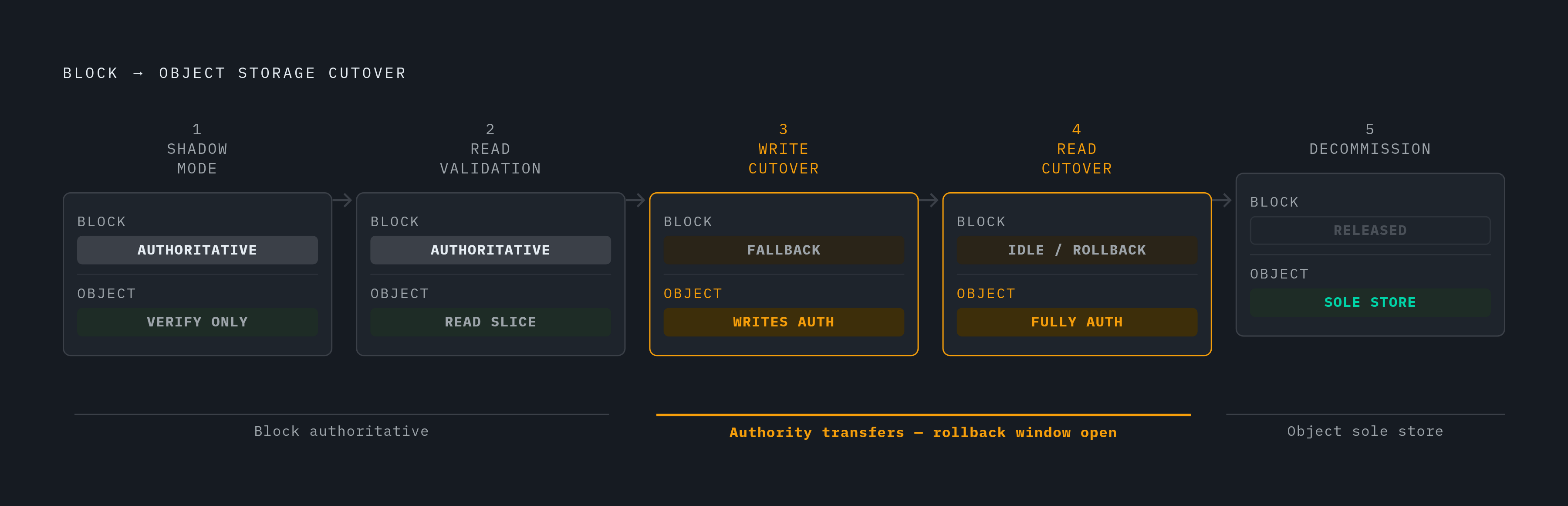
A phased sequence that holds up in practice:
- Shadow mode: new writes go to both block and object at once. Object storage gets verified but doesn't serve production reads yet. Block stays authoritative
- Read validation: a slice of read traffic gets routed to object storage and compared against block-sourced reads, catching access-pattern bugs before they matter
- Write cutover: object storage becomes authoritative for writes, block becomes the fallback, and dual-write continues briefly in case a rollback is needed
- Read cutover: all reads move to object storage, block reads get decommissioned, and block volumes stay available but idle for a defined rollback window
- Decommission: once that window passes without incident, block volumes get released
Order matters within the migration itself, too. Cold and archival data goes first, since it's lowest risk and delivers cost savings immediately. Warm processed data comes next. Hot training data comes last, and active GPU clusters reading live data should never be the starting point.
Checkpoint and model-weight migration deserves its own care. Checkpoint writes suit object storage well, but the migration itself needs to land at a training run boundary, never mid-run.
Rollback criteria, latency thresholds, error rates, checksum failures, need to be defined before cutover starts, not improvised in the middle of an incident. And everyone needs to be on the same page about timing. A storage change the GPU team doesn't know is happening will look, from their side, exactly like a training failure.
Validation: confirming the migration worked before decommissioning anything
Validation isn't a single check run after the fact. It runs continuously, starting in shadow mode and continuing straight through decommission.
On data integrity: checksum every object at write time and verify again at read time, MD5 or SHA-256 per object, depending on provider support. Object count and total byte count in the target need to match the source inventory exactly. And a statistically meaningful sample of objects should get read back and compared on actual content, not just metadata.
On access patterns: run the real application workload against object storage before block gets decommissioned, not a synthetic benchmark standing in for it. Measure throughput under concurrent load specifically, since object storage's whole value proposition is parallelism, and a serial access pattern will make it look slower than block. That's a configuration problem wearing a storage problem's clothes. Confirm lifecycle tiering is triggering on schedule too, and that the file path holds steady across tier transitions.
On reproducibility: re-run a training job against the migrated data and compare the output to the pre-migration baseline. Divergence means the migration introduced a defect somewhere in data transformation or metadata handling. Confirm object versioning is capturing writes as expected, since that's the mechanism now standing in for snapshot-based reproducibility.
On cost: check that the post-migration billing reflects the tiering design that was built. Cold data billing at hot-tier rates means the lifecycle policies didn't apply the way they were supposed to.
Block volumes shouldn't get released until all of the above has passed across the full rollback window, typically a complete training cycle for AI workloads.
The architecture that remains: block and object as complements, not a clean swap
The workload map built at the start already flagged what stays on block. What's left to say is what that looks like structurally once the dust settles.
The standard production pattern by the end of this: a durable copy sits on object storage, and hot data gets cached on fast local media, NVMe, RAM, close to compute. That's the dominant shape for AI serving and training at scale, and it's not a compromise; it is the design.
Block storage keeps real-time inference serving, where model weights need sub-millisecond loads from fast local storage. It keeps transactional databases with clean relational schemas, since object storage was never trying to be a database replacement. And it keeps anything that needs POSIX atomicity guarantees an object-layer abstraction can't fully deliver.
Object storage, on the other side, ends up owning the raw, processed, and curated data lake zones, training data at scale, checkpoints, archives, and anything read concurrently by a pile of GPU workers at once. Neither system wins outright. They just end up doing the jobs they were actually built for.