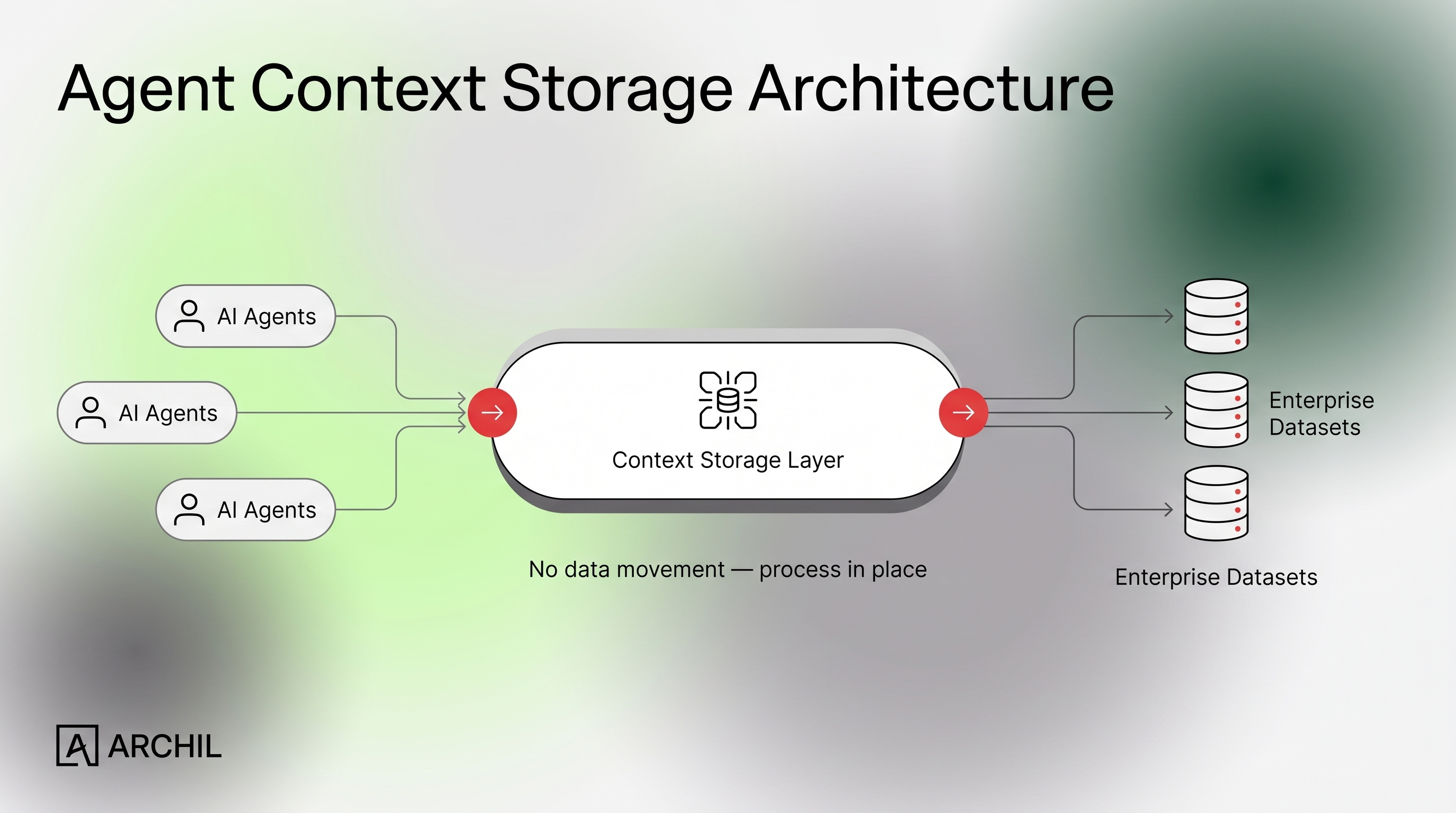
Agent Context Storage Architecture
Why Agent Context Storage Is Now an Infrastructure Decision, Not an Afterthought Agent context storage used to be a footnote in …
Why Agent Context Storage Is Now an Infrastructure Decision, Not an Afterthought
Agent context storage used to be a footnote in AI system design; it isn't anymore. The architectural choices you make at the storage layer. what interface agents use, how state persists across sessions, how concurrent writes are handled. determine whether your agents actually work in production or just work in demos.
That distinction matters more than most teams realize until it's too late.
Traditional AI workloads follow a predictable rhythm: assemble a dataset, train, retrieve output. The I/O pattern is mostly read-heavy and sequential. You can design around it.
Agentic workloads break that rhythm entirely. Agents query, write, modify, and retrieve context across multi-turn sessions. They do it concurrently. They do it autonomously. And they do it in patterns you cannot predict ahead of time.
The models aren't the bottleneck anymore; the models are good enough. The bottleneck is the infrastructure underneath them. McKinsey's 2025 annual AI report found that nearly two-thirds of enterprises were already experimenting with agents, and 88% were using AI in at least one business function. But only one in ten companies successfully scaled beyond the pilot stage. The 88% number isn't surprising; the one-in-ten number is.
Gartner predicts more than 40% of agentic AI projects will fail by 2027. Not because of model quality; because of plumbing.
Global AI infrastructure spending exceeded $250 billion in 2025. Storage and networking are growing nearly as fast as compute. And yet more than 50% of organizations report data and storage bottlenecks actively limiting their AI performance. Fifty-seven percent say their data isn't AI-ready, even as experimentation accelerates.
The gap isn't ambition; it's architecture. Think of it this way: you wouldn't build a highway system and then decide later what kind of roads to use. The foundation determines everything that runs on top of it.
The Memory Hierarchy Agents Actually Need
Agents don't need a single datastore. They need a structured memory taxonomy. The leading agent frameworks model this after OS memory management, and once you see it that way, it clicks.
Three tiers:
- Core memory. Always in the LLM's context window. This is RAM. It holds what this turn needs right now.
- Recall memory. Searchable conversation history. Think of it as a disk cache. It survives the session and is available when needed.
- Archival memory. Long-term storage the agent queries on demand. Cold storage.
Agents actively decide what stays in context versus what gets archived. This isn't a static assignment you make once at design time. The agent is making those decisions continuously, and the storage layer has to support that.
Different tiers demand different storage primitives: vector databases for embeddings and semantic recall, knowledge graphs for relationships, structured logs and relational stores for transactional state.
But here's the thing that drives every downstream decision: the context window is RAM, not storage. Once that actually lands, a lot of other things get clearer fast.
A 2,000-token context at session start can balloon to 25,000 tokens within a few exchanges, once conversation history, retrieved documents, and tool outputs accumulate. At 25,000 tokens, attention spreads far beyond what the model was calibrated for. Output quality degrades in ways that are genuinely hard to trace. You start wondering if the model is getting worse; it isn't. You just stuffed too much into RAM.
There's research that makes this concrete. Agents followed stated user preferences 73% of the time at turn five; by turn 16, that dropped to 33%. The researchers called it "preference dilution." The model isn't drifting. It's losing track of what the user asked for because too much noise is competing for attention. A bloated context window is like a desk buried in papers — the answer is in there somewhere, but good luck finding it when it matters.
The fix is not a larger context window; a larger window just delays the problem. The fix is externalizing everything beyond the current turn to a persistent layer with structured retrieval, so context gets discovered iteratively as the model works, not front-loaded into the prompt.
Retrieval: How Agents Pull Context Back In When They Need It
A lot of teams underinvest here. They stand up a vector database, wire up embedding similarity search, and call it done. That works fine in a notebook; it falls apart in production.
Production retrieval systems run multiple strategies in parallel: semantic search, keyword matching, graph traversal, temporal filtering. Results from all of those get combined and reranked for relevance. It's not elegant; it's what works.
On-demand retrieval via RAG keeps outputs current without inflating the context window. The agent queries an internal file store, the web, or tools exposed via something like the Model Context Protocol (MCP). It pulls in exactly what it needs, when it needs it, instead of carrying everything forward.
Effective compression strategies can reduce token usage by 80% while preserving the information that actually matters. And latency requirements are strict: sub-50ms query latency demands sophisticated caching and indexing. That's a storage performance requirement, not a model requirement.
There's also a hidden cost to bespoke MCP tools that most teams don't account for. Every additional tool added to an agent burns context and accelerates context rot. The more retrieval surfaces you expose, the more overhead the model carries just tracking what's available. Collapsing toward a single interface the model already knows well reduces that overhead significantly.
That's why the file system interface has a structural advantage. Frontier models are trained heavily on bash and file manipulation. When an agent needs to navigate and retrieve data, it reaches for file system semantics by default. That's not a design decision you made; that's training data expressing itself.
The Polyglot Persistence Trap and Other Architecture Mistakes
Teams fall into this one constantly, and it's painful every time.
One vector database for embeddings. One NoSQL database for JSON documents. One graph database for relationships. One relational database for transactions. Each choice is defensible on its own. Together, they're a disaster. Context ends up fragmented across four systems that don't talk to each other cleanly, and the agent has to stitch everything back together at query time. You waste compute, burn tokens, and produce worse results.
The second failure is subtler. Teams stand up a vector database, start embedding everything, then discover months later that they're injecting irrelevant memories into every agent turn. The agent is confidently wrong, citing something from three months ago that doesn't apply anymore. The root cause is almost always the same: they never defined what the agent should remember before building the store. Scope first. Storage second. That order matters.
Unstructured data is particularly poorly served by database-first thinking. Historically, you had to force unstructured data into a structured schema before it became useful. Healthcare records, legal filings, financial documents, government data. That meant ETL pipelines, schema design, data engineering time. AI agents can reason over unstructured data directly, without that ETL step. Forcing that data through a relational or document store before the agent can touch it re-introduces the exact bottleneck you were trying to eliminate.
Databases and file systems are complements, not competitors. Databases are better for anything with a clean, stable schema and transactional requirements. The file system interface excels for unstructured, heterogeneous, large-scale data the agent needs to navigate directly. Use each where it fits.
What the Storage Interface Choice Actually Costs
The interface an agent uses to access storage isn't an implementation detail. It shapes what the agent can do, how fast, and how reliably.
The main options:
- Object storage (S3 API). The dominant data layer for unstructured AI data. More than 70% of enterprise cloud-native data lives here. Scales compute and storage independently. The right default for most workloads.
- Parallel file systems (Lustre, GPFS). Extreme throughput for synchronous, I/O-intensive training. Not designed for multi-session agent state management.
- Distributed file systems (JuiceFS, 3FS, Ceph). Cloud-native flexibility with object storage backends and hybrid access modes.
- NVMe block storage. Lowest latency when directly attached. Coordination complexity across nodes makes it a poor fit when agents need shared, concurrent access.
- POSIX file systems mounted over object storage. Combines the navigability of a file system with the scale and durability of object storage. This is where agent workloads live.
The concrete cost of a mismatched storage layer: when storage can't saturate a Blackwell-class GPU cluster, you're wasting roughly $30,000 per node annually in idle compute costs. Meta implemented GPUDirect Storage, went from 50 GB/s to 192 GB/s, and got a 3.8x improvement in training speed. OpenAI's GPT infrastructure runs 50 PB of WekaFS with an S3 interface, sustaining 175 GB/s to 10,000 GPUs and reducing data loading from 30% of training time to 5%.
Those are training numbers, but the lesson transfers directly. For agent workloads, the specific requirement is an interface that supports concurrent reads and writes across parallel agent runs, not just sequential training I/O.
POSIX semantics are a requirement, not a nice-to-have, for agents running code against a file system. Atomic rename, flock/fcntl, mmap, fsync, hard links, symlinks, sparse files. Without these, existing code and tooling cannot run unmodified. Agents either need custom wrappers or they break on edge cases.
One more thing worth saying plainly: storage must be cloud-agnostic. S3, GCS, R2, and Azure Blob should mount the same way, with no migration, no ETL pipeline, no copies. Lock-in at the storage layer propagates up the entire stack. You end up paying for it everywhere, long after the original decision is forgotten.
State Persistence Across Sessions and Concurrent Writes
This is the part that catches teams off guard more than any other.
Agent context must survive session boundaries. The same workspace an agent worked in during one conversation must be available, unmodified, in the next. Per-session scratch storage fails this requirement by design. Not as a configuration issue; as a fundamental mismatch between what that pattern offers and what agents actually need.
The correct model is persistent, shared storage that multiple agent instances can mount simultaneously.
Concurrency is not an edge case. Parallel agent runs writing to shared state is the production norm. Without proper concurrency controls, agents overwrite each other's intermediate results. You end up with corrupted state that's nearly impossible to debug because the writes happened asynchronously from multiple processes.
File locking primitives (flock, fcntl) are the standard mechanism for this, and only storage with full POSIX semantics provides them. Atomic rename enables safe, in-place updates without exposing partial writes to other agents. These aren't exotic requirements; they're table stakes.
Write durability follows a specific pattern that balances latency with reliability: writes get acknowledged before returning to the agent, then flushed asynchronously to the backing store. This keeps the agent from blocking on disk I/O while still ensuring durability.
The backing object store should remain the source of truth. A storage layer that keeps its own persistent copy outside the customer's account creates a data residency problem and a revocation problem. If you ever need to cut off access, your data should still be exactly where it was, in your own bucket, owned by you. The correct architecture has a cache layer accelerating reads and absorbing writes, with the object bucket always as the authoritative record.
Capacity elasticity matters too. You cannot predict ahead of time whether an agent session needs 1 MB or 1 GB of working storage. Fixed-capacity block storage over-provisions by default and wastes money on headroom you never use. Elastic storage billed on active cache usage fits the actual access pattern.
Serverless Execution Against the File System: Closing the Agent Loop
Agents don't just read and write files; they execute code against them.
If your execution environment is separated from your storage layer, you've reintroduced the data-movement problem at the agent layer. A sandbox that requires copying files in before running commands adds latency, complexity, and a new failure surface. Every time the agent wants to act on something it already has, it has to move data again.
The right model is compute attached to the file system as a service that accepts bash commands and returns results. The agent's workspace. the files it has read, modified, and created. persists between executions without re-staging. Running agent-written code doesn't require a separate sandbox if the execution environment already has direct file system access.
The data engineering world learned this the hard way. Teams that built custom data-movement pipelines to feed inference or training spent enormous amounts of engineering time on infrastructure that added no value. The teams that moved faster were the ones that stopped building data-movement infrastructure altogether. Waiting on downloads before an agent can act is a structural bottleneck, not a tuning problem; no amount of optimization makes data movement free.
The file system interface fits naturally here because, again, frontier models are trained heavily on bash and command-line tools. Agents already know how to navigate, manipulate, and execute against a file system. You're not teaching them a new interface; you're giving them the one they already know.
NVMe cache in front of the object store handles the latency requirement. Sub-millisecond read latency on cache hits means agents that re-read a file they touched earlier in the session don't pay a full object-store round-trip cost. For agents that loop and iterate. which is most of them. this adds up fast.
What a Production-Ready Agent Storage Layer Looks Like
The AI storage market is valued at roughly $36 billion today and projected to reach around $255 billion by 2034. The decisions being made now will compound for a decade. Getting the architecture right early matters more than it appears.
A production-ready agent storage layer needs to do all of the following:
- POSIX-complete interface. Atomic rename, flock/fcntl, mmap, fsync, hard links, symlinks, sparse files. Existing code runs unmodified.
- Object storage as the source of truth. S3, GCS, R2, Azure Blob. No migration, no ETL, no copies, no vendor lock-in on the data itself.
- Sub-millisecond read latency on cache hits via NVMe. Write acknowledgment before flush, with async replication to the bucket.
- Concurrent multi-agent access with proper locking semantics. Parallel runs don't corrupt shared state.
- Persistent, cross-session workspaces. The same disk mounts on many servers simultaneously. Agent context survives session boundaries.
- Elastic capacity billed on active cache, not provisioned maximum. Agent working set size is not predictable in advance.
- Data residency with the customer. Cache nodes accelerate access. The object bucket is always the authoritative record. Revoking access leaves data exactly where it was.
That's the minimum bar for an agent that needs to do useful work reliably, across sessions, at scale. Nobody's giving a conference talk about their POSIX semantics; the storage layer isn't the glamorous part. But it's the part that determines whether everything else holds together when real workloads show up. Right now, most teams are finding that out after the fact.
Sources
- Context Architecture for AI Agents: A Complete 2026 Guide
- Context Engineering in 2025: The Complete Guide to AI ...
- Agentic AI infrastructure: storage requirements
- How to Build AI Agent Memory in 2026 - Fountain City
- Context Engineering 2.0: The Context of Context Engineering
- AI Agents: Evolution, Architecture, and Real-World Applications
- The Storage that feeds AI training and modeling for High-Impact AI