What is Lustre? And When Should You Use Something Simpler?
Lustre excels in supercomputing but demands rigid infrastructure that clashes with cloud elasticity.

Lustre is a powerful distributed file system that has long served as the backbone of high-performance cluster computing. Built for massive scale, high throughput, and fault tolerance, it excels in scenarios where compute nodes require fast, parallel access to shared datasets.
Yet as the industry moves toward dynamic, cloud-native architectures, where elasticity, simplicity, and object storage are the norm, a pressing question emerges:
Is Lustre still the right choice for modern, cloud-native workloads?
This article examines what Lustre is, the architectural scenarios where it thrives, and when a simpler, cloud-native alternative might deliver a more efficient and maintainable infrastructure solution.
What Is Lustre?
Brief History
Lustre was originally developed in 1999 as part of the U.S. Department of Energy's Advanced Simulation and Computing Program (ASC) PathForward program, created to meet the I/O demands of early supercomputing applications. Today it is available as open-source software under the GNU General Public License (GPL).
The name "Lustre" is a lexical blend of "Linux" and "cluster," reflecting its foundational purpose: enabling scalable, parallel file access across Linux-based HPC systems.
Architecture
Lustre relies on a modular architecture that separates metadata and data operations across distinct components to optimize scalability and performance. Its core components include:
Metadata Server (MDS): Coordinates metadata operations such as file creation, deletion, permissions, and directory traversal. The MDS does not store metadata itself; rather, it manages and serves metadata from one or more Metadata Targets (MDTs).
Metadata Target (MDT): The storage volume that physically holds file system metadata. When responding to client requests, the MDS stores and retrieves metadata directly from the MDT.
Object Storage Server (OSS): Manages I/O data operations. Each OSS serves one or more Object Storage Targets (OSTs) and is responsible for reading and writing actual file data, which is spread across OSTs to enable parallel access and high performance.
Object Storage Target (OST): The physical or logical storage volume holding file data. Files can be split across multiple OSTs, allowing parallel read/write access from multiple clients simultaneously.
Separating metadata from file data enables parallelism at scale. Thousands of compute nodes can simultaneously read and write files across distributed storage resources, producing high throughput and availability, both of which are critical for performance-intensive, parallel workloads.
Why This Matters
Lustre's architecture is purpose-built for environments where many clients need concurrent, low-latency access to shared datasets. Lustre Clients run on compute nodes that mount the Lustre file system and carry out I/O operations, coordinating with the MDS/MDT for metadata access and with the OSS/OST for data operations.
Lustre presents all clients with a unified namespace and adheres to standard POSIX semantics, letting applications interact with it as though it were a local file system. This familiar interface enables clients to concurrently read and write to shared files while Lustre maintains coherent, consistent access across the distributed environment.
The result is a system that scales seamlessly, supporting tens of thousands of client nodes, hundreds of petabytes of storage, and aggregate I/O throughput reaching tens of terabytes per second.
These capabilities have made Lustre critical in HPC environments, powering data-intensive workloads such as scientific simulations, genomic analysis, climate and weather modeling, and secure government or defense research operations.
Lustre in the Cloud: Trade-Offs and Limitations
Lustre delivers exceptional performance in traditional HPC environments, but that power comes with significant operational complexity.
Deploying and managing Lustre requires (1) provisioning dedicated infrastructure, (2) configuring metadata and object storage servers, and (3) tuning the system to sustain performance at scale.
That level of control may be justifiable in static, tightly coupled supercomputing clusters, yet it clashes with the dynamic, flexible, and ephemeral nature of cloud-native workloads.
Cloud providers such as AWS (FSx for Lustre) and Azure (AMLFS) offer managed Lustre services to reduce the operational burden, but they do not resolve the underlying rigidity of Lustre's architecture.
Where Lustre Falls Short
In cloud-native systems, infrastructure is expected to adapt to the application, scaling in response to your workload demands.
With Lustre, the opposite tends to be true: you must design your infrastructure around static servers, persistent mounts, and managed data locality. This typically involves glue code, custom synchronization layers, or workarounds that erode the operational simplicity cloud-native systems aim to provide.
Some of the core limitations in the cloud include:
Rigid Infrastructure Assumptions: Lustre assumes long-lived, stateful infrastructure. It struggles to support ephemeral compute environments such as spot instances, auto-scaling groups, and serverless architectures.
Limited Object Storage Integration: FSx for Lustre connects to S3 via Data Repository Associations, but the sync is batch-based and still demands manual lifecycle management. In self-managed Lustre, external copytools and complex policies are required to sync data, adding latency, risk, and inconsistencies between data views.
Static Performance Scaling: Managed services like AWS FSx for Lustre and Azure Managed Lustre (AMLFS) require you to select fixed capacity and performance tiers upfront. This breaks the scale-on-demand model of cloud-native systems, frequently resulting in overprovisioning or performance bottlenecks as workloads fluctuate.
No Elastic Shared Caching: Lustre lacks an intelligent, multi-client caching layer that responds to access patterns or grows with workload size. Consequently, it is poorly suited for multi-region workloads, frequent reuse of reference datasets, or sudden spikes in I/O demands.
This is a particular disadvantage compared to modern cloud-native caching systems that automatically scale and share data across instances.
HSM Adds Complexity for Tiering: Lustre's Hierarchical Storage Management (HSM) is designed to offload cold data from high-performance storage to cheaper archival systems like S3 or HPSS, helping optimize limited local storage. Even so, it requires extra components such as copytools, agents, and policy engines, and it tracks opaque file states. This manual, stateful tiering model does not align well with cloud-native expectations of seamless, built-in object storage lifecycle management, adding operational burden and risk.
For teams running modern AI/ML pipelines, analytics workloads, or S3-native data processing, Lustre, even when managed, can be difficult to operate within modern cloud infrastructure. Its rigid architecture, reliance on persistent mounts, and lack of native object storage integration often force workarounds that compound complexity and reduce agility.
Cloud-native file systems, by contrast, are designed to align with modern infrastructure patterns: dynamic compute, ephemeral workloads, and object-first data architectures.
Rather than bending your architecture to fit the constraints of legacy HPC storage, cloud-native solutions integrate more naturally with the elasticity and abstraction of the cloud.
Introducing Archil: A Cloud-Native Alternative
A modern approach to bridging performance and simplicity in the cloud is to take object storage, such as AWS S3, and layer on the performance, consistency, and usability expected from traditional file systems.
Archil follows this model. It is a fully managed, serverless cloud storage service that transforms S3 buckets into high-performance, POSIX-compliant local storage. By inserting a durable, centralized caching layer between compute instances and object storage, Archil delivers sub-millisecond latency for cached operations, accessed via an encrypted NFSv3 mount.
Because it requires no infrastructure deployment or capacity provisioning, Archil scales automatically based on your application's needs. It supports full POSIX file operations, including renames, appends, file locks, and symlinks, while maintaining strong consistency for all connected clients.
Behind the scenes, Archil handles asynchronous synchronization with your S3 bucket, ensuring 99.999% durability for newly written data before it is persisted to S3. The service also features a centralized, shared cache that accelerates access for multiple instances, automatically managing data synchronization in the background and eliminating the need for manual staging or write coordination.
Archil is compatible with major object storage providers including Amazon S3, GCS, CloudFlare R2, and more. It also works seamlessly across operating systems running on Amazon EC2, including Linux, Windows, and macOS instances.
Operating on a pay-per-use billing model, it combines the durability and scalability of object storage with the performance, consistency, and simplicity of local disk, without the operational overhead of legacy HPC file systems.
Lustre or Archil? It Depends on Your Use Case
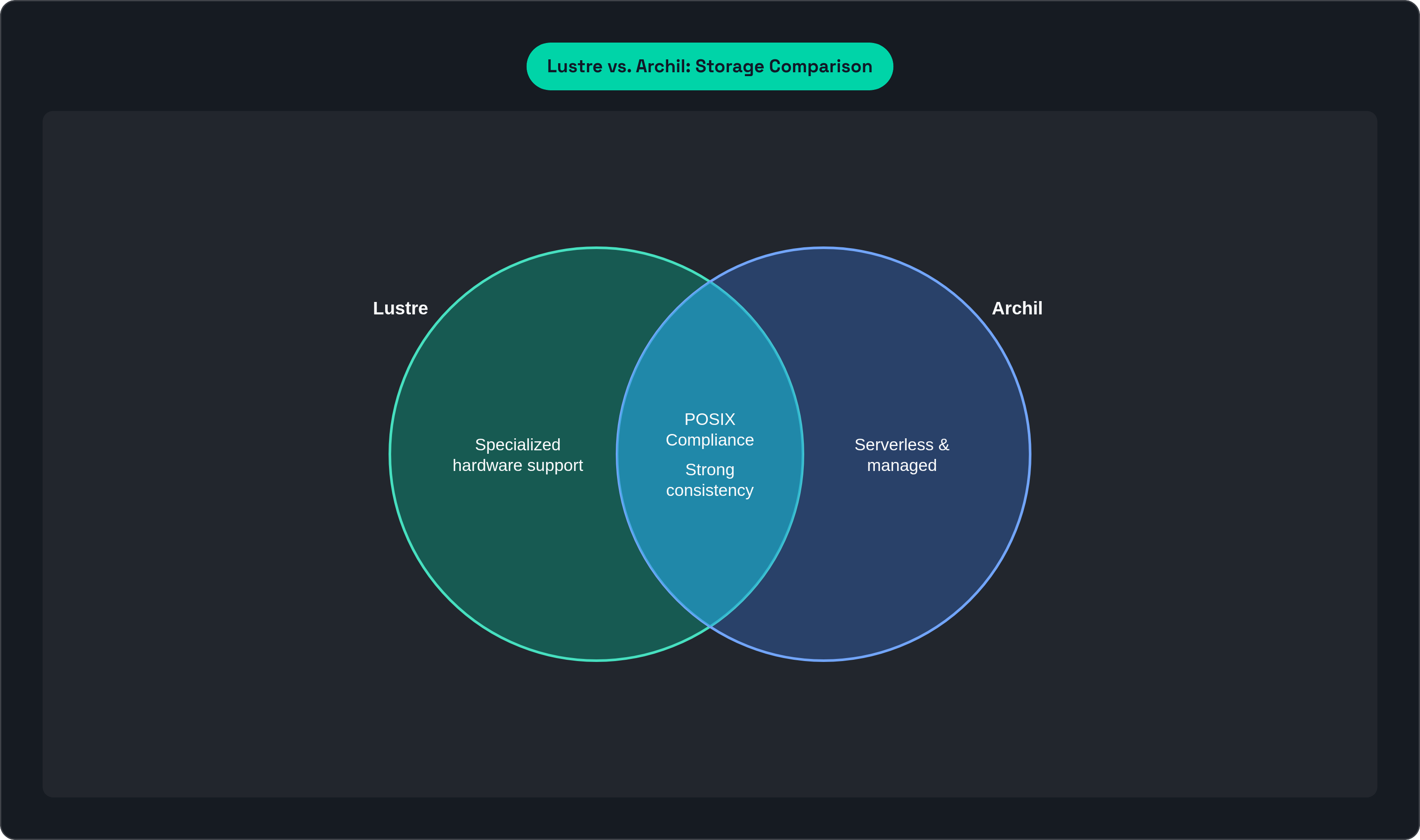
Lustre remains a strong fit for traditional HPC environments where extreme scale and tight coordination between nodes are essential. It excels in scenarios such as massive supercomputing clusters, tightly coupled workloads requiring low-latency communication, and environments that leverage specialized hardware or high-performance networking fabrics.
Organizations operating in on-premises or hybrid cloud setups with the expertise and resources to manage complex, performance-tuned infrastructure will find it well-suited to their needs.
Archil, by contrast, is a better choice for teams working in cloud-native environments who need simplicity, elasticity, and fast access to large datasets without managing file system infrastructure.
Lustre vs. Archil: A Side-by-Side Comparison
To help illustrate the differences between Lustre and Archil, the table below compares them across key attributes. This side-by-side view highlights where each solution excels and which is better suited for different workloads.
Feature Cloud-Native Alternative Lustre Deployment Model Fully managed, serverless (no provisioning required) Self-managed or provisioned via FSx for Lustre / Azure Managed Lustre Cloud Compatibility Native support for AWS, GCS, Cloudflare R2, MinIO, Backblaze B2 Limited; requires custom deployment or managed cloud service Caching Centralized, shared, auto-scaling cache Node-local caching or manual HSM-based staging Performance Sub-millisecond latency for cached data High throughput with infrastructure tuning POSIX Support Full POSIX compliance Full POSIX compliance File Locking & Consistency Strong POSIX semantics with built-in consistency Strong POSIX semantics with proper configuration Cost Structure Pay-per-use; scales with working set Requires capacity provisioning; fixed throughput tiers Supported Use Cases ML/AI training, analytics pipelines, collaborative cloud workloads HPC, tightly coupled simulations, genomics, scientific research
Choosing the Right File System for Your Workload
Lustre remains a powerful and battle-tested file system for high-performance computing environments. For many modern, cloud-native workloads, however, it introduces operational complexity that outweighs its benefits. Managed services like FSx for Lustre and Azure Managed Lustre help streamline deployment, yet they do not eliminate the architectural rigidity or infrastructure overhead Lustre imposes.
For teams building AI/ML pipelines, running analytics on S3-backed datasets, or operating in dynamic cloud environments, Archil offers a compelling alternative.
Ultimately, the right choice hinges on your workload demands, your level of cloud adoption, and how much DevOps overhead your team is prepared to absorb. Lustre shines in traditional HPC; Archil excels in the cloud.